General information, not personalised tax, legal or investment advice.

Introduction
Most people treat tax filing and investing as completely separate activities — one handled by an accountant in April, the other managed by a financial advisor year-round. This separation is exactly why many households pay far more in taxes than necessary over a lifetime.
Consider this: the top 1% of earners face a lifetime net tax rate of 34.7%. While you may not be in that bracket, taxes remain one of the largest wealth erosion forces every investor faces — and fragmented advice makes the problem worse.
The cost of disconnected planning adds up fast. Common consequences include:
- Tax drag that quietly erodes portfolio returns year after year
- Roth conversions that happen too late — or not at all
- Estate documents that conflict with account beneficiary designations
- Retirement withdrawals drawn down in an order that maximizes the tax bill
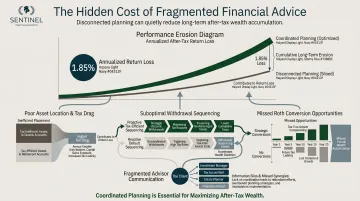
According to Vanguard research, these siloed decisions cost investors up to 1.85% in annualized net returns.
This guide walks through what coordinated tax planning actually means, how much fragmented decision-making costs, the three pillars of an integrated wealth plan, and which strategies deliver the greatest benefit when tax and investment decisions are made together.
Key takeaways
- Coordinated tax planning aligns investment, retirement, and estate decisions so each move reinforces the others
- Technically correct decisions still leave five- and six-figure savings unrealized when advisors work in silos
- High-leverage moves like Roth conversions, asset location, and withdrawal sequencing only work when your advisor, accountant, and attorney share information
- Early coordination preserves the most options; waiting until retirement significantly narrows the window for tax-efficient moves
What Is Coordinated Tax Planning?
Coordinated tax planning is a systematic, year-round process in which tax decisions are made within the context of your full financial picture — including account types, investment holdings, retirement timeline, income needs, and estate goals — rather than as a standalone compliance exercise.
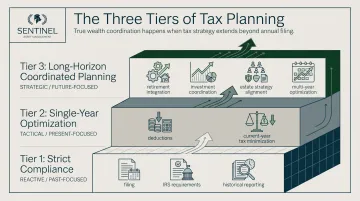
The Three Tiers of Tax Work
Not all tax preparation is created equal. Understanding where your current service falls can help you identify what's missing:
Tier 1: Strict Compliance — Getting the right numbers in the right boxes, filing on time, meeting IRS requirements. This is essential but purely backward-looking.
Tier 2: Single-Year Optimization — Maximizing deductions and minimizing tax liability for the current year. Better, but still limited in scope.
Tier 3: Long-Horizon Planning — A three-to-ten-year view that integrates directly with wealth management goals, coordinates across multiple account types, and positions you for sustained tax efficiency. This is where coordinated wealth building happens.
According to the AICPA's Statements on Standards for Tax Services, Tier 1 and Tier 2 fall under tax return preparation. Tier 3 is what the AICPA classifies as true "Tax Planning" — forward-looking advice developed in coordination with your financial advisor, not just your accountant.
The Financial Ecosystem Concept
Tax, investment, retirement, and estate decisions are interconnected — a change in one area triggers consequences across all the others.
Selling a business, inheriting an IRA, or converting a traditional 401(k) to a Roth can shift your tax bracket, affect your Medicare premiums, and alter your estate distribution in ways no single advisor sees alone. Without coordination, each decision may be technically correct within its own domain but still leave money on the table.
This is the case Sentinel Asset Management makes for coordinated planning. Every client portfolio is guided by an Investment Policy Statement that accounts for tax situation, income needs, and legacy objectives — so investment decisions and tax strategy move together rather than in parallel.
Why Most Financial Plans Miss the Mark
Even clients who have a skilled CPA and a capable financial advisor often receive fragmented advice. The two professionals rarely share information, compare notes, or co-develop a unified strategy. Each optimizes their own domain while the gaps between them go unaddressed.
The Most Common and Costly Gaps
- Holding tax-inefficient assets in taxable accounts while growth-oriented investments sit in tax-deferred accounts — this asset location error runs backwards and costs you every year.
- Missing the Roth conversion window between retirement and the onset of RMDs locks in higher lifetime taxes than necessary.
- Donating cash instead of appreciated shares, skipping Qualified Charitable Distributions (QCDs), or failing to bunch contributions in high-income years leaves real tax savings unclaimed.
- When your will says one thing and your IRA beneficiary form says another, your IRA wins — creating unintended tax bills for your heirs.
Research confirms the cost: siloed financial decision-making costs investors up to 1.85% in annualized net returns, with 110 basis points lost to suboptimal withdrawal sequencing and another 75 to poor asset location. Closing these gaps is exactly what coordinated tax planning and wealth management is designed to do.
The Three Pillars of a Coordinated Wealth Plan
The real leverage comes not from mastering each pillar individually, but from the coordination between them.
Pillar 1: Tax Strategy
Effective tax strategy goes far beyond annual filing. It involves year-round bracket management, identifying underutilized tax years for Roth conversions or income acceleration, and using the completed tax return as a forward-looking diagnostic tool.
The Retirement Tax Desert
This is the window after retirement (average age 62) but before required minimum distributions begin (age 73-75 under SECURE 2.0) and Social Security starts. This 5-to-13-year period often presents the lowest-bracket years of your life — the ideal time for Roth conversions.
In 2022, conversions represented $36.5 billion in inflows to Roth IRAs, surpassing direct contributions. Vanguard's research demonstrates that paying conversion taxes from a taxable account lowers the break-even tax rate threshold significantly, making conversions highly profitable even if future tax rates drop.
Tax-Loss and Gain Harvesting
Tax-loss harvesting (TLH) yields a "tax alpha" of 0.85% to 1.10% per year when executed systematically, according to MIT research spanning 1926 to 2018. Vanguard projects 15-year annualized TLH alpha ranging from 0.47% for mass-affluent investors to 1.27% for ultra-high-net-worth investors.
Tax-gain harvesting is less known but equally powerful. During low-income years, you can realize long-term capital gains completely tax-free up to these thresholds:
| Filing Status | 2025 0% Capital Gains Threshold |
|---|---|
| Single | $48,350 |
| Married Filing Jointly | $96,700 |
| Head of Household | $64,750 |
Realizing gains at 0% permanently steps up your cost basis, eliminating future 15% or 20% taxes on that appreciation.
Pillar 2: Investment Management
Asset Location Strategy
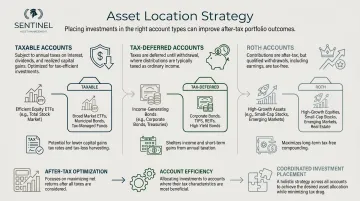
Asset location means deliberately placing investments in the account type that maximizes after-tax returns:
- Taxable accounts: Growth-oriented, low-income assets like tax-efficient ETFs
- Tax-deferred accounts: Income-generating investments like bonds
- Roth accounts: High-growth assets earmarked for heirs, allowing tax-free appreciation
Two portfolios with identical pre-tax returns can produce dramatically different after-tax results based solely on where assets are held. Vanguard research finds that optimal asset location adds 5 to 30 basis points of after-tax return annually compared to equal-location strategies.
ETFs vs. Mutual Funds
Between 1993 and 2023, active mutual funds distributed an average of 3.72% of assets as capital gains annually, while ETFs distributed just 0.12%. This creates a 1.05% annual "tax alpha" advantage for ETF investors in taxable accounts.
ETFs use in-kind redemptions to flush out low-basis shares without triggering taxable events for remaining shareholders — a structural advantage that makes them far better suited for taxable accounts.
The right investments in the right accounts set the stage — but how you draw them down matters just as much.
Pillar 3: Retirement and Estate Planning
Withdrawal Sequencing
The order in which you draw down taxable, tax-deferred, and tax-free accounts is one of the most consequential — and least discussed — tax decisions retirees face. Poor sequencing can trigger Medicare Income-Related Monthly Adjustment Amount (IRMAA) surcharges, cliff-based premium increases that can add thousands in annual costs.
For married couples filing jointly in 2025, crossing just one IRMAA threshold by $1 triggers an additional $74 monthly Part B surcharge per person — $1,776 annually. Research on dynamic, all-years withdrawal strategies consistently shows better portfolio longevity than the standard "taxable first, then tax-deferred, then tax-free" approach.
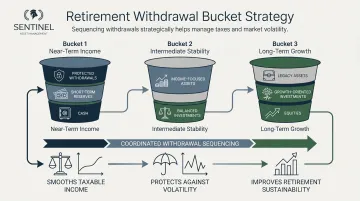
Sentinel Asset Management structures client withdrawals into dedicated "buckets" — near-term holdings insulated from market swings, paired with growth-oriented allocations for longer time horizons.
Estate Planning and Tax Consequences
Three estate planning decisions carry significant tax consequences that are frequently overlooked:
- Beneficiary designations determine how inherited assets are taxed at distribution
- Asset titling affects whether heirs receive a step-up in cost basis
- Gifting strategies interact with both income taxes and estate taxes simultaneously
Charitable vehicles like qualified charitable distributions (QCDs) and donor-advised funds can satisfy RMD obligations, remove appreciated assets from the taxable estate, and generate income tax benefits — but only when the advisor, accountant, and estate attorney are working from the same plan.
The federal estate tax basic exclusion amount is $13,990,000 for 2025, increasing to $15,000,000 in 2026 under the recently enacted "One Big Beautiful Bill Act."
Key Strategies That Benefit Most from Coordination
Roth Conversion Planning
The optimal timing and amount of a Roth conversion depends on:
- Projected future income
- Expected tax bracket trajectory
- Available cash to pay conversion taxes outside the IRA
- Estate goals
Poorly timed conversions push clients into higher brackets or trigger Medicare premium surcharges. A well-timed conversion, by contrast, lets those assets compound tax-free for decades — a meaningful difference over a long retirement.
Asset Location in Practice
Consider an investor holding bonds in a taxable brokerage account and growth ETFs in a traditional IRA. This arrangement is backwards:
- Bonds generate ordinary income taxed annually at rates up to 37%
- ETFs' growth will eventually be taxed as ordinary income upon withdrawal from the IRA
Reversing this placement — bonds in the IRA, ETFs in the taxable account — improves after-tax outcomes without changing the underlying investments.
Charitable Giving as a Tax Coordination Tool
Three coordination-dependent charitable strategies:
- Donating appreciated shares instead of cash — Removes unrealized gains from the taxable estate while deducting the full fair market value up to 30% of AGI
- Using QCDs from IRAs — Satisfies RMDs without the income hitting your tax return (up to $108,000 annually for 2025, increasing to $111,000 in 2026)
- Bunching contributions into a donor-advised fund — Maximizes itemized deductions in high-income years while distributing grants over multiple years
According to the Donor Advised Fund Research Collaborative, DAFs reached a record 3.56 million accounts in 2024, with total assets growing 27.5% to $326.45 billion.
That shift from accumulation to distribution makes withdrawal sequencing the next critical coordination point.
Withdrawal Sequencing and the Bucket Approach
Retirees who draw solely from tax-deferred accounts early in retirement often face large, unavoidable RMDs later — pushing them into higher brackets, increasing Medicare premiums, and reducing assets available for heirs.
The structured withdrawal "bucket" approach sequences withdrawals across account types to address these risks directly:
- Smooths taxable income across retirement years
- Insulates near-term cash needs from market volatility
- Preserves tax-free assets for later retirement or legacy transfer
Tax-Gain Harvesting in Low-Income Years
Realizing long-term capital gains during years when income falls in the 0% bracket resets your cost basis without triggering tax. This removes embedded gains from the portfolio and sidesteps future 15% or 20% rates that would otherwise apply.
These windows are easy to miss in isolation. When a financial advisor and accountant track income projections together, they can act on them before year-end — often saving clients thousands that a siloed approach would leave on the table.
How to Build Your Coordinated Financial Plan
Start with a Full Financial Diagnostic
Use your most recent tax return as the entry point. Review it not just for accuracy but for what it reveals about missed opportunities:
- Unreported cost basis
- Unclaimed deductions
- Suboptimal account structures
- Bypassed Roth conversion windows
The AICPA's "Analysis of a Tax Return for Personal Financial Planning" checklist guides advisors to review Schedule B for asset location inefficiencies, Schedule D for loss harvesting opportunities, and itemized deductions for charitable bunching potential.
Break Down Silos Between Advisors
The most effective coordinated plans involve at minimum a financial advisor, CPA, and estate attorney who:
- Share relevant client information
- Meet regularly
- Review major decisions together before implementation — not after

Your role as the client is to facilitate this communication if the advisors don't do it proactively.
Build a Living, Written Plan
Once your advisors are aligned, the strategy needs to be formalized. A written Investment Policy Statement captures your tax situation, income needs, time horizon, risk tolerance, and estate goals — and keeps everyone working from the same page. Stress-test that plan against multiple scenarios:
- Market downturns
- Extended longevity
- Tax law changes
At Sentinel Asset Management, every client portfolio is guided by an Investment Policy Statement calibrated to the client's complete financial picture — tax situation, income needs, and legacy objectives included.
Review Proactively, Not Reactively
A written plan only holds its value if it stays current. Certain life events should trigger an immediate coordinated review:
- Retirement
- A large inheritance
- A business sale
- Divorce
- Death of a spouse
- Significant change in tax law
Beyond these triggers, build an annual review cadence into your coordinated plan regardless of life changes.
Frequently Asked Questions
What is tax coordination?
Tax coordination is the practice of aligning tax planning decisions with investment management, retirement planning, and estate planning so that each area informs the others — rather than treating taxes as a separate, annual compliance task.
What are the three types of taxes?
The three broad categories most relevant to wealth management are:
- Income taxes — on wages, investment income, and retirement distributions
- Capital gains taxes — on appreciated assets sold, with different rates for short- vs. long-term holdings
- Estate/transfer taxes — on assets passed to heirs
When should I start coordinating my tax and wealth planning?
The earlier coordination begins, the more options you have. Many strategies like Roth conversions, asset location, and tax-efficient gifting require time to compound their benefits. Waiting until retirement significantly narrows the available options.
How does asset location reduce my tax burden?
Asset location means matching the tax characteristics of an investment with the tax treatment of the account holding it. Keeping income-generating assets in tax-deferred accounts and high-growth assets in Roth accounts shelters the least tax-efficient returns from annual taxation.
What is a Roth conversion and when does it make sense in a coordinated plan?
A Roth conversion transfers funds from a pre-tax retirement account to a Roth IRA, triggering tax now in exchange for tax-free growth and withdrawals later. It works best during low-income years — early retirement, before Social Security and RMDs begin — and should be sized annually with your advisor and accountant.
How does estate planning connect to tax planning?
Estate planning decisions carry tax consequences across income, capital gains, and estate taxes. Misalignment between estate documents and account structures can create unexpected tax bills for heirs — which is why coordination among your estate attorney, financial advisor, and accountant is essential.
Take the next step in your financial journey by exploring our courses page for upcoming live seminars.