General information, not personalised tax, legal or investment advice.

Many people want to leave a meaningful legacy that reflects their values, but they struggle with the mechanics. Should you give during your lifetime or through your estate? Which assets are most tax-efficient to donate? How do you ensure your wealth supports both your family and the causes you care about—without creating unnecessary tax burden or complexity?
The good news: the right philanthropic strategies can accomplish both goals simultaneously. This guide walks through the primary charitable giving vehicles, their tax advantages, the timing question of lifetime versus at-death gifts, and how to integrate philanthropy into a broader retirement and legacy plan that reflects what matters most to you.
Key takeaways
- Charitable gifts to qualified 501(c)(3) organizations receive an unlimited estate tax deduction, directly reducing your taxable estate
- Donating appreciated securities or real estate eliminates capital gains tax while generating a full fair-market-value income tax deduction
- Donor-Advised Funds provide immediate tax deductions during high-income years while retaining flexibility to recommend grants over time
- IRA owners aged 70½ and older can send distributions directly to charity tax-free, satisfying required minimum distributions in the process
- Timing gifts strategically around retirement income and tax planning maximizes both philanthropic impact and financial efficiency
Why Philanthropy Belongs in Your Financial Legacy Plan
Legacy planning has traditionally focused on transferring wealth to heirs. Incorporating philanthropy transforms an estate plan into a values statement — one that ensures your wealth reflects what mattered most to the person who built it.
Charitable giving isn't just for the ultra-wealthy. Individuals at many wealth levels use structured giving strategies to reduce estate and income tax drag while generating meaningful impact. According to the National Philanthropic Trust's 2024 DAF Report, the average Donor-Advised Fund account size is $141,120—demonstrating that structured philanthropy is accessible well below ultra-high-net-worth thresholds.
The family dimension matters just as much. Involving heirs in philanthropic decisions — through a Donor-Advised Fund with named successors, for example — turns giving into a shared practice. It passes forward more than wealth:
- Instills shared values across generations
- Encourages financial responsibility in younger heirs
- Creates a multi-generational giving tradition rooted in purpose
At Sentinel Asset Management, we help clients integrate philanthropic planning into their broader financial ecosystem—coordinating portfolio management, tax optimization, retirement income planning, and legacy goals to ensure your wealth reaches the people and causes you care about on your terms, with minimal tax drag and maximum impact.
Philanthropic Giving Vehicles: Matching Strategy to Goals
Bequests in a Will or Trust
The simplest starting point. A bequest designates a specific dollar amount, asset, or percentage of your residuary estate to a qualified charity through your will or revocable trust.
Key advantages:
- Flexible and easily updated as circumstances change
- Requires no action or sacrifice during your lifetime
- Delivers an unlimited estate tax deduction on amounts left to qualified 501(c)(3) charities
Precision matters: use the charity's exact legal name, tax ID number, and current address to avoid delays or disputes during estate settlement.
Beneficiary Designations on Retirement Accounts and Life Insurance
Retirement accounts are uniquely well-suited for charitable giving because individual heirs must pay income tax on inherited IRA or 401(k) distributions, while a charity — which pays no income tax — receives the full value.
How it works:
- Name a charity as full or partial beneficiary on your IRA, 401(k), or life insurance policy
- The charity receives the asset directly, bypassing probate
- Your estate receives an estate tax deduction for the full amount
Leave tax-deferred retirement assets to charity and tax-efficient assets (like appreciated stock or real estate) to your heirs. This maximizes the effective value of each asset for its intended recipient.
Donor-Advised Funds (DAFs)
A DAF is a giving account that lets you contribute assets now, receive an immediate tax deduction, and recommend grants to charities over time.
Mechanics:
- You make an irrevocable contribution to a sponsoring organization (like Fidelity Charitable, Schwab Charitable, or a community foundation)
- You receive an immediate income tax deduction for the full fair market value
- You retain advisory rights over how the funds are distributed, though the sponsor has legal control
Particularly strategic during:
- High-income years when you need to offset taxable income
- Liquidity events (business sale, real estate sale, large bonus)
- Years when you want to "bunch" multiple years of charitable contributions to exceed the standard deduction threshold
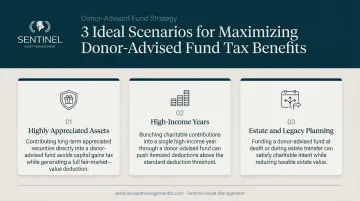
Estate planning benefit: DAFs can name successor advisors, allowing your children or other family members to continue recommending grants after your death—creating a lasting philanthropic legacy without the complexity of a private foundation.
Charitable Remainder Trusts (CRTs)
Where a DAF separates giving from distribution, a CRT generates income for you first. It's an irrevocable trust that pays income to you (and/or other non-charitable beneficiaries) for a set term or your lifetime, with the remaining assets going to charity.
Three tax benefits:
- Partial income tax deduction in the year of funding based on the present value of the charity's remainder interest
- The trust can sell appreciated assets without immediate capital gains tax recognition (because the trust itself is tax-exempt)
- Assets are removed from your taxable estate
CRTs work particularly well for individuals holding highly appreciated, low-yield assets — such as concentrated stock positions or real estate — who also need retirement income. The structure converts a low-income asset into a reliable income stream while deferring capital gains and securing a charitable deduction.
Other Advanced Vehicles
Charitable Lead Trusts (CLTs) work in reverse: the charity receives income for a defined period, and the remainder passes to your heirs—often with reduced gift and estate tax. This strategy works well when you want to transfer appreciating assets to heirs while reducing transfer taxes.
Private Foundations offer the most control for very large estates but carry heavy administrative and compliance burdens, plus a 1.39% excise tax on net investment income. Practitioner benchmarks suggest a minimum of $10 million in assets for cost-effectiveness.
The Tax Benefits of Strategic Charitable Giving
Estate Tax Deduction
Assets donated to a qualified 501(c)(3) charity—whether through a bequest, trust, or beneficiary designation—are deducted from your gross taxable estate with no dollar cap.
Current federal estate tax exemption: $13.99 million per individual in 2025 (per IRS Rev. Proc. 2024-40). For estates exceeding this threshold, the unlimited charitable deduction can meaningfully reduce or eliminate federal estate tax liability.
Looking ahead: The exemption is scheduled to increase to $15 million in 2026 under Public Law 119-21, though future legislative changes remain possible.
Income Tax Deductions for Lifetime Gifts
Charitable contributions made during your lifetime generate an itemized income tax deduction, subject to IRS AGI limitations.
Per IRS Publication 526, AGI limits vary by asset type and recipient:
- Cash to public charities: 60% of AGI
- Appreciated property to public charities: 30% of AGI
- Cash to private foundations: 30% of AGI
- Appreciated property to private foundations: 20% of AGI
You must itemize to claim the deduction. Unused deductions carry forward up to five years, and contributions to a DAF qualify for the higher public charity limits.
Capital Gains Tax Avoidance on Appreciated Assets
Donating appreciated securities, real estate, or other long-term capital assets directly to a charity (or to a DAF or CRT) produces a two-part advantage:
- Avoid capital gains tax on the appreciation
- Receive a deduction based on the full fair market value—not the cost basis
Illustrative comparison (adapted from Schwab Charitable):
| Strategy | Sale Price | Capital Gains Tax (20%) | Amount to Charity | Tax Deduction | Your After-Tax Cost |
|---|---|---|---|---|---|
| Sell stock, donate proceeds | $100,000 | $19,000 | $81,000 | $81,000 | Higher |
| Donate stock directly | $100,000 | $0 | $100,000 | $100,000 | Lower |
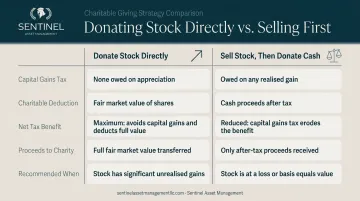
The charity receives $19,000 more, and you receive a $19,000 higher deduction—all from the same asset.
Qualified Charitable Distributions (QCDs) from IRAs
Donors aged 70½ or older can transfer up to $108,000 in 2025 (per IRS Notice 2024-80) directly from a traditional IRA to a qualified charity.
The QCD counts toward your Required Minimum Distribution (RMD), and the distribution is excluded from taxable income entirely—not just deducted, but excluded. This makes QCDs especially valuable for retirees who don't need their full RMD for living expenses and already take the standard deduction.
Strategic note: At Sentinel Asset Management, we model QCD strategies as part of our comprehensive tax and retirement income planning. For clients in distribution phase, QCDs become a powerful annual tool—serving both philanthropic goals and tax management simultaneously.
Reduction of Probate Costs and Administrative Burden
Beyond income tax tools, charitable giving also affects how efficiently your estate transfers. Assets transferred to charities via beneficiary designations or trust structures bypass probate entirely, reducing both time and legal costs associated with estate settlement—and ensuring faster delivery of assets to their intended recipients.
Timing Your Gifts: Lifetime Giving vs. Bequest Strategies
Lifetime Giving Advantages
Charitable gifts made during your lifetime offer several distinct benefits:
- You see the impact of your giving while you're still here
- Immediate income tax deductions reduce current-year tax liability at your highest marginal rates
- Remove appreciating assets from your estate before they grow further, reducing future estate tax exposure
Strategic timing: For individuals in peak earning years or facing a significant liquidity event (business sale, real estate sale, inheritance), front-loading a DAF or funding a CRT locks in deductions at high marginal tax rates. Fidelity Charitable notes that contributing to a DAF during a high-income year allows you to maximize the tax benefit while retaining flexibility to recommend grants over multiple future years.
At-Death Giving Advantages
Bequests and beneficiary designations require no sacrifice of assets during your lifetime—making them appropriate for those who need their wealth for retirement income security.
Key benefits:
- The estate tax deduction applies at death, shrinking your taxable estate
- Retirement assets left to charity avoid the income tax burden that would fall on individual heirs
- Maximum flexibility—wills and beneficiary designations can be updated as circumstances change
Your charitable gifts are funded only after your lifetime needs are met. There's no need to predict how much you'll need in retirement—you give what remains.
The Role of RMDs in the Timing Decision
Once you reach the age triggering Required Minimum Distributions — currently 73 for those born 1951–1959, rising to 75 for those born in 1960 or later per the Federal Register — the Qualified Charitable Distribution (QCD) strategy becomes a powerful annual tool.
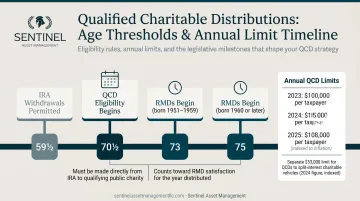
If you don't need your full RMD for living expenses, a QCD lets you satisfy the distribution requirement without adding to your taxable income. This matters most for retirees who take the standard deduction and wouldn't otherwise see any benefit from a charitable deduction.
Matching Timing to Overall Financial Position
The right timing depends on:
- Current and projected marginal tax rates
- The nature of the assets being donated (appreciated stock, cash, retirement funds)
- Cash flow needs in retirement
- Estate size relative to the federal exemption
At Sentinel Asset Management, we coordinate these factors through an integrated financial plan—ensuring that every withdrawal, sale, and charitable gift is optimized for tax efficiency and aligned with your long-term goals. As your income, estate size, and tax situation shift over time, so does the optimal giving approach — which is why we revisit these decisions annually rather than treating them as settled.
Building a Philanthropic Plan That Works With Your Retirement
Start With Clarity on Values and Charitable Goals
Effective philanthropic planning begins with understanding what matters most to you:
- Which causes or organizations do you care about deeply?
- What kind of impact do you want to create—immediate or sustained over time?
- Do you want to see the results of your giving, or are you comfortable with a legacy gift?
Involve your family: Discuss your philanthropic intentions with your heirs. A shared giving plan can become a powerful way to pass forward values and create a multi-generational tradition.
Integrate Philanthropy Into the Broader Financial Ecosystem
Charitable giving works best when it's fully coordinated with portfolio management, tax planning, and retirement income planning—not treated as an afterthought.
Integration points to coordinate:
- Donate appreciated stock rather than cash to avoid capital gains and maximize the deduction
- Time contributions to high-income years or liquidity events to capture the greatest tax benefit
- Align QCDs and DAF distributions with your withdrawal plan to avoid unintended income spikes
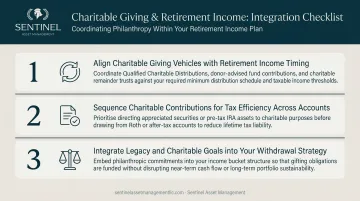
Getting this coordination right requires seeing your taxable, tax-deferred, and tax-free account "buckets" as one cohesive plan. At Sentinel Asset Management, that integration is central to how we build philanthropic strategies—ensuring charitable giving enhances your retirement income rather than working against it.
Review and Update Regularly
Philanthropic plans should be revisited when life events occur:
- Significant portfolio changes or liquidity events
- Death of a spouse or changes in family structure
- Changes in tax law (such as RMD age adjustments or exemption amounts)
- Addition of new heirs or changes in charitable priorities
Key components to review:
- Beneficiary designations on retirement accounts and life insurance
- DAF successor instructions
- Trust structures and charitable provisions in your will
Regular reviews ensure that your philanthropic plan remains aligned with your current intentions and takes advantage of evolving tax law and planning opportunities.
Frequently Asked Questions
What is the difference between a Charitable Remainder Trust and a Charitable Lead Trust?
A Charitable Remainder Trust (CRT) pays income to you or other non-charitable beneficiaries first, with the charity receiving the remainder at the end of the trust term. A Charitable Lead Trust (CLT) works in reverse—the charity receives income for a set period, and the remaining assets pass to your heirs, often with reduced gift and estate tax.
Can charitable gifts made through my estate reduce my estate taxes?
Yes. Qualifying gifts to 501(c)(3) charities—whether through a will, trust, or beneficiary designation—receive an unlimited estate tax deduction. The full donated amount is excluded from your taxable estate, which can significantly reduce or eliminate federal estate taxes for larger estates.
What is a Qualified Charitable Distribution, and who can use it?
A QCD is a direct transfer from a traditional IRA to a qualified charity, available to donors aged 70½ or older, with a 2025 limit of $108,000. The distribution counts toward your Required Minimum Distribution and is excluded from your taxable income, making it one of the most tax-efficient giving tools for retirees.
Why is donating appreciated stock more tax-efficient than donating cash?
When you donate appreciated stock directly to a charity, you avoid the capital gains tax you would have owed on the appreciation, and you still receive a charitable deduction for the full fair market value. This lets you give more at a lower after-tax cost than selling the stock first and donating the proceeds.
How does a Donor-Advised Fund differ from a private foundation?
A DAF is simpler and lower-cost: you contribute to a sponsoring organization, receive an immediate tax deduction, and recommend grants over time. A private foundation offers more control but comes with administrative burden, regulatory compliance, a 1.39% excise tax on investment income, and typically requires $10 million+ in assets to be cost-effective.
When is the right time to start incorporating philanthropy into an estate plan?
Philanthropic planning can begin at any stage, but natural trigger points include peak earning years, a major liquidity event, reaching RMD age, or a scheduled estate plan review. Integrating charitable goals early gives you the most flexibility to choose tax-efficient strategies and build lasting impact.
Take the next step in your financial journey by exploring our courses page for upcoming live seminars.