General information, not personalised tax, legal or investment advice.

Introduction
Most people treat wealth management and estate planning as two separate to-do list items—one handled by an investment advisor, the other by a lawyer. That divided approach is where costly gaps form: outdated beneficiaries, uncoordinated tax strategies, and assets that bypass the estate plan entirely.
More than 40% of Americans have never updated their beneficiary forms after major life events, and 56% of U.S. adults have no estate planning documents whatsoever. The consequences are real: beneficiary designations on retirement accounts override wills regardless of intent, unfunded trusts force assets through costly probate, and families inherit tax bills that could have been avoided.
What follows breaks down how wealth management and estate planning differ, why combining them produces better outcomes, and which tools bring both disciplines into a single, coordinated plan.
Key takeaways
- Wealth management grows and protects assets during your lifetime; estate planning governs how those assets transfer after death
- Aligning the two closes gaps in tax strategy, beneficiary designations, and account titling before they become costly problems
- Key tools that connect both disciplines include trusts, beneficiary designations, account titling, and tax-advantaged gifting
- Most critical estate planning steps are executed through wealth management decisions, not in a lawyer's office
Wealth Management vs. Estate Planning: What Each One Actually Does
Defining Wealth Management
Wealth management is the ongoing process of growing, protecting, and distributing assets during your lifetime. It encompasses:
- Investment management and portfolio construction
- Retirement income planning
- Tax-efficient withdrawal strategies
- Risk management and insurance coordination
The SEC defines an investment adviser as an individual or firm engaged in providing investment advice about securities for compensation. Wealth managers build portfolios based on your goals, income needs, tax situation, and risk tolerance—all calibrated to serve you throughout your lifetime.
Where wealth management focuses on your lifetime, estate planning governs what happens next.
Defining Estate Planning
Estate planning is the set of legal arrangements that determine what happens to your assets after death or during incapacity. It includes:
- Wills and trusts
- Powers of attorney
- Healthcare directives
- Beneficiary designations
The American Bar Association defines estate planning as a process involving professional advisors to cover the transfer of property at death and other personal matters, often involving tax planning.
The Key Distinction
Wealth management focuses on growing and protecting your assets throughout your lifetime. Estate planning ensures those assets reach the right people — efficiently, and on your terms.
| Aspect | Wealth Management | Estate Planning |
|--------|-------------------|-----------------|
| Primary Focus | Growing and preserving assets during life | Transferring assets at death or incapacity |
| Core Tools | Investment portfolios, retirement accounts, tax strategies | Wills, trusts, powers of attorney, beneficiary forms |
| Primary Goal | Maximize wealth and income while managing risk | Ensure assets reach intended recipients efficiently |
| Time Horizon | Current and future needs during lifetime | Post-death or incapacitation |
Why Wealth Management and Estate Planning Work Better Together
The Estate Plan Can Only Work With What the Wealth Plan Has Built
Investment decisions made during your lifetime directly shape what is available to transfer. Portfolio size, account types, and asset mix all affect both your retirement security and your heirs' inheritance. A poorly structured investment strategy leaves less to pass on—and what does remain may be positioned inefficiently for transfer.
Beneficiary Designation Coordination
Retirement accounts (IRAs, 401(k)s) and life insurance policies pass directly to named beneficiaries outside of the will. Federal law is clear: the U.S. Supreme Court has repeatedly affirmed the "plan documents rule," meaning plan administrators must pay the beneficiary named on the form, regardless of what a will, divorce decree, or state law says (Kennedy v. Plan Administrator, 2009).
If beneficiary designations have not been reviewed alongside the estate plan, they can contradict the intended distribution entirely. An ex-spouse listed on an old 401(k) form will inherit that account even if the will names someone else.
Retirement Withdrawal Sequencing Affects Estate Outcomes
Which accounts are drawn down first during retirement changes the composition of what remains for heirs—and at what tax cost. The sequence matters:
- Drawing from tax-deferred accounts first may leave heirs with a larger but fully taxable inheritance
- Drawing from taxable accounts first preserves tax-deferred growth and can reduce heirs' future tax burden
- Preserving Roth (tax-free) accounts longest maximizes the tax-free inheritance passed on
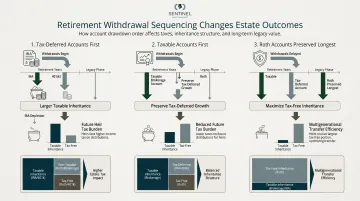
Getting this sequencing right requires coordinating investment strategy with legacy goals — a decision that sits squarely at the intersection of wealth management and estate planning.
Charitable Giving Strategies That Serve Both Disciplines
Strategic philanthropy can reduce taxable income while fulfilling legacy goals:
- Donor-Advised Funds (DAFs): Allow you to take an immediate tax deduction while retaining advisory privileges over future grant distributions. In 2023, DAFs held $251.52 billion in charitable assets and distributed $54.77 billion in grants.
- Charitable Remainder Trusts (CRTs): Convert appreciated assets into an income stream and a future charitable gift without triggering immediate capital gains, preserving value for both you and your chosen causes.
The Quarterback Role: Coordinating Financial and Legal Structures
A wealth manager working in this quarterback role reviews legal documents alongside account structures — catching mismatches before they become costly. That means verifying that trust ownership aligns with account titling, that beneficiary designations reflect the estate plan's intent, and that tax strategy informs both investment decisions and legacy goals simultaneously.
At Sentinel Asset Management, this coordination is built into how planning works — investment goals, tax situations, and estate wishes are addressed as a single plan, not as separate conversations happening in parallel.
The Key Tools That Bridge Both Disciplines
Revocable Trusts (Living Trusts)
Revocable trusts hold assets, avoid probate, and allow a successor trustee to manage affairs if the grantor becomes incapacitated. From a wealth management perspective, assets must be properly titled into the trust—funding the trust is a financial action, not just a legal one.
Critical Point: A trust only governs the assets it owns. If assets remain titled in your individual name, the trust is an empty shell and those assets will go through probate anyway.
Irrevocable Trusts
Once assets are transferred into an irrevocable trust, they are generally removed from the taxable estate and protected from creditors. The trade-off is loss of direct control—a wealth manager helps determine when this makes sense given your net worth and goals.
Advanced strategies include:
- SLATs (Spousal Lifetime Access Trusts): Best for married couples who want to reduce estate tax exposure without fully surrendering access — the spouse retains limited access to trust assets
- QPRTs (Qualified Personal Residence Trusts): Transfers a home out of the taxable estate while you retain the right to live in it for a defined term — useful when real estate represents a large share of the estate
Both strategies require an attorney for drafting and a wealth manager for ongoing coordination, particularly around asset allocation and trust funding after execution.
Beneficiary Designations
IRAs, 401(k)s, annuities, and life insurance policies all transfer by contract to named beneficiaries, regardless of what a will says. A wealth manager's role includes auditing these designations regularly to ensure they reflect the current estate plan and family circumstances.
Key Point: The core of estate planning activity happens within the wealth management relationship — beneficiary updates, trust funding, account retitling, and withdrawal sequencing are all financial actions that can be handled without returning to legal counsel each time.
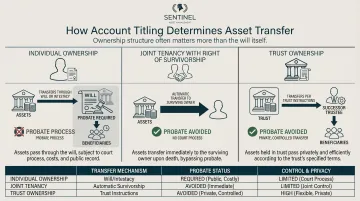
Account Titling
How investment accounts, bank accounts, and real estate are titled—individually, jointly, or in a trust—determines how they transfer at death. Incorrect titling can route assets into probate even when a trust exists.
Common titling structures:
| Titling Structure | How It Transfers | Probate Required? |
|---|---|---|
| Individual ownership | Per will or state intestacy law | Yes |
| Joint tenancy with right of survivorship | Automatically to surviving owner | No |
| Trust ownership | Per trust instructions | No |
How Tax Strategy Connects the Two
Federal Estate Tax
The federal estate tax exemption for 2025 is $13,990,000 per individual, with a top marginal rate of 40% on taxable amounts exceeding the exemption. Recent legislation (P.L. 119-21) sets the exemption at $15 million for 2026, indexed for inflation thereafter.
While most families are not affected by federal estate tax, those with net worth approaching or exceeding these thresholds must coordinate minimization strategies across both wealth management and estate planning.
Annual Gift Tax Exclusion
The annual gift tax exclusion for 2025 is $19,000 per recipient. Systematic gifting during life reduces the taxable estate while transferring wealth—a strategy a wealth manager can build into cash flow planning.
Step-Up in Cost Basis at Death
Gifting and holding assets aren't interchangeable strategies—each carries a different tax consequence for heirs. Assets inherited from a deceased person generally receive a step-up in cost basis to the fair market value at date of death, eliminating embedded capital gains for heirs. Gifts made during life, by contrast, retain the donor's original carryover basis—meaning heirs inherit your cost basis and owe capital gains tax on all appreciation since you bought the asset.
As a practical rule: highly appreciated assets (securities, real estate) typically favor holding until death to capture the step-up, while assets with little unrealized gain are better candidates for lifetime gifting. Coordinating this decision with your wealth manager and estate attorney can prevent heirs from facing an unexpected tax bill.
Common Mistakes When They're Managed Separately
Outdated Beneficiary Designations
A beneficiary named on a retirement account or life insurance policy overrides the will. If the beneficiary list has not been updated after a divorce, remarriage, or death, assets can pass to the wrong person regardless of what the legal documents say.
More than 40% of Americans have never updated their beneficiary forms after major life events—creating a massive liability for accidental disinheritance.
Uncoordinated Asset Titling
Assets held in the wrong name or structure bypass trusts entirely and are routed through probate—the opposite of what the estate plan intended. This gap forms when the financial advisor and estate attorney are not communicating.
Tax Planning Gaps
Investment decisions made without estate context can create avoidable tax bills for heirs. Concentrating appreciated assets in a taxable brokerage account, for example, misses opportunities to structure for step-up basis or trust transfer.
When coordination breaks down, probate becomes the fallback—and it is expensive. The numbers illustrate the stakes:
- Probate consumes 3%–7% of an estate's gross value in fees and court costs
- The process typically takes 6–9 months to resolve
- In states like California, timelines stretch to 9–18 months
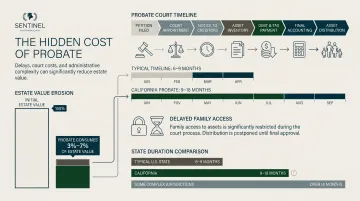
Keeping wealth management and estate planning in sync is what keeps assets out of that process entirely.
When to Review Your Integrated Plan
Life Event Triggers
Schedule an immediate review when you experience:
- Marriage or divorce
- Birth or adoption of a child
- Death of a beneficiary or heir
- Significant inheritance or windfall
- Business sale
- Entering or approaching retirement
Any of these shifts can alter how your assets should be titled, who receives them, and how your portfolio is structured to support those goals.
Periodic Reviews
Even without life events, review your integrated plan every three to five years at minimum to account for:
- Changes in tax law (particularly estate tax exemption thresholds)
- Shifting investment account balances
- Evolving family circumstances
Frequently Asked Questions
What is the difference between wealth management and estate planning?
Wealth management grows and protects assets during life through investment strategy, tax planning, and risk management. Estate planning governs how those assets transfer after death through legal documents and beneficiary designations. The two work best when coordinated as a single strategy.
What is the typical fee for a wealth manager?
Most wealth managers charge a percentage of assets under management (AUM). According to 2024 industry research, average AUM fees range from 100-120 basis points (1.00%-1.20%) for portfolios under $1 million, dropping to 80-100 basis points for portfolios over $2 million as portfolio size increases.
Do I need both a wealth manager and an estate planning attorney?
Yes. The wealth manager handles financial strategy, account structure, beneficiary coordination, and implementation. The estate attorney drafts the legal documents—wills, trusts, powers of attorney. A wealth manager can coordinate between the two so you don't have to manage the process alone.
When should I start integrating wealth management and estate planning?
There is no minimum wealth threshold. Integration is relevant at any stage of adult life. The most common trigger is having assets, dependents, or retirement accounts that would be affected by your death or incapacity—which describes most working adults.
Can estate planning help reduce taxes on inherited assets?
Yes. The step-up in cost basis eliminates income tax on unrealized capital gains for inherited assets. Irrevocable trusts can remove assets from the taxable estate entirely. A wealth manager and estate attorney working together ensure these income tax and estate tax strategies don't conflict.
What happens to my investment portfolio if I die without an estate plan?
Assets pass according to state intestacy laws, which may not reflect your wishes. Named beneficiaries on retirement accounts and life insurance still govern those accounts directly. Everything else may enter probate—a public, costly process that can consume 3-7% of the estate's value.
Take the next step in your financial journey by exploring our courses page for upcoming live seminars.