General information, not personalised tax, legal or investment advice.

Introduction
Most people spend decades building wealth. Far fewer spend meaningful time deciding what that wealth is supposed to do — or who it should serve. According to the Trust & Will 2026 Estate Planning Report, 56% of U.S. adults still have no estate planning documents in place, and 42% would not know what to do if a family member died today.
This gap reveals a fundamental misunderstanding: estate planning transfers assets, but legacy planning transfers purpose, values, and financial clarity. When financial, legal, and tax decisions aren't coordinated, what you leave behind can create confusion, family disputes, or avoidable tax costs.
When those decisions are aligned thoughtfully, your legacy becomes something more than a transfer of wealth. It becomes a guide that empowers the people you care about most, preserving the values and intentions that give that wealth meaning.
Key Takeaways
- Legacy planning is a cohesive strategy covering finances, values, charitable goals, and family communication
- Tax-efficient wealth transfer should be built into your plan from the start, not added as an afterthought
- Special needs dependents and blended families require customized planning structures
- Legacy planning is ongoing — periodic reviews and cross-professional coordination keep your plan effective as life changes
Legacy Planning vs. Estate Planning: Why the Distinction Matters
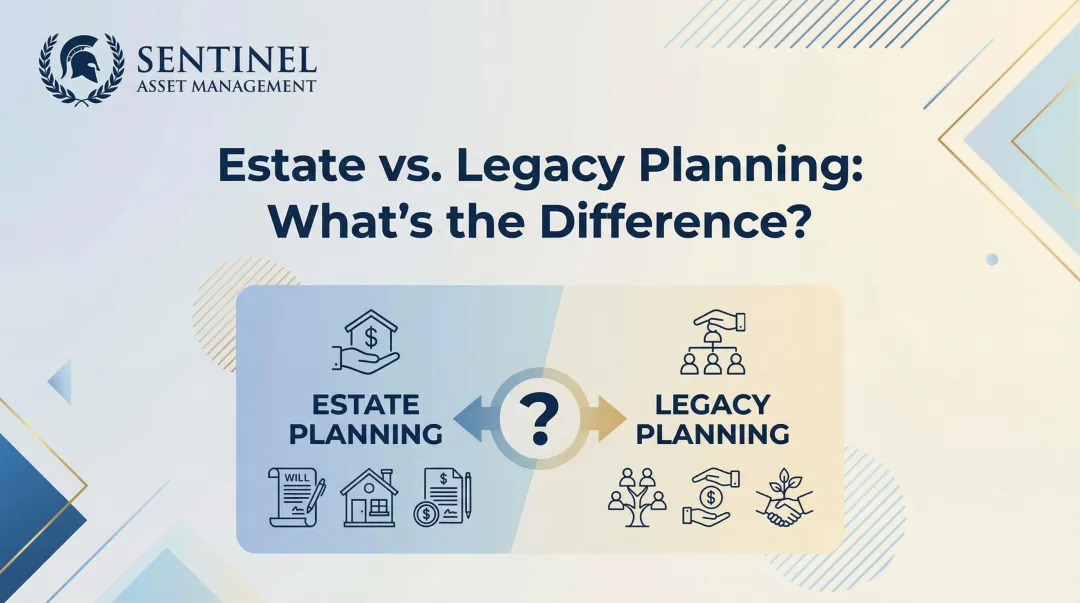
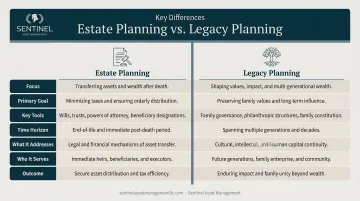
Estate planning is the legal and financial framework for distributing assets after death. It includes wills, trusts, powers of attorney, and beneficiary designations — the foundational mechanisms that determine who receives what and when. This framework is essential, but it's not the ceiling.
Legacy planning builds on that foundation by addressing what estate planning cannot: the values, intentions, and generational purpose behind your wealth. It answers questions no legal document is designed to ask:
- What principles should guide how my heirs use this wealth?
- How do I prepare them to steward it responsibly?
- What causes do I want to support beyond my lifetime?
- How should wealth function across multiple generations?
The distinction matters because legal documents alone don't transfer wisdom. A will directs assets, but it doesn't prepare your children to manage them. A trust can protect wealth for decades and still fail to teach the responsibility needed to preserve it. Legacy planning addresses the behavioral and relational dimensions that determine whether transferred wealth is used purposefully — or erodes within a generation.
The Core Elements of a Comprehensive Legacy Plan
Wills and Trusts: The Foundation
Wills direct asset distribution after death, but they require probate — a court-supervised process that is public, time-consuming, and costly. Probate typically consumes 3% to 7% of an estate's gross value and can take 12-18 months to complete.
Revocable living trusts bypass probate entirely. Assets transferred into the trust during your lifetime pass directly to beneficiaries upon death — immediately and privately. Most complete legacy plans include both: a will to cover any assets outside the trust and to name guardians for minor children, and a revocable living trust to handle the bulk of the estate efficiently.
Beneficiary Designations: The Override Mechanism
Beneficiary designations on retirement accounts (IRAs, 401(k)s) and life insurance policies are among the most neglected elements of legacy planning — and among the most consequential. These designations legally supersede instructions in a will.
Your will could direct your IRA to your children, but if the beneficiary designation still lists an ex-spouse from 20 years ago, the ex-spouse receives the account. Keeping these designations current and aligned with your overall plan is non-negotiable.
Charitable Giving Vehicles
Legacy planning offers multiple structures for purposeful philanthropy:
- Donor-Advised Funds (DAFs): Contribute assets, receive an immediate tax deduction, then recommend grants to qualified charities over time. The 2024 National Philanthropic Trust DAF Report puts total DAF charitable assets at $251.52 billion across 1.78 million accounts — reflecting their growing role in structured giving
- Charitable Remainder Trusts (CRTs): These pay you (or other beneficiaries) an income stream for a specified term or lifetime, with remaining assets distributed to charity — combining income, tax benefits, and legacy giving
- Direct bequests: Straightforward charitable gifts made through your will or trust
Educational Funding Structures
529 college savings plans and educational trusts direct legacy wealth toward future generations' opportunities. Contributions grow tax-free, and distributions for qualified education expenses carry no federal tax. As of the end of 2024, 529 plans held $525.1 billion in total assets across 16.96 million accounts.
Under the SECURE 2.0 Act, beneficiaries can now roll over up to $35,000 from a 529 plan to a Roth IRA tax-free, provided the account has been open for at least 15 years. That flexibility makes 529 plans a stronger multigenerational tool than most families realize.
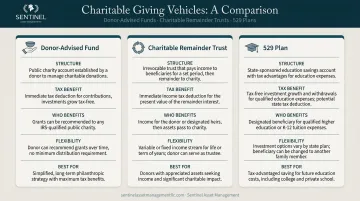
Pulling these elements together — wills, trusts, beneficiary designations, giving vehicles, and education accounts — requires coordination, not just documentation. Sentinel Asset Management guides clients through the estate planning process, aligning beneficiary designations, tax positioning, and asset structure before legal counsel is ever engaged.
Passing On Values, Not Just Wealth
Family Mission Statements
A family mission statement is a written articulation of shared values, long-term goals, and guiding principles. It serves as a reference point for financial decisions, inheritance conversations, and family governance across generations. Rather than leaving heirs to guess at your intentions, a mission statement provides clear direction.
Ethical Wills and Legacy Letters
An ethical will (or legacy letter) is a personal, non-legal document in which you record your values, life lessons, hopes for your heirs, and reflections on what mattered most. Unlike a legal will, it doesn't distribute assets — it distributes wisdom. For many families, this becomes one of the most meaningful documents in the entire legacy plan.
Documenting Family History
Preserving family history through written narratives, recorded interviews with older family members, or curated archives of photographs and documents maintains identity and continuity in ways that money alone cannot. These records provide context for why certain decisions were made and what the family stands for.
Family Meetings and Heir Education
Planning in isolation often creates misaligned expectations. Involving the right family members at the right time — sometimes with a financial advisor facilitating — creates space for transparent conversations before wealth changes hands. Structured meetings serve several purposes:
- Reduce friction by aligning expectations early
- Prepare future stewards to manage and protect inherited wealth
- Transfer values and intentions alongside financial assets
These conversations don't replace legal documents, but they give your plan a human foundation that paperwork alone can't provide.
Tax-Efficient Wealth Transfer Strategies
Annual Gift Tax Exclusion
The IRS allows individuals to gift up to $19,000 per recipient per year (as of 2025 and 2026) without triggering gift or estate tax. A couple can gift $38,000 annually to each child or grandchild, meaningfully reducing the taxable estate over time — and over a decade, that adds up to hundreds of thousands of dollars removed from a taxable estate without filing a single gift tax return.
Irrevocable Life Insurance Trusts (ILITs)
Life insurance proceeds are typically included in your taxable estate if you retain any "incidents of ownership" — the power to change beneficiaries, surrender the policy, or pledge it for a loan. An ILIT removes these proceeds from your estate by transferring ownership to the trust.
This is particularly valuable for families with illiquid assets (real estate, a business) who want to provide heirs with immediate cash without forcing a sale. One key caveat: if you transfer an existing policy to an ILIT and die within three years, the proceeds are pulled back into your estate under the IRC §2035 three-year rule. Having the trust purchase a new policy directly avoids this risk entirely.
Roth Conversions and Multi-Generational Tax Planning
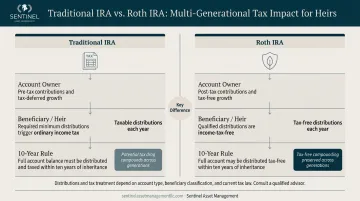
Heirs inheriting traditional IRAs face ordinary income tax on withdrawals. Under the SECURE Act, most non-spouse beneficiaries must withdraw the entire inherited IRA within 10 years, potentially pushing them into higher tax brackets during their peak earning years.
Strategically converting traditional IRA assets to Roth IRAs during your lower-income years reduces the lifetime tax burden across generations — not just for you, but for your heirs who will inherit tax-free Roth assets instead.
Family Limited Partnerships (FLPs)
Beyond account-level planning, structural tools like FLPs let you transfer business interests or investment assets while maintaining management control. Valuation discounts — applied for lack of control and lack of marketability — can meaningfully reduce the taxable value of transferred interests.
The IRS scrutinizes FLPs closely, though. A structure can unravel if it lacks:
- A legitimate non-tax business purpose
- Clear separation between the grantor's personal use and partnership assets
- Genuine economic substance beyond estate reduction
Any of these gaps can result in the full asset value being pulled back into the taxable estate — negating the strategy entirely.
Planning for Every Heir: Special Needs and Blended Families
Special Needs Trusts (SNTs)
Families with a child or dependent who has special needs require a special needs trust to preserve eligibility for government benefit programs like Medicaid and Supplemental Security Income (SSI). The 2026 SSI resource limit is strictly $2,000 for an individual and $3,000 for a couple.
Leaving assets directly to a special needs dependent can disqualify them from essential benefits — even when the intent is generous. A properly drafted SNT preserves eligibility by exempting trust assets from resource counting. The trust must include a mandatory Medicaid payback provision upon the beneficiary's death to maintain that protection.
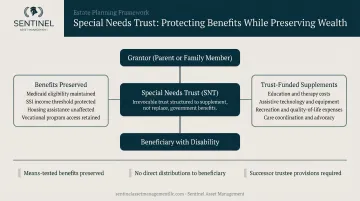
Sentinel Asset Management has spent 25 years working alongside families navigating these decisions, supporting more than 20 families long-term in building financial structures that protect both government benefit eligibility and long-term care access.
Blended Family Complexity
Approximately 16% of U.S. children live in blended families — households with a stepparent, stepsibling, or half-sibling. This creates competing beneficiary interests and increased risk of disputes.
A Qualified Terminable Interest Property (QTIP) trust addresses this directly. It allows the grantor to:
- Provide income to a surviving spouse for life
- Preserve the principal for children from a prior marriage
- Qualify for the marital deduction, deferring estate taxes, while retaining control over who ultimately receives the assets
For any non-traditional family structure, the default rules of intestacy (dying without a will) are unlikely to reflect actual wishes. Without a deliberate plan in place, the law decides — and it rarely accounts for the relationships and intentions that matter most.
Common Mistakes in Legacy Planning
Neglecting Values, Communication, and Heir Preparation
Many legacy plans focus entirely on financial instruments and overlook what actually determines whether transferred wealth is used wisely: values, family communication, and heir preparation. Education and transparency are what create responsible stewards — the legal documents just carry the intent.
Creating a Plan and Never Revisiting It
Major life events — marriage, divorce, births, deaths, and significant changes in tax law — all require a plan review. Industry standards recommend reviewing estate plans every 3-5 years or immediately following major life events.
Without periodic reviews, your plan quietly drifts out of sync with your life. Common consequences include:
- Beneficiary designations that no longer reflect your wishes
- Tax strategies that have become inefficient or obsolete
- Family dynamics that the plan no longer accounts for
Leaving Digital Assets Without Instructions
48% of Americans have no instructions for their digital accounts when they die. Online accounts, digital investments, cryptocurrency, intellectual property, and even social media profiles have real or sentimental value that must be accounted for in a modern legacy plan.
The Revised Uniform Fiduciary Access to Digital Assets Act (RUFADAA) — adopted by 46 states and Washington D.C. — provides a legal framework for fiduciaries to access these assets, but generally requires explicit consent in a will, trust, or power of attorney. Without this, fiduciaries may be legally blocked from accessing a decedent's digital legacy.
Frequently Asked Questions
What is a legacy blueprint?
A legacy blueprint is a coordinated, documented plan that outlines not only how assets are distributed but also the values, intentions, and financial structures that guide what happens to your wealth. Heirs receive clear direction on your wishes and the reasoning behind them — not just a list of assets.
What are examples of a legacy strategy?
Common examples include:
- Establishing a donor-advised fund to support a lifelong charitable cause
- Creating a family mission statement to guide how inherited wealth is used
- Setting up an educational trust or 529 plan for grandchildren's college tuition
What is the difference between a will and a legacy plan?
A will is one legal document within a broader legacy plan. It directs asset distribution at death but does not address values, tax efficiency, charitable goals, heir education, or family governance — all of which a full legacy plan encompasses.
When should you start legacy planning?
Start when you have dependents, meaningful assets, or a defined sense of what you want your wealth to accomplish. No minimum threshold applies. Starting earlier opens more options for tax-efficient strategies and gives you time to prepare heirs.
How do you pass on values to future generations?
Write an ethical will or legacy letter documenting your values and life lessons. Host family meetings with your advisor to discuss how inherited wealth aligns with those values. A family mission statement or shared charitable practice can reinforce both across generations.
What is an ethical will?
An ethical will is a personal document — not legally binding — in which you record the values, life lessons, and hopes you want to pass on to your heirs. It is one of the most meaningful non-financial elements of a complete legacy plan.
Take the next step in your financial journey by exploring our courses page for upcoming live seminars.