
General information, not personalised tax, legal or investment advice.

This guide serves as both a practical timeline checklist and a broader financial planning resource. You'll learn how your Maryland pension is calculated, which forms to file and when, how to layer Social Security and personal savings on top of your pension, and what Maryland-specific tax and healthcare rules mean for your retirement income. By the end, you'll have a concrete action plan for the 12-36 months leading up to your retirement date.
Key takeaways: Maryland State Retirement Checklist at a Glance
- 1–3 years out: Register for mySRPS and request a benefit estimate (Form 9 or online portal)
- 12 months out: Purchase prior service credit (Form 26) and claim military credit (Form 43)
- 6 months out: Meet with the State Retirement Agency and a financial advisor to confirm your benefit options
- File your retirement application (Form 13/23), direct deposit form (Form 85), and tax withholding forms 2 months before your retirement date
- Submit your formal resignation letter to your employer 1 month before your retirement date
Understanding Your Maryland State Pension Benefits
Which System Covers You?
The Maryland State Retirement and Pension System (MSRPS) is not a single plan—it's a collection of systems covering different employee groups:
- Employees' & Teachers' Retirement System: Covers state and municipal employees, public school personnel, and affiliated university staff enrolled before January 1, 1980
- Employees' & Teachers' Pension System: Covers regular state employees, appointed/elected officials, and educational staff enrolled after 1980
- Correctional Officers' Retirement System (CORS): Covers state correctional officers and local detention center officers of participating counties
Your retirement benefits, eligibility rules, and vesting requirements depend entirely on which system you belong to and when you were enrolled.
How Your Pension Is Calculated
Your monthly pension benefit is determined by this formula:
Average Final Compensation × Years of Creditable Service × Benefit Multiplier
Average Final Compensation (AFC) is the average of your highest-earning consecutive years:
- Pre-July 1, 2011 members: Highest 3 consecutive years
- Post-July 1, 2011 members: Highest 5 consecutive years
Benefit multipliers vary by system and enrollment date:
| System | Enrollment Period | Multiplier |
|---|---|---|
| Retirement System | Pre-1980 | 1.818% per year |
| Pension System (ACPS) | Pre-July 1, 2011 | 1.2% for service before 6/30/1998 + 1.8% after |
| Pension System (RCPB) | On/After July 1, 2011 | 1.5% per year |
| CORS | All eras | 1.818% per year |
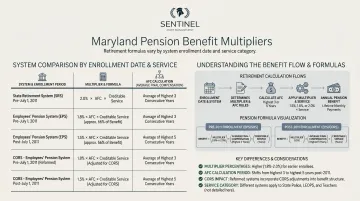
Example: If you're a post-2011 Pension System member retiring with $70,000 AFC and 25 years of service, your annual pension would be $70,000 × 25 × 1.5% = $26,250 (or $2,187.50/month).
Vesting Requirements
Vesting determines whether you're entitled to a pension at all:
- Enrolled before July 1, 2011: 5 years of eligibility service required
- Enrolled on or after July 1, 2011: 10 years of eligibility service required
Once vested, you can choose between a vested deferred retirement (receive benefits starting at a future age after leaving employment) or an immediate retirement (receive benefits immediately upon meeting age and service criteria).
Once you know you're eligible, the next—and most permanent—decision you'll make is how to receive your pension. This choice cannot be reversed after your first payment is issued.
The Six Payment Options
MSRPS offers a Basic Allowance and six optional payment structures. Choose carefully: this election is locked in once your first payment becomes due.
Single-Life Options:
- Basic Allowance: Pays the maximum monthly amount for your lifetime; nothing continues to beneficiaries at death
- Option 1: Slightly lower benefit; guarantees your beneficiaries receive the full present value if you die early
- Option 4: Reduced benefit; guarantees your beneficiaries recover your employee contributions at death
These options work best when you have no dependents relying on your income or have other assets designated for a surviving spouse.
Dual-Life Options (Survivor Protection):
- Option 2: Lower monthly benefit; your survivor receives 100% of your payment for their lifetime
- Option 3: Moderate reduction; your survivor receives 50% of your payment for their lifetime
- Option 5: Lower benefit with a "pop-up" — pays 100% to your survivor, but jumps back to the Basic Allowance rate if your survivor dies before you
- Option 6: Moderate reduction with a "pop-up" — pays 50% to your survivor, reverts to Basic Allowance if survivor predeceases you
Important: Options 2, 3, 5, and 6 require proof of birth for your designated beneficiary, who cannot be more than 10 years younger than you unless they are your spouse or disabled child.
Your Maryland Retirement Checklist: A Timeline
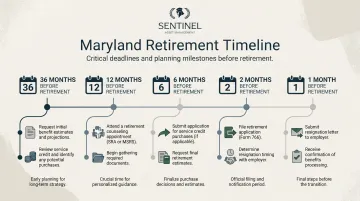
1-3 Years Before Retirement
Register for mySRPS
If you haven't already, create your account at sra.maryland.gov. The portal gives you access to:
- Real-time benefit estimates
- Service credit history
- Beneficiary updates
- Account statements
Starting early allows time to identify and correct errors in your service records before they delay your retirement.
Attend Pre-Retirement Education
The State Retirement Agency offers pre-retirement webinars each spring and fall. Between sessions, use the mySRPS benefit estimator to:
- Model different retirement dates
- Test salary assumptions
- Compare beneficiary options
Running multiple scenarios early helps you spot problems before they become urgent.
12 Months Before Retirement
Request a Formal Benefit Estimate
Submit Form 9 (Service Retirement Estimate Request) to receive a written estimate by mail (allow 6 weeks), or generate one instantly through mySRPS. Request estimates for all six payment options so you can compare the actual dollar differences.
Claim Prior Service and Military Credit
File these forms at least 12 months out:
- Form 26 (Request to Purchase Previous Service): Claim credit for eligible prior employment or leave
- Form 43 (Claim of Retirement Credit for Military Service): Add creditable service for qualifying military duty
Delaying reduces the time you benefit from the added service credit, so act early.
6 Months Before Retirement
Schedule SRA Counseling
Call the State Retirement Agency at 410-625-5555 or 1-800-492-5909 to schedule a counseling appointment. Bring your latest benefit estimate. Family members and beneficiaries are welcome to attend.
Confirm Health Insurance Continuation
Contact your HR/personnel office to determine whether employer-provided health insurance can continue into retirement and what enrollment deadlines apply. This is handled by your employer, not the SRA.
Meet with a Financial Advisor
Use this window to build a comprehensive retirement income budget. Compare your expected pension income, Social Security, and personal savings against projected retirement expenses.
A fee-only fiduciary advisor can help you sequence these income sources effectively. Sentinel Asset Management (Bethesda, MD) specializes in coordinating pension benefits, Social Security timing, and investment withdrawals for Maryland retirees — with 2,000+ clients guided through this transition.
2 Months Before Retirement
File Your Retirement Application
Submit Form 13/23 (Application for Service or Disability Retirement) to your personnel office. You'll need to:
- Select your payment option (this is your last chance to choose)
- Designate beneficiaries
- Provide proof of birth for beneficiaries under Options 2, 3, 5, or 6
Complete Mandatory Banking and Tax Forms
File these forms simultaneously:
- Form 85 (Direct Deposit Authorization): Mandatory for all retirees; failure to submit can suspend benefits
- Form W-4P (Federal Tax Withholding): Set federal withholding rate
- Form 766.11 (Maryland State Tax Withholding Request): Set state withholding rate
Acknowledge Reemployment Rules
Complete Form 127 (Reemployment After Retirement) to acknowledge the earnings rules that apply if you return to work for a participating employer.
1 Month Before Retirement
Submit Your Resignation Letter
Provide a formal, written letter of resignation/retirement to your employer. Confirm the notice period required by your specific agency or department and keep a copy for your records.
Beyond the Pension: Building a Complete Retirement Income Plan
The Three-Legged Stool
Most Maryland state retirees rely on three primary income sources:
- State Pension: Guaranteed monthly income for life
- Social Security: Federal retirement benefit
- Personal Savings/Investments: IRAs, 401(k)s, taxable accounts
Relying solely on your pension without coordinating the other sources can create cash flow shortfalls, especially in early retirement when expenses—travel, home projects, healthcare—tend to be higher.
Social Security Coordination
Maryland state retirees can file for Social Security as early as age 62, but timing this decision has enormous consequences:
- Age 62: Receive 70% of your full benefit
- Full Retirement Age (67 for those born in 1960 or later): Receive 100% of your full benefit
- Age 70: Receive 124% of your full benefit
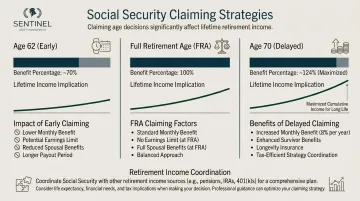
According to the Center on Budget and Policy Priorities, claiming at 62 versus waiting until 70 can result in a lifetime income difference exceeding $100,000 for an average earner.
Strategic coordination: If your pension covers essential expenses, you may have the flexibility to delay Social Security and capture the higher lifetime benefit. For most people, the breakeven point falls around age 78–82 — meaning if you expect to live past that, waiting typically pays off.
Structured Withdrawal Buckets
One effective strategy pairs your guaranteed pension income with a three-bucket investment approach:
- Near-term liquid reserves (1-3 years): Cash and money market funds to cover short-term needs
- Intermediate bonds/income assets (4-10 years): Investment-grade bonds and dividend-paying stocks
- Long-term growth assets (10+ years): Equities and growth-oriented investments
This structure protects you from being forced to sell equities during market downturns. Your pension provides a guaranteed income base, while your investment withdrawals are timed to avoid selling at losses.
Bridging the Retirement Income Gap
How much you draw from those buckets depends heavily on where in Maryland you live. Maryland's cost of living index sits at 117.4 — 17% above the national average. The income floor varies significantly by location:
- Statewide baseline: ~$53,949/year for a single adult (MIT Living Wage Calculator)
- Montgomery County: ~$60,901/year due to higher housing and healthcare costs (MIT Living Wage Calculator)
If your pension and Social Security fall short of your target income, investment accounts fill the gap. A comprehensive income plan quantifies that shortfall early and sequences withdrawals to cover it without depleting your portfolio prematurely.
Maryland-Specific Tax and Healthcare Considerations
Pension Taxation and Exclusion
Maryland taxes most pension income at the state level, but residents age 65 or older or who are totally disabled may qualify for a substantial exclusion:
- Maximum exclusion: $41,200 for tax year 2025 and $40,600 for 2026
- Qualifying income: Includes MSRPS pensions, 401(k)s, and 403(b)s (but not traditional IRAs or Keogh plans)
- Calculation: Total Social Security benefits received must be subtracted from the maximum exclusion amount
Maryland does not tax Social Security benefits — but higher Social Security income reduces your pension exclusion dollar-for-dollar, so the balance between the two matters for tax planning.
Medicare Transition
Most Maryland state retirees must enroll in Medicare Parts A and B at age 65, even if already retired. Medicare becomes the primary payer, and the State health plan automatically becomes secondary. If you fail to enroll when eligible, you're responsible for claims Medicare would have covered.
Part D Prescription Coverage requires separate action:
- The State does not provide prescription coverage for Medicare-eligible retirees
- You must enroll in a standalone Medicare Part D plan
- Retirees hired before July 1, 2011, and retired before January 1, 2020, may qualify for a State-funded Health Reimbursement Arrangement (HRA) to offset prescription costs
Action Step: Contact your employer's benefits office at least 6 months before turning 65 to understand your transition timeline and enrollment requirements.
Estate Planning and Beneficiary Alignment
When filing your MSRPS paperwork, simultaneously review:
- Your will and trust documents
- Beneficiary designations on all retirement accounts (IRAs, 401(k)s, life insurance)
- Account titling and ownership structures
Estate documents and account-level beneficiaries operate independently. If they conflict, assets may pass to unintended recipients. An estate planning professional can identify these conflicts before they become irreversible — account beneficiary designations override what's written in a will.
Key Forms Filing Checklist
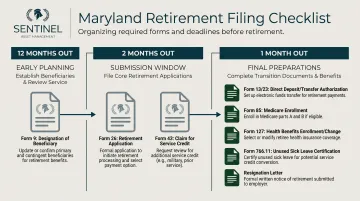
Filing the right forms at the right time is one of the most common retirement planning missteps. Use this table as your submission roadmap.
| Form | Purpose | Filing Deadline |
|---|---|---|
| Form 9 | Service Retirement Estimate Request | 12 months out |
| Form 26 | Request to Purchase Previous Service | 12 months out |
| Form 43 | Claim of Retirement Credit for Military Service | 12 months out |
| Form 13/23 | Application for Service or Disability Retirement | 2 months out |
| Form 85 | Direct Deposit Authorization (mandatory) | 2 months out |
| Form 127 | Reemployment After Retirement | 2 months out |
| Form 766.11 | Maryland State Tax Withholding Request | 2 months out |
| Resignation Letter | Formal written notice to employer | 1 month out |
Filing Accuracy Checklist
Errors or missing documents are the most common cause of processing delays. Before submitting any form:
- Verify your Social Security number is correct
- Read all explanatory information before signing
- Check whether notarization is required
- Confirm your retirement coordinator has signed where needed
- Keep copies of all submitted forms
- Include all required supporting documents (proof of birth, marriage certificates, etc.)
Contact Information
Submit completed forms directly to the Maryland State Retirement Agency by mail, in person, or through their online portal.
Maryland State Retirement Agency 120 East Baltimore Street Baltimore, MD 21202 Phone: 410-625-5555 or 1-800-492-5909 Website: sra.maryland.gov
Frequently Asked Questions
How long do I have to work for the state of Maryland to get a pension?
Vesting requirements depend on your enrollment date. If you were enrolled before July 1, 2011, you need 5 years of creditable service. If enrolled on or after July 1, 2011, you need 10 years. Once vested, you're entitled to either a vested deferred retirement (benefits starting at a future age) or an immediate retirement if you meet age and service criteria.
Can I retire at 60 and still get full state pension?
It depends on your system and enrollment date. Pre-1980 members can retire unreduced at 60 or with 30 years of service; Pre-2011 Pension members qualify at 62 with 5 years or 30 years of service; Post-2011 members need age 65 with 10 years or must satisfy the Rule of 90 (age + service = 90). Check the SRA website or speak with a counselor to confirm your specific eligibility.
How much money do you need to retire comfortably in Maryland?
Maryland's cost of living is roughly 17% above the national average, with significant variation by location. MIT's Living Wage Calculator estimates a single adult in Maryland needs approximately $53,949 annually, rising to $60,901 in Montgomery County. Your actual needs depend on housing costs, healthcare expenses, lifestyle goals, and whether you have a spouse or dependents.
Is $5,000 a month a good retirement income?
$5,000/month ($60,000/year) can be adequate in many parts of Maryland but may fall short in high-cost areas like Montgomery County, where the living wage for a single adult exceeds $60,900 annually. Whether it works for you depends on housing costs (own vs. rent), Medicare premiums, out-of-pocket healthcare, and long-term care needs — run a detailed budget against your specific situation.
What is the first thing to do before retiring?
Register for mySRPS at sra.maryland.gov and request a benefit estimate using Form 9 or the online portal. Reviewing your projected benefit 12-36 months out gives you time to adjust your retirement date, close savings gaps, and choose the right pension payment option — before those decisions become urgent.
Ready to build a comprehensive retirement income plan? Contact Sentinel Asset Management to speak with an advisor who specializes in Maryland state employee retirement planning. With Maryland offices in Bethesda and Rockville, Sentinel has guided 2,000+ clients into retirement and can help you coordinate your pension, Social Security, and personal savings into a resilient income strategy.
Take the next step in your financial journey by exploring our courses page for upcoming live seminars.