
General information, not personalised tax, legal or investment advice.

Introduction
Building wealth over a lifetime requires discipline, sacrifice, and careful planning. Losing a meaningful portion of it to taxes upon death—taxes that could have been legally minimized or avoided—is a preventable outcome. Estate tax planning is not reserved for the ultra-wealthy.
If you own a home, have retirement accounts, carry life insurance, or operate a business, your estate may face tax exposure you haven't accounted for—particularly at the state level, where thresholds can be far lower than federal limits.
This guide covers what estate taxes are, which types apply to your estate, proven strategies to reduce exposure, when to start planning, and how to take actionable first steps. Whether you're approaching state-level thresholds or planning multi-generational wealth transfer, understanding these strategies now can preserve hundreds of thousands—or millions—for the people and causes you care about.
Key takeaways:
- Federal estate tax hits 40% on estates above $13.99 million (2025); the exemption rises to $15 million in 2026
- Many states tax estates at much lower thresholds—Maryland at $5 million, Oregon at just $1 million
- Annual gifting, irrevocable trusts, charitable giving, and life insurance strategies reduce taxable estate value
- Estate planning should begin when net worth approaches state thresholds, often as low as $1–2 million
- Coordinating your financial advisor, estate attorney, and tax professional keeps strategies aligned
What Is Estate Tax Planning (and Why It Matters Now)
Estate tax planning is the process of structuring your assets, transfers, and legal documents in advance so that the maximum amount of wealth reaches your intended beneficiaries—not the IRS or state tax authorities. Done well, it gives you control over who receives what, when, and how—before those decisions get made for you.
How the Federal Estate Tax Works
The federal estate tax is levied on the transfer of property at death. It's calculated on your "gross estate"—the fair market value of everything you own or have an interest in at the time of death, including:
- Cash and investment accounts
- Real estate (primary residence, vacation homes, rental properties)
- Retirement accounts (401(k)s, IRAs, pensions)
- Business interests
- Life insurance death benefits
- Trusts where you retain control or benefit
- Personal property (vehicles, jewelry, collectibles)
After subtracting allowable deductions (debts, funeral expenses, charitable bequests, assets passing to a surviving spouse), what remains is your "taxable estate." If that amount exceeds the federal exemption threshold, the excess is taxed at rates up to 40%.
The 2025 and 2026 Federal Exemption
For 2025, the federal basic exclusion amount is $13,990,000. Following passage of the One Big Beautiful Bill Act (OBBBA) in 2025, the scheduled TCJA sunset was averted, and the exemption for 2026 will increase to $15,000,000.
Portability: A Critical Tool for Married Couples
Portability allows a surviving spouse to use any unused exemption from the first spouse to die—called the "deceased spousal unused exclusion" (DSUE). This effectively doubles the exemption for married couples without requiring complex trust structures.
To elect portability, the executor must file a complete and timely Form 706—even if no estate tax is owed. Under Revenue Procedure 2022-32, estates not otherwise required to file have up to five years from the date of death to make this election. Missing that window forfeits the benefit entirely.
Estate Taxes Are Not Just for the Ultra-Wealthy
Rising real estate values, accumulated retirement savings, life insurance proceeds, and business interests can push estates above state-level thresholds even when they fall well below the federal exemption. The federal cutoff may feel distant—but many states draw the line much lower.
State Tax Reality Check:
| State | 2025 Exemption | Portability Allowed? | Notes |
|---|---|---|---|
| Connecticut | $13,990,000 | No | Conforms to federal exemption but denies portability; requires bypass trust planning for married couples |
| Maryland | $5,000,000 | Yes | Exemption not indexed for inflation; also imposes inheritance tax |
| Oregon | $1,000,000 | No | Lowest state exemption in the US |
| Rhode Island | $1,802,431 | No | Indexed annually for inflation |
The table above illustrates why geography matters as much as net worth. According to the 2022 Federal Reserve Survey of Consumer Finances, mean household net worth for ages 65–74 is $1,780,720—above Oregon's exemption entirely, and approaching Maryland's threshold for many families with real estate and retirement assets combined.

The Types of Taxes That Affect Your Estate
Federal Estate Tax vs. Inheritance Tax
Estate tax comes out of the estate itself, before any assets reach your heirs. Inheritance tax, by contrast, falls on the beneficiary who receives the assets — and only certain states impose it, not the federal government.
As of 2025, five states impose an inheritance tax: Kentucky, Maryland, Nebraska, New Jersey, and Pennsylvania. (Iowa repealed its inheritance tax effective January 1, 2025.) Inheritance tax rates vary based on the beneficiary's relationship to the decedent:
- Lineal heirs (spouses, children, parents) are typically exempt or face lower rates
- Unrelated individuals face rates up to 15–16%
Maryland is the only state that imposes both an estate tax and an inheritance tax, making tax-efficient planning especially critical for Maryland residents.
Gift Tax and the Lifetime Exemption
Estate taxes don't operate in isolation from gifting. Gift taxes and estate taxes share a unified lifetime exemption — taxable gifts made during your lifetime reduce the exemption available at death, dollar-for-dollar.
2025 Gift Tax Rules:
- Annual gift tax exclusion: $19,000 per recipient (you can gift this amount to unlimited recipients each year without triggering gift tax or using your lifetime exemption)
- Lifetime unified exemption: $13,990,000 (shared between gift and estate taxes)
- Direct payments for tuition or medical expenses: Unlimited exclusion when paid directly to the institution or provider
Annual exclusion gifts let you move wealth out of your estate each year without touching your lifetime exemption. For a couple with three children and six grandchildren, gifting $19,000 per person removes $342,000 from the taxable estate annually — a meaningful reduction compounded over time.
Generation-Skipping Transfer (GST) Tax
Beyond gifting, families transferring wealth across multiple generations face a third layer of taxation. The GST tax applies when assets skip a generation — passing directly from grandparents to grandchildren, bypassing the parents entirely. It exists specifically to prevent high-net-worth families from sidestepping estate taxes at each generational transfer.
2025 GST exemption: $13,990,000 (mirrors the estate tax exemption)
GST tax rate: 40%
The GST exemption makes generation-skipping trusts worth serious consideration for families with significant assets. By allocating your exemption strategically to these trusts, you can benefit grandchildren — or even great-grandchildren — without triggering an additional 40% tax hit at each generational handoff. For families in Maryland or other high-tax states, layering GST planning with state-level strategies can make a substantial difference in what actually transfers.
Key Estate Tax Planning Strategies
No single strategy eliminates estate tax exposure on its own. The right approach depends on your estate size, liquidity position, family structure, and long-term goals — and most effective plans layer several of the tools below.
Annual Gifting
Systematic annual gifting (up to the $19,000 exclusion per recipient) removes assets from your estate each year without using any lifetime exemption.
Compounding effect example:
A couple with four children gifting $19,000 per child annually:
- Annual removal from estate: $152,000
- Over 10 years: $1,520,000
- Tax savings at 40% rate: $608,000
All appreciation on gifted assets also occurs outside your estate, compounding the tax benefit over time.
Irrevocable Trusts
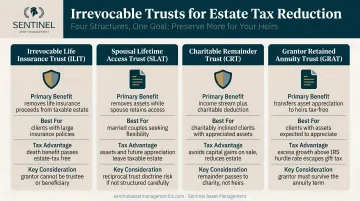
Irrevocable trusts are powerful estate tax reduction tools because assets transferred to them are removed from your taxable estate—if structured correctly.
Irrevocable Life Insurance Trust (ILIT):
Holds life insurance policies outside your estate by transferring "incidents of ownership" under IRC §2042. The death benefit passes to beneficiaries tax-free and provides liquidity to pay estate taxes without forcing asset sales.
Spousal Lifetime Access Trust (SLAT):
One spouse creates an irrevocable trust for the benefit of the other, using the lifetime exemption while maintaining indirect access to funds. Critical risk: The reciprocal trust doctrine—if spouses create substantially identical trusts for each other, the IRS may "uncross" them and pull assets back into the taxable estate.
Grantor Retained Annuity Trust (GRAT):
You transfer assets to the trust and retain an annuity payment for a term of years. The remainder passes to heirs. The gift value is discounted based on the retained interest, allowing tax-efficient transfer of appreciation.
Qualified Personal Residence Trust (QPRT):
Removes your home from the taxable estate at a discounted gift-tax value while allowing you to continue living there for a specified term. After the term, the home passes to beneficiaries.
Charitable Giving Strategies
Donating assets to qualifying charities reduces the taxable estate by the full value of the gift under IRC §2055.
Charitable Remainder Trust (CRT):
You transfer assets to the trust, retain an income stream for life or a term of years, and the remainder goes to charity. You receive an immediate estate tax deduction for the present value of the charitable remainder.
Donor-Advised Funds:
Allow you to make a charitable contribution, receive an immediate tax deduction, and recommend grants to charities over time—providing flexibility while reducing estate value.
Family Limited Partnerships (FLPs) and LLCs
Where charitable giving transfers assets outright, FLPs and LLCs take a different approach: restructuring ownership so assets can be transferred at a discount. Senior family members retain management control while shifting discounted ownership interests to heirs.
Valuation discounts:
- Lack of control (minority interest): Typically 20–30% discount
- Lack of marketability: Typically 20–35% discount
These discounts reduce the taxable value of transferred interests, making more efficient use of the lifetime exemption.
IRS scrutiny warning: The IRS aggressively attacks FLPs and LLCs under IRC §2036, pulling assets back into the gross estate if the decedent retained too much control. In Estate of Powell v. Commissioner (148 T.C. 392), the Tax Court included assets in the estate because the decedent retained the ability to dissolve the partnership. Structure these entities with legitimate business purposes and arm's-length transactions to withstand IRS challenge.
Using Life Insurance to Fund Estate Tax Obligations
Permanent life insurance held inside an ILIT provides tax-free liquidity to pay estate taxes—most critical for estates holding illiquid assets like closely held businesses or real estate, where a forced sale destroys value.
The liquidity problem is more severe than most families anticipate:
According to Joint Committee on Taxation data, estates electing IRC §6166 deferral for closely held businesses hold only 50 cents in liquid assets for every dollar of tax and debt liability.
Life insurance held in an ILIT bridges this gap — delivering cash precisely when it's needed, without triggering a liquidation of the assets you spent decades building.
When Should You Start Estate Tax Planning?
At What Net Worth Should You Do Estate Planning?
There is no single threshold. Anyone with dependents, real estate, retirement accounts, a business interest, or a desire to leave a legacy should have a basic plan (will, powers of attorney, healthcare directives).
Proactive tax-focused strategies become critical when net worth approaches state-level estate tax thresholds—which can be as low as $1 million in Oregon or $1.8 million in Rhode Island.
The 2026 Exemption Change and Planning Window
The federal exemption increased to $15 million for 2026 under OBBBA, giving more estates room to maneuver before tax exposure kicks in. That said, acting now—particularly through large gifts to trusts—locks in today's higher limits before any future law change reduces them again.
Tax law is just one reason to revisit your plan. Life changes just as often.
Estate Tax Planning Is Not a One-Time Event
Marriages, divorces, births, business sales, and shifting tax law all require plan review. Only 24–26% of Americans have a will as of 2025/2026, down from 33% in 2022. Among those who do update their wills, 62% did so within the last five years, primarily driven by family expansion or asset changes.
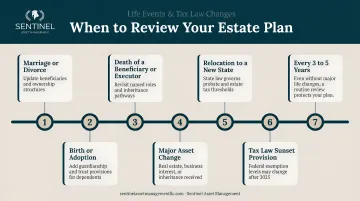
A plan written five years ago may already be out of step with your current assets, family structure, or the tax code — scheduling a review is the simplest way to find out.
Common Mistakes to Avoid in Estate Tax Planning
Even well-intentioned estate plans can fall short when key details are overlooked. These are the most common mistakes families make — and how to avoid them.
Failing to Account for State-Level Estate Taxes
Many families focus only on the federal exemption and are caught off guard by state estate taxes that apply at much lower asset levels.
Connecticut conforms to the federal exemption but does not allow portability between spouses, requiring bypass trust planning. Maryland taxes estates over $5 million and also imposes an inheritance tax.
Relying Solely on a Will
A will goes through probate, does not minimize estate taxes, and can be contested or delayed. A will is merely a set of instructions that must be validated by a probate court before assets can be distributed. Effective estate tax planning requires a coordinated set of trusts, beneficiary designations, and gifting programs — not a single document.
Not Updating the Plan After Major Life or Law Changes
An estate plan drafted years ago may reflect outdated exemption amounts, incorrect beneficiary designations, or assets that have significantly appreciated. Despite 73% of Americans stating that estate planning is personally important, 56% have no estate planning documents whatsoever. Even among those with plans, many fail to revisit them when it matters most.
Common triggers that warrant a plan review include:
- Marriage, divorce, or the death of a spouse
- Birth or adoption of a child or grandchild
- Significant changes in asset values or new acquisitions
- Major shifts in federal or state tax law
- Relocation to a state with different estate tax rules

How to Build Your Estate Tax Plan: A Step-by-Step Approach
Step 1 — Take Inventory of Your Gross Estate
List all assets and how they are titled:
- Bank and investment accounts
- Retirement accounts (401(k), IRA, pensions)
- Real estate (primary residence, vacation homes, rental properties)
- Business interests (S-corps, partnerships, LLCs)
- Life insurance death benefits
- Personal property (vehicles, jewelry, art, collectibles)
This establishes your planning baseline. Most people are surprised by how quickly values add up—especially when life insurance death benefits and retirement accounts are included.
Step 2 — Identify Your Goals and Beneficiaries
Clarify who you want to benefit, in what amounts, and under what conditions. Do you want:
- Equal distribution among children, or differentiated based on need?
- Outright transfers, or trusts that protect assets from creditors, divorce, or mismanagement?
- Charitable legacy alongside family bequests?
- Multi-generational planning that benefits grandchildren?
Your answers shape which strategies are most appropriate.
Step 3 — Map the Right Strategies to Your Situation
Not every strategy is appropriate for every estate. A financial advisor can model different scenarios (for example, annual gifting alone vs. gifting combined with an irrevocable trust) to quantify the tax savings and trade-offs of each approach.
Sentinel Asset Management coordinates the full financial picture — investments, tax efficiency, and legacy planning — so strategies work together rather than in isolation. The firm organizes assets across the three U.S. tax categories (taxable, tax-deferred, and tax-free) and develops strategies to support orderly transitions between them.

Much of this work involves reviewing titling, beneficiary designations, wills, and trusts for consistency and working directly with your accounts, insurance policies, and ownership structures to ensure plans reflect your actual intentions.
Step 4 — Assemble the Right Team and Review Regularly
A coordinated team — financial advisor, estate planning attorney, and tax professional — ensures that documents reflect the strategy, beneficiary designations are aligned, and the plan is updated as laws and life circumstances evolve.
With 100+ years of combined advisory experience and 2,000+ clients guided through retirement and legacy planning, Sentinel Asset Management helps families in CT, MD, and across the region navigate this process with confidence. The firm collaborates with estate attorneys when more complex instruments are needed, coordinates tax-efficient withdrawal sequencing and gifting strategies, and keeps the plan aligned with both your intentions and the people who matter most to you.
Frequently Asked Questions
How do you avoid estate tax?
Avoiding estate tax entirely depends on estate size and state of residence. The most common tools are annual gifting (up to $19,000 per recipient), irrevocable trusts, charitable giving, and portability elections for married couples—all of which reduce taxable estate value or use exemptions efficiently.
At what net worth should you do estate planning?
Basic estate planning (wills, beneficiary designations, powers of attorney) is recommended for any adult with assets or dependents. Tax-focused estate planning becomes relevant when net worth approaches state estate tax thresholds—which can be as low as $1–2 million in states like Connecticut and Maryland.
How is a house taxed when inherited?
Inherited property typically receives a "stepped-up basis" to its fair market value at the date of death under IRC §1014, meaning heirs generally owe no capital gains tax on appreciation that occurred during the original owner's lifetime. The home's full market value is included in the gross estate for estate tax calculations.
How to avoid capital gains tax on inherited property?
The stepped-up basis rule generally eliminates capital gains taxes on inherited property if sold shortly after inheritance. Selling well after the inheritance date, however, may trigger capital gains on any appreciation that occurred post-inheritance.
What are common mistakes to avoid in estate planning?
The top three: failing to plan for state estate taxes (which trigger at much lower thresholds than federal), relying only on a will without trust structures or updated beneficiary designations, and not revisiting the plan after major life events or tax law changes.
What are the 7 steps in the estate planning process?
- Inventory your assets and liabilities
- Identify your goals and beneficiaries
- Choose an estate structure (will, trusts, beneficiary designations)
- Select executors and trustees
- Minimize tax exposure through strategic tools
- Finalize and execute all legal documents
- Review the plan regularly as life and tax laws change
Take the next step in your financial journey by exploring our courses page for upcoming live seminars.