General information, not personalised tax, legal or investment advice.

Introduction
Taxes are one of the largest drags on long-term investment returns — far more than most investors realize. According to Morningstar research, the average U.S. equity product surrendered 2% of its pre-tax return to taxes over a three-year period. For a portfolio compounding over decades, that difference adds up to tens or hundreds of thousands of dollars in lost wealth.
In response to rising capital gains exposure, investors are adopting strategies to reclaim those lost returns. Tax-managed separately managed accounts surged 67% to over $500 billion by mid-2024, reflecting widespread recognition that what you keep matters more than what you earn. Tax-loss harvesting is one of the most direct tools driving that shift.
Most investors encounter it as a year-end checklist item. Its real value emerges when applied consistently throughout the year as part of an integrated strategy. This guide covers how it works, what it delivers, and how to use it as an ongoing discipline rather than a one-time fix.
Key takeaways
- Tax-loss harvesting uses realized investment losses to offset capital gains and reduce taxable income.
- Short-term offsets deliver the greatest immediate tax impact due to higher ordinary income tax rates.
- Excess losses can offset up to $3,000 of ordinary income annually, with unused losses carried forward indefinitely.
- Year-round application integrated with portfolio rebalancing produces better outcomes than a single year-end pass.
- High-income earners and retirement income planners benefit most, especially in years with significant gains or major asset sales.
What Is Tax-Loss Harvesting?
Tax-loss harvesting is the practice of selling investments that have declined in value to realize a capital loss, which can then be used to offset taxable capital gains or a portion of ordinary income — ultimately reducing the investor's tax bill for that year.
This strategy applies in taxable investment accounts (not tax-advantaged accounts like IRAs or 401(k)s) and involves any security — stocks, ETFs, mutual funds — that has decreased in value below its original purchase price (cost basis).
The goal is to put normal market volatility to work. When a position dips below its cost basis, selling it locks in a recognized loss for tax purposes — even if the broader portfolio remains on track. Those harvested losses translate directly into a lower tax bill, keeping more capital compounding in the portfolio over time.
Key Advantages of Tax-Loss Harvesting
The advantages below are tied to measurable financial outcomes — specifically, tax liability, after-tax wealth accumulation, and portfolio efficiency — rather than theoretical benefits that rarely materialize in practice.
Advantage 1: Reducing Capital Gains Tax in the Current Year
By selling an investment at a loss and using that loss to offset gains from other sold positions, an investor directly lowers the amount of capital gains subject to tax in the current year — and can also offset up to $3,000 of ordinary income if losses exceed gains.
How This Works in Practice:
An investor who realizes a $20,000 gain from selling appreciated stock can sell another position sitting at a $15,000 loss — reducing their taxable gain to $5,000. The proceeds from the sold position can then be reinvested in a comparable (but not substantially identical) security to maintain market exposure.
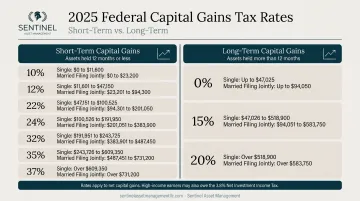
Offsetting short-term capital gains — which face ordinary income rates up to 37% federally — delivers the highest immediate tax savings.
Current Federal Capital Gains Tax Rates:
| Filing Status | 2025 20% LTCG Threshold | 3.8% NIIT MAGI Threshold |
|---|---|---|
| Single | Over $533,400 | Over $200,000 |
| Married Filing Jointly | Over $600,050 | Over $250,000 |
| Head of Household | Over $566,700 | Over $200,000 |
| Married Filing Separately | Over $300,000 | Over $125,000 |
Investors exceeding these thresholds face a combined top federal rate of 40.8% on short-term gains (37% ordinary income + 3.8% Net Investment Income Tax) and 23.8% on long-term gains (20% preferential rate + 3.8% NIIT).
Dollar-Value Tax Savings:
For a top-bracket investor subject to the NIIT:
- Offsetting $100,000 of short-term gains saves $40,800 in federal taxes
- Offsetting $100,000 of long-term gains saves $23,800 in federal taxes
- Difference: $17,000 in additional tax savings per $100,000 harvested
This advantage has the highest impact in years with significant realized gains from any source — stock sales, real estate, private equity distributions, or concentrated position liquidations.
Advantage 2: Compounding After-Tax Returns Over Time
Every dollar saved in taxes through harvesting losses is a dollar that stays invested — and over a long investment horizon, those retained dollars compound just like any other investment gain.
How TLH Creates Compounding Value:
When a loss is harvested and the tax savings are reinvested rather than paid to the IRS, the portfolio starts the next year with more capital working on its behalf. Carried-forward losses also act as a buffer against future gains — shielding future gains from taxation for years as the portfolio grows.
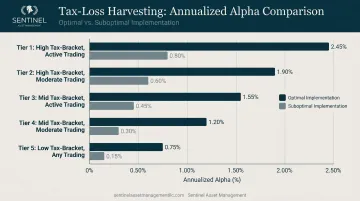
Vanguard research projects that systematic tax-loss harvesting generates an annualized after-tax "alpha" of 0.47% to 1.27% over a 15-year horizon, provided tax savings are reinvested. For a $1 million portfolio, that's between $4,700 and $12,700 in additional annual value — compounding year after year.
Estate Planning Enhancement:
Investors who plan to pass wealth to heirs may benefit even more. Under IRS rules, inherited assets receive a step-up in cost basis to their fair market value at the date of death. This eliminates the deferred tax liability entirely — converting temporary tax deferral from tax-loss harvesting into permanent tax elimination.
Sentinel Asset Management builds globally diversified, tax-efficient portfolios with this compounding effect as a core objective — coordinating harvesting, asset location, and estate planning to reduce lifetime tax liability across generations.
Advantage 3: Rebalancing Your Portfolio Without Triggering Added Tax Costs
Beyond compounding, tax-loss harvesting creates a practical, tax-efficient entry point for portfolio rebalancing — the process of selling overweighted positions and reallocating to underweighted ones. The realized losses offset the gains from selling outperforming assets, reducing or eliminating the tax drag typically associated with rebalancing.
How This Works in Practice:
When a position has declined and is sold to harvest the loss, the proceeds go directly to assets that better align with the investor's target allocation. This converts a paper loss into a deliberate rebalancing move — without the net tax cost rebalancing would normally generate.
For example, rebalancing a $10 million portfolio where realized gains amount to 50% of sale proceeds could create a $119,000 tax bill. Pairing rebalancing with tax-loss harvesting offsets these gains, maintaining desired risk exposure without immediate tax erosion.
This combination is most valuable after periods of significant market volatility, when portfolios drift furthest from their intended allocation. For retirement income planners specifically, it helps maintain the right risk exposure for withdrawal sequencing while keeping the portfolio tax-efficient through both accumulation and distribution.
What Happens When You Ignore Tax-Loss Harvesting
Investors who skip tax-loss harvesting pay full capital gains taxes on every profitable sale without offset. Over years of compounding returns and periodic rebalancing, those uncaptured losses translate into higher lifetime tax bills and a smaller investable portfolio base.
The Year-Round Opportunity Cost:
A reactive, year-end-only approach misses the intra-year harvesting opportunities created by normal market volatility. The S&P 500 averages a 14% intra-year drawdown, even in positive calendar years. Individual stocks experience even wider dispersion — in Q1 2025, 62% of S&P 500 stocks outperformed the benchmark, but this dropped to 29% in Q2 2025.
These intra-year dips represent harvesting windows for investors who monitor portfolios regularly.
The Broader Planning Risk:
Without TLH integrated into an ongoing strategy:
- Portfolio rebalancing triggers unnecessary taxable events
- Loss carryforwards go unused
- Investors lose flexibility to manage their taxable income bracket
- Coordinating Roth conversions, Social Security timing, and required minimum distributions in retirement becomes harder to optimize
These planning costs are quantifiable. Vanguard research shows that suboptimal TLH behavior (quarterly harvesting, no ongoing cash flows, commingled funds) yields a median 15-year annualized alpha of just 0.04% to 0.13%. Optimal behavior (daily scanning, direct indexing) yields 0.47% to 1.27%.
How to Get the Most Out of Tax-Loss Harvesting
Apply the Strategy Year-Round, Not Just in December
Because individual securities experience losses throughout the year regardless of overall market direction, monitoring for harvesting opportunities on an ongoing basis — rather than scrambling at year-end — captures more value.
Research comparing continuous monitoring to periodic approaches has found materially more tax savings for investors who review portfolios more frequently. Daily or weekly monitoring enables capture of temporary market dips that vanish during recoveries.
Master the Wash Sale Rule Before Executing
The IRS disallows a harvested loss if the investor repurchases the same security or a "substantially identical" one within 30 days before or after the sale — a 61-day window known as the wash sale rule.
How to Maintain Market Exposure:
To avoid triggering the wash sale rule while staying invested, replace the sold position with a comparable but distinct security. Switching from one large-cap ETF to a similar but non-identical one in the same sector is a common approach.
This requires careful planning, particularly for investors with employer stock vesting schedules or automated dividend reinvestment. Studies show wash-sale constraints reduce annualized tax alpha from 1.08% to 0.82%.
Prioritize Short-Term Losses Strategically
You must first offset gains of the same type — short-term against short-term, long-term against long-term. Excess losses of one type can then offset the other. Because short-term gains are taxed at the highest rates, prioritizing short-term losses delivers the largest immediate tax reduction.
IRS Loss Ordering Rules:
- Short-term losses must first offset short-term gains
- Long-term losses must first offset long-term gains
- Any excess losses can then cross over to offset gains of the other type
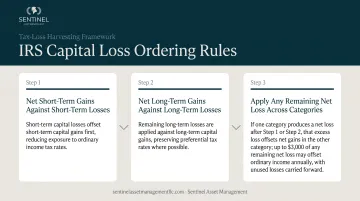
For a high-income earner in the 37% bracket, misapplying this order can mean losing the benefit of offsetting short-term gains that would otherwise be taxed nearly twice as heavily as long-term ones.
Work with a Financial Advisor Who Coordinates TLH Within Your Full Financial Picture
Applying these rules correctly is one thing. Coordinating them across your full financial picture — retirement income planning, withdrawal sequencing, tax-bracket management, and estate considerations — is where the real compounding value comes from.
Sentinel Asset Management integrates tax-loss harvesting into each client's broader financial plan. Every portfolio is guided by an Investment Policy Statement, stress-tested under different market conditions, and monitored continuously. Harvesting decisions are weighed against:
- Roth conversion timing and tax-bracket positioning
- Multi-account withdrawal sequencing
- Income needs and near-term cash flow requirements
- Estate and legacy planning objectives
By managing where assets are held and when gains are realized, advisors ensure that tax savings compound as part of a purposeful strategy, not a reactive one.
Conclusion
Practiced consistently and coordinated with a broader financial plan, tax-loss harvesting does more than reduce your annual tax bill. It preserves investable capital, compounds returns more efficiently, and keeps your portfolio working harder across every market cycle.
The investors who benefit most treat it as a living part of their strategy — reviewed regularly, executed with discipline, and integrated with retirement income planning, estate considerations, and risk management. If your current approach isn't addressing tax efficiency at this level, that's worth a conversation with a fiduciary advisor who sees the full picture.
Frequently Asked Questions
Is tax-loss harvesting a good strategy?
Yes — for most taxable investors, especially those with capital gains or high income, TLH is a proven tax-reduction strategy. Its value depends on the investor's tax bracket, the size of their gains, and whether it is applied consistently as part of a broader plan rather than sporadically.
Is tax-loss harvesting worth it for high income earners?
High-income earners benefit most from TLH because they face the highest capital gains tax rates — up to 20% federal for long-term gains, plus the 3.8% Net Investment Income Tax, plus state taxes. Every dollar of gains offset by harvested losses delivers a proportionally larger tax saving than it would for investors in lower brackets.
What is the $3,000 capital loss rule?
If an investor's capital losses exceed their capital gains in a given year, the IRS allows them to deduct up to $3,000 of the remaining losses against ordinary income ($1,500 if married filing separately). Any unused excess is carried forward to offset gains or income in future tax years indefinitely.
Do you get money back on your taxes when you tax-loss harvest?
TLH does not produce a direct tax refund — it reduces taxable gains or income, so the investor owes less for the year. This can increase a refund if withholding was set at a higher rate, but the core benefit is a lower tax bill.
Do brokerages and wealth managers offer tax-loss harvesting services?
Many brokerages and registered investment advisors offer TLH as part of their portfolio management services, ranging from automated tools at large brokerages to fully integrated, advisor-guided strategies. At Sentinel Asset Management, TLH is coordinated with the client's retirement income plan, tax situation, and long-term financial goals.
What does Warren Buffett say about tax-loss harvesting?
Buffett has expressed skepticism about tax-driven trading, preferring to hold great businesses and let compounding work undisturbed. Most financial professionals draw a clear line, though — strategically harvesting genuine losses within a disciplined portfolio is a distinct practice from trading purely to generate losses, and one that consistently adds value for investors.
Take the next step in your financial journey by exploring our courses page for upcoming live seminars.