
General information, not personalised tax, legal or investment advice.

Introduction
Most people know they should have an estate plan. But far fewer understand the role trusts play in making that plan work effectively—or that there are meaningfully different types designed for very different situations.
Despite 64% of Americans believing estate planning is important, only 32% have a will and just 13% use a living trust. This gap exposes families to probate that typically runs 6 to 16 months and erodes 3–8% of the estate's value.
This article explains the most common types of trusts used in estate planning, what makes each one distinct, and how to determine which one—or which combination—best fits your goals.
Key takeaways
- A trust lets you control how assets are managed and distributed during your lifetime and after death
- Beyond probate avoidance, trusts can shield assets, cut estate taxes, and protect eligibility for government benefits like Medicaid and SSI
- Key types to know: revocable living trusts, irrevocable trusts, testamentary trusts, special needs trusts, and charitable trusts
- The right choice depends on your assets, family situation, tax exposure, and legacy goals
- An estate attorney drafts the legal documents — a financial advisor ensures the trust fits your retirement income, tax, and legacy strategy
What Is a Trust in Estate Planning?
A trust is a legal arrangement in which a grantor transfers assets to a trustee, who manages those assets on behalf of one or more beneficiaries according to the terms the grantor sets. Three roles define every trust:
- Grantor (also called settlor or trustor): Creates the trust and transfers property to it
- Trustee: Holds legal title and administers trust property for the beneficiaries
- Beneficiary: Receives property or income from the trust

How a Trust Differs from a Will
A will takes effect only at death and goes through probate—a public, court-supervised process. Probate typically takes six to nine months and can extend to 16 months depending on complexity. The process consumes 3-8% of total estate value in costs.
A trust operates during the grantor's lifetime and sidesteps all of that. Once a will is probated, it becomes public record accessible to anyone, including creditors — trust terms, by contrast, remain entirely private.
Dispelling the "Only for the Wealthy" Myth
Those practical advantages — cost savings, speed, privacy — are why trusts make sense well beyond large estates. Anyone who wants more control over how assets reach loved ones can benefit, including:
- Homeowners with real estate to transfer
- Parents of minor children
- Families with a member who has special needs
- Anyone seeking privacy and probate avoidance
Types of Trusts for Estate Planning
Trusts are not one-size-fits-all. The right type depends on your specific goals—whether that's flexibility, asset protection, tax efficiency, or preserving a beneficiary's government benefits.
Revocable Living Trust
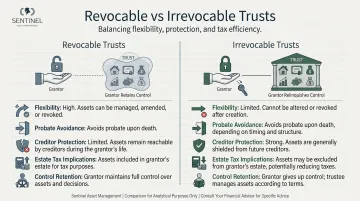
A revocable living trust is created during your lifetime and can be amended, updated, or dissolved at any point while you are alive. You typically serve as your own trustee initially, and a successor trustee takes over upon your death or incapacity.
Strengths of this structure:
- Avoids probate so assets transfer quickly and privately
- Allows you to maintain full control during your lifetime
- Includes instructions for managing assets if you become incapacitated
One key trade-off: because you retain control, assets in a revocable trust remain part of your taxable estate and are accessible to creditors. It offers flexibility but not asset protection.
If protection from creditors or estate tax reduction is a priority, an irrevocable structure may be the stronger choice.
Irrevocable Trust
Once established, an irrevocable trust generally cannot be changed or dissolved without beneficiary consent. The grantor formally removes ownership of the transferred assets, which become a separate legal entity.
This structure is built for protection:
- Assets are shielded from creditors and lawsuits
- Generally excluded from the grantor's taxable estate
- Preferred structure for high-net-worth individuals reducing estate tax exposure
- Commonly used in Irrevocable Life Insurance Trusts (ILITs) to keep life insurance proceeds out of the estate
Under IRC § 2042, life insurance proceeds are included in the gross estate if the decedent possessed any "incidents of ownership" at death. An ILIT avoids this by having the trust own the policy.
The trade-off is control. Once funded, assets cannot be freely accessed or redirected, and changes require legal process and beneficiary consent. Income tax treatment adds another layer of complexity — compressed tax brackets reach 37% on income over $16,000 in 2026, which matters for trusts generating significant income.
For families who don't need asset protection but want to control how and when assets reach beneficiaries, a testamentary trust offers a simpler path.
Testamentary Trust
A testamentary trust is established within a will and only takes effect after the grantor's death. It does not exist as a legal entity during the grantor's lifetime, meaning assets must still pass through probate before entering the trust.
This structure works well for parents who want to delay asset distribution to minor children until they reach a certain age or milestone — such as college graduation. It's a practical, lower-cost option when probate avoidance is not a priority. The downside: because it is will-based, trust terms become part of the public record and distribution may be delayed.
For families with a dependent who has a disability, a different trust structure is required — one designed specifically to protect government benefit eligibility.
Special Needs Trust
A special needs trust (also called a supplemental needs trust) provides financial support for a beneficiary with a physical or cognitive disability. Structured carefully, trust assets are not counted as personal assets of the beneficiary, preserving eligibility for government programs such as SSI, Medicaid, and other benefits.
Key strengths of this structure:
- Ensures a dependent family member is financially cared for without disqualifying them from essential public assistance
- Can be funded during the grantor's lifetime or through a life insurance policy
- Integrates with a broader financial and legacy plan when coordinated with a qualified advisor
There are two distinct types, and the difference has significant consequences:
First-Party Special Needs Trust: Funded with the beneficiary's own assets (e.g., from a legal settlement). Must be established before age 65 and requires Medicaid payback upon the beneficiary's death.
Third-Party Special Needs Trust: Funded by a parent or family member. No Medicaid payback required — remaining funds can pass to other family members.
In 2024, approximately 7.4 million people received federally administered SSI payments, with 84% eligible based on blindness or disability. Proper trust structure is essential for preserving these benefits.

Families navigating this planning often benefit from working with an advisor experienced in both the financial and benefit-eligibility dimensions — not just the legal structure alone.
Charitable Trust
Charitable trusts allow a grantor to donate assets to one or more charitable organizations in a tax-efficient way. Two structures are most common:
Charitable Remainder Trusts (CRTs) pay income to the grantor or beneficiaries for a set period before the remainder goes to charity. The remainder donated must be at least 10% of the initial net fair market value of the property.
Charitable Lead Trusts (CLTs) pay income to charity first and then pass remaining assets to heirs.
CRTs provide a partial charitable deduction upfront along with an income stream during the grantor's life. CLTs can reduce gift and estate taxes on assets passed to heirs. Both are irrevocable, so they suit donors with clear giving goals and a stable financial picture.
Which Trust Fits Your Situation?
Rather than choosing a trust based on what sounds most sophisticated, start by identifying the specific outcome you need—probate avoidance, asset protection, tax reduction, caring for a dependent, or charitable giving.
For Those Prioritizing Control and Simplicity
A revocable living trust is the most widely used starting point. It keeps your estate private, avoids probate, and can be updated as your life changes. If your primary concern is ease of transfer rather than asset protection, this is typically the right choice.
For Those with Significant Assets or Liability Exposure
An irrevocable trust provides stronger protection—particularly relevant for professionals in high-liability fields or individuals with estates likely to exceed estate tax thresholds.
The 2026 federal estate tax exemption is $15,000,000 per individual. However, 12 states and D.C. impose state-level estate taxes at much lower thresholds—Oregon at $1,000,000, Massachusetts at $2,000,000, and New York at $7,160,000.
For Parents of Children with Disabilities
A special needs trust is often essential to balance financial support with government benefit eligibility. Funding the trust through a life insurance policy is a common and effective approach—one that Sentinel Asset Management has helped implement for families with special needs for over 25 years. Coordinating the trust structure with your broader retirement and estate plan ensures benefits eligibility isn't compromised as financial needs evolve.
For Families with Complex Dynamics
Blended families, second marriages, and charitable intent often require combinations of trust types. Common pairings include:
- A revocable living trust combined with a testamentary trust for minor children
- A QTIP trust in second marriages to balance spousal support with children from a prior relationship
- A charitable remainder trust (CRT) for donors who want lifetime income alongside a charitable legacy
Key Factors to Consider Before Choosing a Trust
Your Estate's Size and Tax Exposure
The 2026 federal estate tax exemption is $15,000,000 per individual. Estate size relative to this threshold should influence whether an irrevocable structure is warranted.
State-level estate taxes vary significantly:
- Oregon: $1,000,000 exemption, 10–16% tax rate
- Massachusetts: $2,000,000 exemption, 0.8–16% tax rate
- New York: $7,160,000 exemption, 3.06–16% tax rate
- Connecticut: $13,990,000 exemption (matches federal), 12% flat rate

Who Your Beneficiaries Are and Their Circumstances
The right trust structure depends heavily on who you're protecting. Common scenarios that call for different approaches include:
- Minor children: Require a trustee to manage assets until they reach a specified age
- Adults with disabilities: Often need a Special Needs Trust to preserve eligibility for government benefits
- Blended families: May require separate trusts to protect a surviving spouse while preserving assets for children from a prior relationship
- Financially independent adult heirs: Can receive distributions under simpler, more flexible terms
Whether Flexibility or Protection Matters More
Revocable trusts offer maximum flexibility but minimal legal protection. Irrevocable trusts offer strong protection but require a permanent transfer of control. As a general rule: if retaining control over assets matters most, a revocable structure fits better. If shielding assets from creditors, estate taxes, or Medicaid lookback periods is the priority, irrevocable is the more appropriate path.
Common Mistakes to Avoid When Setting Up a Trust
Failing to Fund the Trust
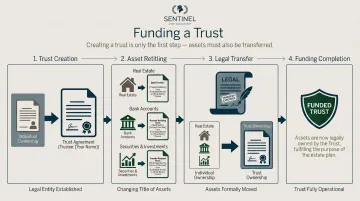
A trust that has been created but not funded—meaning assets have not been legally retitled into the trust—does nothing. This is one of the most common and costly oversights.
Funding means physically retitling assets from your name into the trust's name — such as executing a new deed for real estate or updating bank account ownership records. Without this step, intended trust assets pass through probate instead.
Choosing the Wrong Trust Type for the Goal
Selecting a trust based on what sounds most protective — such as defaulting to an irrevocable trust — when a simpler revocable trust would better serve the actual goals is a common mismatch. The reverse happens too. Beyond the initial choice, trust documents also need to be revisited as family circumstances evolve:
- A new child or grandchild may need to be added as a beneficiary
- A divorce can make an existing trustee designation inappropriate
- Changes in asset value may shift whether certain tax-advantaged structures still apply
Not Coordinating the Trust with the Broader Financial Plan
A trust does not exist in isolation—it must align with beneficiary designations on retirement accounts, life insurance policies, and investment accounts. Failing to update these designations to reflect the trust's existence can result in assets bypassing the trust entirely.
Assets controlled by beneficiary designations pass automatically at death to the named beneficiary, entirely outside the trust. Without this alignment, even a well-drafted trust may fail to capture the assets it was designed to protect.
Conclusion
Trusts are one of the most powerful tools in estate planning. They give you specific control over how, when, and to whom your assets are transferred—flexibility that a will alone simply cannot provide.
The right trust depends entirely on your goals, family circumstances, and financial situation. That decision works best when made as part of a coordinated estate and financial plan—one that accounts for your tax situation, income needs, and the people depending on you.
A few questions worth bringing to that conversation:
- What do you want your assets to do—and for whom?
- Do you need flexibility, or is locking in terms an advantage?
- Are there tax, Medicaid, or special needs considerations in play?
- Who will serve as trustee, and are they equipped for the role?
At Sentinel Asset Management, estate and legacy planning is built into the broader financial picture—not treated as a separate legal exercise. If you're weighing trust options, starting with a clear financial plan makes the legal decisions simpler and more purposeful.
Frequently Asked Questions
What type of trust is best for estate planning?
There is no single best trust. Revocable living trusts are the most widely used for their flexibility and probate avoidance, while irrevocable trusts are better for asset protection and estate tax reduction. The right choice depends on individual goals.
What is the difference between estate planning and a trust?
Estate planning is the broader process of deciding how your assets will be managed and distributed. A trust is one specific legal tool within that process, alongside wills, beneficiary designations, and powers of attorney.
How do trusts avoid estate taxes?
Irrevocable trusts remove assets from the grantor's taxable estate. Since the grantor no longer legally owns the assets, they are not counted when calculating estate tax liability. Revocable trusts do not provide this benefit.
Does a trust affect SSDI?
A properly structured special needs trust generally does not affect SSDI eligibility, as SSDI is based on work history rather than assets. However, SSI is means-tested, and a special needs trust must be carefully drafted to avoid disqualifying a beneficiary from SSI or Medicaid.
What assets cannot be placed in a trust?
Retirement accounts (IRAs, 401(k)s) cannot be owned by a trust while the account owner is living. Assets with existing beneficiary designations, health savings accounts, and Social Security benefits are also generally excluded — they transfer under their own beneficiary rules and should be coordinated with your trust plan separately.
What is the biggest mistake parents make when setting up a trust fund?
The most common mistake is creating the trust but never funding it. Other frequent errors include failing to update it after major life events and not aligning the trust terms with the family's real financial situation and goals.
Take the next step in your financial journey by exploring our courses page for upcoming live seminars.