General information, not personalised tax, legal or investment advice.

Introduction
Most families equate legacy planning with transferring wealth—real estate, retirement accounts, brokerage portfolios. A complete plan goes further than that.
It also covers the values that guide decision-making, governance structures that prevent family conflict, philanthropic intentions, and preparing the people who will actually receive what you've built.
Leaving a financial inheritance without the "why" behind it leads to court disputes, lost wealth, and missed opportunities. 42% of Americans wouldn't know what to do if a family member died today, and 26% of families regret spontaneous wealth discussions. Without a structured plan, good intentions rarely survive the transition.
This guide will explain what family legacy planning is, its core components, the legal and tax strategies that protect it, how to bring heirs into the conversation, and when to review your plan. Whether you're beginning this process or updating an existing structure, the goal is the same: ensuring your wealth, values, and intentions carry forward to the people and causes that matter most.
Key takeaways
- Family legacy planning transfers wealth, values, and wishes across generations—not just assets
- 56% of Americans still lack basic estate planning documents despite recognizing its importance
- The 2025 One, Big, Beautiful Bill locked in a $15 million federal estate tax exemption for 2026, creating new opportunities
- Beneficiary designations override wills—outdated forms can misdirect hundreds of thousands
- Without trusts, gifting strategies, and heir preparation, even well-built wealth can erode—or fracture family relationships
What Is Family Legacy Planning?
Family legacy planning is the deliberate process of deciding how your wealth, values, and wishes will be preserved and transferred to future generations. It's distinct from basic estate planning—wills and beneficiary forms—because a true legacy plan addresses not just what transfers, but when, to whom, under what conditions, and crucially, why.
The Stakes of Incomplete Planning
Failing to establish a comprehensive legacy plan exposes families to court interventions, unnecessary costs, and misdirected assets.
When individuals die without a will (intestate), state laws dictate asset distribution, removing family control entirely. Even with a will, estates face probate. The average estate completes probate in six to nine months, with typical costs starting at $1,500—but escalating dramatically if the will is contested.
Outdated beneficiary designations are equally dangerous. A documented estate plan cannot override beneficiary designations on retirement accounts or life insurance. In the 2009 Supreme Court case Kennedy v. DuPont, a decedent's $400,000 savings plan was paid to his ex-wife—despite a divorce decree waiving her rights—because he never updated the plan's beneficiary forms. The Court ruled plan documents supersede divorce decrees and wills.
A legacy plan is not a one-time event—it evolves with your family, your finances, and shifts in tax law. Common triggers for reviewing your plan include:
- Marriage or divorce
- Birth of a child or grandchild
- Death of a named beneficiary or executor
- Business sale or major asset change
- Relocation to a new state
- Significant legislative changes to estate or tax law
The Three Types of Family Legacy
Financial Legacy
The financial legacy covers the transfer of assets—real estate, investments, retirement accounts, business interests, life insurance—and the legal structures and tax strategies that govern how those assets move to heirs.
According to Cerulli Associates, the "Great Wealth Transfer" will see $124 trillion transferred through 2048. Of this total, $105 trillion is expected to flow to heirs, while $18 trillion will go to charity. Nearly $100 trillion will transfer from Baby Boomers and older generations.
According to the Federal Reserve's 2022 Survey of Consumer Finances, 14.6% of families owned business equity, with nearly half of the top decile owning a business. Asset allocation also varies sharply by generation: younger investors (21–43) allocate 31% to real estate, 28% to crypto/digital assets, and 26% to private equity, whereas older investors allocate 41% to U.S. stocks and 32% to real estate.

Yet financial assets are only one part of what a family passes down.
Values and Traditions Legacy
The non-financial legacy documents family values, life lessons, and traditions through personal letters, ethical wills, recorded messages, or governance frameworks like family mission statements and regular family meetings.
This dimension gives future generations context for the wealth they receive. When asked what will be most meaningful, 41% of Americans say memories and relationships—outranking financial assets (22%) and property (22%).
Without this layer, heirs receive assets but not the judgment to steward them well.
Philanthropic Legacy
Charitable giving extends your values beyond immediate heirs. Families can structure philanthropic legacies through:
- Donor-Advised Funds (DAFs)
- Charitable Remainder Trusts
- Private Foundations
- Bequest language in estate documents
DAFs held $251.52 billion in charitable assets in 2023 and distributed $54.77 billion in grants. Charitable bequests totaled $45.84 billion in 2024, representing a consistent 7–9% of total U.S. giving over four decades.
Involving heirs in these decisions early also builds the kind of financial judgment that transfers better than any dollar amount.
Key Steps to Build Your Family Legacy Plan
Step 1 — Define Your Vision and Goals
Before selecting any legal structure or tax strategy, articulate what you actually want your legacy to accomplish.
Questions to Consider:
- Who gets what assets and when?
- Are there heirs with unique needs—minor children, family members with disabilities, spendthrift beneficiaries?
- What values or causes are most important to carry forward?
- What conflicts could arise among beneficiaries and how can structure prevent them?
Clarity on these questions drives every subsequent decision.
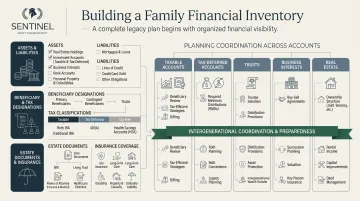
Step 2 — Create a Complete Personal Financial Inventory
Document all income sources, assets, and liabilities:
Assets:
- Cash, qualified and non-qualified investments
- Real estate and business interests
- Life insurance policies
Critical Details:
- Account numbers and titling details
- Beneficiary designations
- Location of key documents
- Tax category (taxable, tax-deferred, tax-free)
Many estate planning decisions can be informed by this inventory before ever engaging an attorney. This organizational work establishes clarity about what you own, how it's titled, who should receive it, and what tax implications exist.
Step 3 — Select the Right Legal Structures
Core Documents Every Legacy Plan Needs:
- Will
- Durable Power of Attorney
- Healthcare Directive
- Updated Beneficiary Designations
When Trusts Become Necessary: Trusts are essential for controlling distributions over time, protecting heirs from creditors, avoiding probate, or addressing estate tax exposure. The right combination of documents depends entirely on family circumstances.
Step 4 — Address Special Planning Circumstances
Not all families have the same structure. Specific scenarios require customized planning approaches:
Families with Special Needs: A Special Needs Trust preserves government benefit eligibility while providing supplemental financial support. Sentinel Asset Management has spent 25 years guiding 20+ families through these complex scenarios, coordinating with attorneys and care planners to get the details right.
Business Owners: Succession planning requires addressing ownership transfer, valuation, tax minimization, and leadership transition — often simultaneously.
Blended Families and High-Net-Worth Households: Specific trust structures protect biological children's inheritance across multiple marriages, while families with estate tax exposure require coordinated use of exemptions, trusts, and gifting strategies.
Step 5 — Assemble a Coordinated Advisory Team
Effective legacy planning requires collaboration among a financial advisor, estate planning attorney, and CPA. The best plans treat these professionals as a coordinated ecosystem rather than siloed advisors, so your investment strategy, tax planning, and legal structures work in concert.
Sentinel Asset Management serves as that integrated starting point for many families, drawing on 100+ years of combined advisory experience across 2,000+ client engagements. The firm handles the financial coordination layer — accounts, insurance policies, ownership structures — and brings in estate attorneys when complex instruments require it.
Essential Legal and Tax Strategies for Legacy Planning
Understanding Trusts
A trust allows you to control how and when assets are distributed, protect assets from creditors and probate, and in some cases minimize estate and transfer taxes.
Revocable vs. Irrevocable:
- Revocable Trusts: Flexible during your lifetime, no tax benefit, avoids probate
- Irrevocable Trusts: Removes assets from your taxable estate, limited flexibility, stronger protection
Common Trust Types:
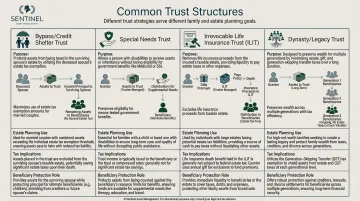
| Trust Type | Purpose | Key Mechanics |
|---|---|---|
| Bypass/Credit Shelter Trust | Married couples maximize estate tax exemptions | Holds assets up to exemption amount; bypasses surviving spouse's taxable estate |
| Special Needs Trust | Preserves benefit eligibility for disabled beneficiary | Supplements public benefits; strict distribution rules |
| Irrevocable Life Insurance Trust (ILIT) | Keeps life insurance death benefits out of taxable estate | Trustee owns policy; uses Crummey withdrawal powers |
| Dynasty/Legacy Trust | Passes wealth across multiple generations | Minimizes estate and generation-skipping transfer taxes; can last in perpetuity in certain states |
25% of Baby Boomers cite probate avoidance as a primary motivation for their estate plans, and trust ownership among U.S. adults rose to 14% in 2026.
Tax Minimization Strategies
The 2025 One, Big, Beautiful Bill: The Tax Cuts and Jobs Act (TCJA) temporarily doubled the Basic Exclusion Amount, scheduled to sunset after December 31, 2025. However, the One, Big, Beautiful Bill (OBBB), signed July 4, 2025, permanently eliminated this sunset. For 2026, the IRS basic exclusion amount is $15 million per individual ($30 million for married couples).
IRS final regulations also confirm an "anti-clawback" rule: individuals who made large gifts during 2018–2025 will not be penalized when exemptions change.
Annual Gift Tax Exclusion and Lifetime Exemption: The annual gift tax exclusion is $19,000 per donee for 2025 and 2026. Internal Revenue Code Section 2503(e) also allows an unlimited exclusion for amounts paid directly to a qualifying educational organization for tuition or to a healthcare provider for medical care — neither counts against the annual gift limit.
529 Plan Superfunding: The IRS allows a special five-year election for 529 plans. In 2025, a donor can contribute up to $95,000 to a 529 plan for a single beneficiary and elect to treat it as if it were made ratably over five years, fully utilizing the annual exclusion without triggering gift taxes.
Asset Titling and Beneficiary Designations: Jointly titled assets and outdated beneficiary forms are two of the most preventable errors in estate planning. Assets with a named beneficiary pass outside the will and outside probate entirely — which is efficient, but only when those designations are current. Review these regularly:
- Retirement accounts (IRAs, 401(k)s) — supersede any will instructions
- Life insurance policies — outdated beneficiaries are a common post-divorce problem
- TOD/POD accounts — transfer-on-death and payable-on-death accounts follow the named beneficiary, not the estate plan
Preparing Your Heirs to Receive Your Legacy
The Communication Gap
Despite the scale of wealth transfers underway, families struggle to discuss them. A 2023 Merrill Lynch study found 78% of families had wealth conversations come up spontaneously, and 26% later regretted them.
Families avoid these conversations due to fear of entitlement, discomfort with mortality, or worry about discouraging ambition. Yet silence is more harmful: heirs kept in the dark often feel financially helpless when the time comes, or make major mistakes with complex assets they don't understand.
How to Start the Conversation
Framing the Discussion:
- Begin with values, not numbers
- Explain the purpose behind the wealth and what you hope it enables
- Invite heirs to share their own goals and concerns
- Recognize this is rarely a single conversation—revisit it as circumstances evolve
A 2024 Bank of America Private Bank study found that 69% of parents of adult children have talked with their children about family wealth plans, but only after their children reached age 31 on average. Waiting until your 30s leaves little runway to correct financial habits or adjust expectations before a transfer occurs.
Bringing heirs to meet with your financial advisor is a low-stakes first step that normalizes the conversation.
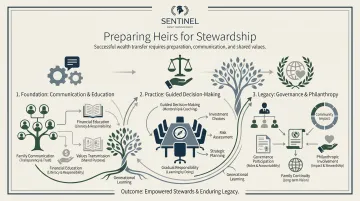
Preparing Heirs for Financial Stewardship
Beyond conversation, heirs benefit from hands-on experience with financial decisions:
- Give a smaller financial gift with coaching to observe and develop financial judgment
- Involve heirs in family charitable decisions, where stakes are lower and values are easier to discuss
- Cover financial fundamentals — budgeting, investing basics, and how taxes affect inherited assets
Trusts can be structured with incentive provisions—for example, matching earned income—to encourage responsible behavior without removing all support.
The Role of Family Governance
For families with significant assets, a family governance structure can include:
- A shared family mission statement
- Defined decision-making processes for shared assets (such as a family business or real estate)
- Regular family meetings to review shared decisions and surface concerns before they become disputes
Without this structure, even well-prepared heirs can find themselves disagreeing over assets that were never clearly assigned a decision-making process.
When to Review and Update Your Legacy Plan
Life Events That Trigger an Immediate Plan Review
- Marriage or divorce
- Birth or adoption of a child or grandchild
- Death of a beneficiary or named executor
- Significant increase or decrease in assets
- Starting or selling a business
- Relocation to a different state (which may affect trust siting and estate tax laws)
- A child reaching adulthood
Baseline Review Cadence
The American Bar Association and American College of Trust and Estate Counsel (ACTEC) recommend clients revisit estate plans every three to five years, even without a triggering event. Tax law changes — particularly around lifetime exemption thresholds, which have shifted significantly in recent years — can render existing plans less effective or open new planning options.
Often-Overlooked Update Triggers
Several triggers go unnoticed until they become problems:
- Beneficiary life changes — divorce, substance abuse issues, or mounting debt may warrant adjusting distribution terms in a trust
- Executor or trustee availability — personal circumstances or willingness to serve can shift, requiring updates to fiduciary appointments
- State estate tax thresholds — many states tax estates at far lower levels than the federal exemption (currently ~$13.99 million per individual for 2025, subject to annual adjustment). New York's 2026 exemption sits at $7,350,000; Massachusetts at $2,000,000; Washington at $3,076,000. Families residing in — or owning property in — these states should review bypass and gifting strategies accordingly
Frequently Asked Questions
What is a family legacy plan?
A family legacy plan is a comprehensive strategy for preserving and transferring your wealth, values, and wishes to future generations. It goes beyond wills and beneficiary forms to include family governance, values transmission, and philanthropic intentions alongside legal and financial structures.
How does legacy planning work?
You define your goals and values, inventory your assets, select appropriate legal structures (wills, trusts, beneficiary designations), implement tax strategies, and communicate the plan with heirs. Legacy planning requires ongoing review as family circumstances and laws change.
What are the three types of family legacy?
The three types are financial legacy (asset transfer), values and traditions legacy (passing on wisdom, family culture, and guiding principles), and philanthropic legacy (charitable giving and community impact). All three are essential for a complete plan.
How to build a financial legacy for your family?
Start by documenting all assets and liabilities, then establish or update legal structures — trusts, wills, and beneficiary designations. Layer in tax-efficient gifting strategies and heir education, with a coordinated advisory team ensuring your legal, financial, and tax goals stay aligned.
What is legacy wealth management?
Legacy wealth management is the ongoing advisory process of growing, protecting, and transferring wealth across generations. It combines investment management, estate planning, tax strategy, and family communication into a coordinated long-term plan.
What is a family legacy example?
Consider a family that funds a dynasty trust with appreciated assets, contributes annually to grandchildren's 529 accounts, and runs a donor-advised fund together. Annual family meetings reinforce the shared values and financial literacy that make the wealth meaningful — not just transferable.
Final Thoughts
Family legacy planning demands intention. The wealth you've built can reach the people and causes you care about — efficiently, gracefully, and on your terms — but only when you plan deliberately, communicate openly, and revisit the plan as life changes.
The families who get this right start with a clear picture of what they want their legacy to accomplish. If you're ready to build that picture, working with an experienced advisory team is the most reliable next step.
Take the next step in your financial journey by exploring our courses page for upcoming live seminars.