
General information, not personalised tax, legal or investment advice.

Introduction
Many people spend years building wealth but overlook one of the simplest and most consequential steps in protecting it: naming a beneficiary. For accounts like retirement plans, life insurance policies, and bank accounts with transfer-on-death provisions, the beneficiary designation form carries more legal weight than your will. When you die, the financial institution doesn't consult your will. It looks at the form on file and distributes the asset accordingly.
Beneficiary designations are binding legal contracts — and treating them as routine paperwork is a costly mistake. A missing, outdated, or mismatched designation can delay distributions, trigger disputes, or send assets to the wrong person entirely. What follows covers why these designations carry such weight, and what goes wrong when they're ignored.
Key takeaways
- Beneficiary designations dictate who receives specific assets upon death, bypassing probate entirely
- Designations override your will for retirement accounts, life insurance, and TOD/POD accounts
- Naming both primary and contingent beneficiaries creates a safety net under virtually any circumstance
- Outdated designations send assets to the wrong person, force probate, or create family disputes
- Review designations after every major life event and at least every 2–3 years
What Are Beneficiary Designations?
A beneficiary designation is a formal legal instruction filed with a financial institution, specifying who receives an asset when the account holder dies—independent of your will.
Account types that carry beneficiary designations:
- Life insurance policies
- IRAs and Roth IRAs
- 401(k)s, 403(b)s, and pension plans
- Annuities
- Bank accounts with payable-on-death (POD) arrangements
- Brokerage accounts with transfer-on-death (TOD) designations
Beneficiary designations are the actual mechanism that determines where your wealth goes. The institution distributes the asset based solely on what the form says—not what your will instructs, and not what your family believes you intended.
Key Advantages of Naming Beneficiaries
The advantages below have direct, measurable impact on how smoothly an estate is settled, how quickly loved ones access funds, and whether your wishes are actually honored.
Advantage 1: Assets Transfer Directly, Without Probate
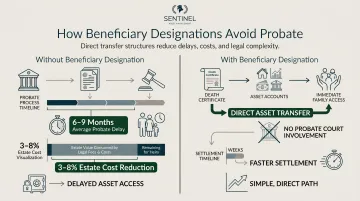
Assets with a named beneficiary bypass the probate process entirely. They transfer directly to the designated person without court involvement, legal fees, or multi-month delays.
How it works in practice:
When the account holder dies, the financial institution distributes the asset to the named beneficiary upon receipt of a death certificate. No judge, no attorney, no waiting period required.
Why this matters:
Probate can take six to nine months on average and consume 3% to 8% of an estate's total value in legal fees, court costs, and executor fees. Beneficiary designations eliminate this cost and delay for covered accounts, giving families access to funds when they may need them most—for immediate expenses like funeral costs or ongoing household needs.
Beyond speed, bypassing probate also protects against creditor claims that can surface during the settlement process—a meaningful safeguard for surviving spouses and dependents who rely on that income.
What this means for your family:
- Time to asset access (months reduced to days or weeks)
- Estate settlement costs (legal and court fees avoided)
- Financial stability for surviving dependents
Advantage 2: Beneficiary Designations Override Your Will—Your Instructions Govern
For accounts with a beneficiary form on file, the designation supersedes what the will says. The named beneficiary receives the asset regardless of any conflicting instruction in the estate document.
Real-world example:
In The Procter & Gamble U.S. Business Services Company v. Estate of Jeffrey Rolison (2024), a man died with $754,006.54 in his retirement account. In 1987, he had designated his then-girlfriend, Margaret Losinger, as the sole beneficiary. The couple broke up in 1989, but Rolison never updated his beneficiary form. When he died in 2015, the federal court ruled that under ERISA's plan documents rule, the funds had to go to the named beneficiary on file. That was his ex-girlfriend from 35 years prior. The designation overrode state intestacy law and any will.
Why this is an advantage when used correctly:
When designations are intentional and current, this legal priority works in your favor. Your family doesn't have to wait for will validation or navigate estate litigation to claim what you intended for them.
The flip side: the system enforces what is on file, not what was intended. Outdated designations carry the same legal force as current ones—which is why treating each beneficiary form as a critical estate document (not routine paperwork) matters.
What this means for your family:
- Risk of unintended asset distribution (eliminated when current)
- Family dispute rate (reduced)
- Legal challenge exposure (minimized)
When this advantage matters most:
After major life transitions—divorce, remarriage, death of a named beneficiary—when a will may have been updated but account-level designations were overlooked.
Advantage 3: Protects Vulnerable Beneficiaries and Complex Family Situations
Beneficiary designations—when properly structured—can provide tailored protection for specific types of beneficiaries: minor children, individuals with special needs, blended families, or beneficiaries who may not be equipped to manage a large inheritance.
How this is achieved:
Naming a trust (rather than an individual) as beneficiary allows the account holder to set conditions on how and when assets are distributed, managed by a trustee according to the grantor's intentions. For individuals with disabilities, a Special Needs Trust (SNT) can be the named beneficiary to preserve government benefit eligibility while ensuring the inheritance is still received.
Why this matters:
For families with special needs members, an outright inheritance can disqualify the recipient from Medicaid, SSI, and other government benefit programs. SSI eligibility requires that countable resources not exceed $2,000 for individuals. A direct inheritance will disqualify a disabled dependent if it pushes them over this strict limit. A properly structured SNT as beneficiary prevents this outcome.
For blended families, naming specific beneficiaries on individual accounts (rather than relying on a will alone) provides clarity and helps prevent disputes among children, stepchildren, and a surviving spouse.
What this means for your family:
- Government benefit eligibility protection (preserved via SNT)
- Family dispute rate (reduced through specificity)
- Asset management continuity (maintained through trust structures)
Sentinel Asset Management has spent 25 years working alongside families navigating these decisions, with 20+ special needs families supported long term. Coordinating beneficiary designations with the right trust structures is a core part of that work—ensuring inheritance reaches the people it's meant for, without disrupting the benefits they depend on.
When this advantage matters most:
Families with minor children, special needs dependents, or complex family structures including stepchildren and prior marriages.
What Happens When Beneficiaries Are Missing or Outdated
When no beneficiary is named—or when designations are never updated after life events—the account typically falls into the estate and must go through probate, erasing the primary benefit of having the account in the first place.
Common consequences include:
- Funds pass to an ex-spouse, estranged relative, or deceased individual because a decades-old form was never updated
- Minor children inherit outright without a trust or custodian, triggering court-appointed guardianship
- A disabled beneficiary loses government benefit eligibility when no special needs trust (SNT) is named as recipient
- Families enter litigation when perceived intentions conflict with what the legal form actually says
- Non-spouse beneficiaries face accelerated required minimum distribution (RMD) obligations and avoidable tax exposure
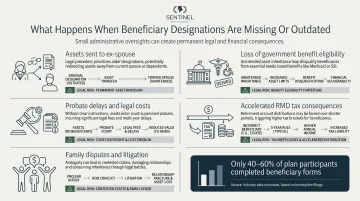
A 2012 Department of Labor report found that only 40% to 60% of defined contribution plan participants had completed beneficiary designation forms. None of these outcomes are unusual — they happen regularly and can be avoided with periodic review of existing designations.
How to Get the Most from Your Beneficiary Designations
The practical value of naming beneficiaries compounds over time. That only happens when designations are actively maintained, not completed once and forgotten.
Name both primary and contingent beneficiaries on every eligible account
- Specify exact percentages for multiple beneficiaries to eliminate ambiguity
- Example: "Primary: Spouse (100%); Contingent: Child A (50%), Child B (50%)"
- This layered approach ensures assets transfer to the right person under virtually any circumstance
Review designations after every major life event and on a routine schedule
- Major life events: marriage, divorce, birth, death of a named beneficiary
- Routine schedule: at least every two to three years
- Confirm that forms are on file and that named individuals are still the intended recipients
Coordinate beneficiary designations with the broader estate plan
- Ensure what's on file with each financial institution aligns with the will, any trust structures, and overall financial goals
- For clients with complex needs, this coordination step is where gaps between accounts, trusts, and wills most often surface—and where working with an advisor pays off
Sentinel Asset Management works with clients to do exactly this kind of coordination across accounts, retirement assets, and legacy goals through deliberate, organized planning that ensures nothing falls through the cracks.
Conclusion
Beneficiary designations are among the most impactful steps in estate planning, yet they require no attorney and no court filing to execute. Kept current and coordinated, they work quietly in the background to protect your intentions. Left unreviewed, the consequences are often permanent and painful for the people you meant to protect.
Your legacy isn't just about assets — it's about who receives them, when, and under what circumstances. Start by reviewing your current designations. If you want those decisions to fit into a larger plan, a Sentinel advisor can help you connect beneficiary planning with the full picture of your retirement and estate goals.
Frequently Asked Questions
Frequently Asked Questions
Do beneficiary designations override wills?
Yes, for covered accounts — retirement accounts, life insurance, and TOD/POD accounts — beneficiary designations take legal precedence over the will. The named beneficiary receives the asset regardless of what the will instructs.
Why do beneficiaries matter in estate planning?
Beneficiary designations allow specific assets to bypass probate and transfer directly to the right people. For covered accounts, they are the most reliable way to ensure your wishes are honored without court involvement.
What are the different types of beneficiary designation?
Primary beneficiaries receive assets first; contingent beneficiaries inherit if the primary predeceases the account holder or disclaims the asset. Designations also fall into two categories:
- Revocable: Changeable at any time by the account holder
- Irrevocable: Requires the beneficiary's consent to modify
Named recipients can be individuals, trusts, charities, or estates.
What happens if I don't name a contingent beneficiary?
If no contingent beneficiary is named and the primary beneficiary cannot receive the asset, the asset defaults to your estate and enters probate. That means delays, potential court costs, and distribution according to state law — not your wishes.
What are common beneficiary mistakes?
The most common — and costly — mistakes include failing to name a beneficiary at all, not updating designations after major life events (especially divorce), naming a minor without a trust or custodian, and assuming the will overrides a beneficiary form on file.
What is the best way to designate beneficiaries?
Complete the designation form with each financial institution using full legal names, and assign specific percentages to both primary and contingent beneficiaries. Review all designations regularly — especially after major life events — as part of a coordinated estate plan.
Take the next step in your financial journey by exploring our courses page for upcoming live seminars.