General information, not personalised tax, legal or investment advice.

Introduction
Over the next two decades, American families are navigating the largest transfer of wealth in history — and most have done little to prepare for what comes next. An estimated $124 trillion will change hands through 2048, with $105 trillion flowing to heirs and $18 trillion to charity. Yet despite decades of careful accumulation, the majority of this wealth will be managed by entirely new advisory relationships within months of transfer.
The core tension isn't technical. Estate documents are signed, trusts are funded, and beneficiaries are named. The fracture happens in relationships.
81% of next-generation high-net-worth heirs plan to switch from their parent's wealth management firm within 1-2 years after inheritance. The planning didn't fail. The relationship simply never existed with the next generation.
This article examines the scale of the Great Wealth Transfer, why advisor loyalty breaks down at the moment families need continuity most, and what a multigenerational advisory relationship actually requires.
Key takeaways
- $124 trillion in assets will move from Baby Boomers and the Silent Generation to younger heirs over the next two decades — the largest wealth transfer in history
- 81% of heirs change advisors after receiving an inheritance, leaving most families without consistent guidance at a critical financial moment
- Unprepared heirs and family communication breakdowns — not poor financial planning — are the leading causes of failed wealth transfers
- Advisors who engage the entire family early — not just the primary account holder — dramatically improve retention and outcomes
- Successful transfers require early planning, prepared heirs, and wealth strategies anchored in shared family values
The Great Wealth Transfer: What the Numbers Mean for Your Family
The Scale and Concentration of Assets
Cerulli Associates projects that $124 trillion will transfer through 2048, with $105 trillion flowing to heirs and $18 trillion to charity. The scale alone is staggering — but the concentration is what makes it unprecedented. More than half of this volume ($62 trillion) originates from high-net-worth and ultra-high-net-worth households, which represent only 2% of all households.
This concentration creates a critical planning gap: the families holding the most wealth face the most complex transfer challenges, yet many have never had conversations about what happens next.
Who Is Giving and Who Is Receiving
The transfer follows a clear generational path:
- Baby Boomers and the Silent Generation hold the wealth — transferring nearly $100 trillion (81% of all transfers)
- Generation X receives first — inheriting $39 trillion total, with $14 trillion in the next decade alone
- Millennials inherit long-term — receiving $46 trillion over the next 25 years
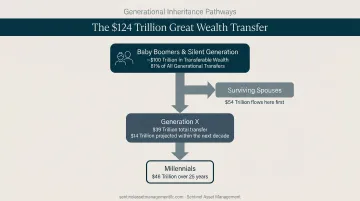
Before reaching the next generation, $54 trillion will transfer first to surviving spouses, with nearly $40 trillion going to widowed women in the Baby Boomer and older generations. This spousal transfer phase presents its own retention risk — industry statistics suggest that 70% of widowed women change their financial advisors within a year of their partner's death.
The Complexity Hidden in Asset Diversity
That retention risk rarely exists in isolation. It's compounded by the sheer complexity of what's being transferred — assets that extend well beyond an investment portfolio and require coordinated planning long before a death occurs.
Families are transferring:
- Financial portfolios across taxable, tax-deferred, and tax-free accounts
- Real estate holdings including primary residences, vacation properties, and investment properties
- Business interests and succession planning considerations
- Private equity and alternative investments
- Personal property with sentimental and financial value
This diversity creates planning complexity that extends far beyond what a basic will addresses. By 2035, approximately six million small and medium-size businesses will face ownership transitions, representing up to $5 trillion in enterprise value. Without clear succession pathways, this concentration of ownership among an aging cohort increases disruption risk dramatically.
Generational Expectations Are Fundamentally Different
Younger inheritors approach wealth management with different values and expectations than their parents:
99% of Gen Z and 97% of Millennial global investors say they're interested in sustainable investing, compared to just 23% of Baby Boomers. For younger generations, ESG alignment isn't optional — it's how they define investment success.
Digital access carries similar weight. Younger investors expect technology-enabled personalization, virtual meetings, and transparent platforms. Advised investors using virtual assistant app features report satisfaction scores 72 points higher than those at firms without these tools.
Perhaps most significantly, younger inheritors want a seat at the table. 72% of millennial and Gen Z investors believe "it's no longer possible to achieve above-average returns solely on traditional stocks and bonds," compared to 28% of older investors. They want collaboration, not quarterly statements delivered after the fact.
This Moment Is About Values, Not Just Valuations
The families who navigate this transfer well share one trait: they started the conversation early. Not just about account titles or beneficiary designations, but about what the wealth is for — the values, the obligations, the vision for what comes next. That conversation is where advisors either earn multi-generational loyalty or lose it.
Why Heirs Leave — and What Keeps Them Loyal
The Central Retention Problem
81% of next-generation high-net-worth individuals plan to switch from their parent's wealth management firm within 1-2 years after inheritance. Among those who have already received an inheritance, only 20% maintained a relationship with the benefactor's advisor.
For families who want continuity of institutional knowledge and consistent stewardship across generations, this pattern represents a serious structural failure — one that starts long before the transfer itself.
Why Heirs Walk Away
The data reveals specific, addressable causes:
| Primary Driver | Percentage Citing | What It Means |
|---|---|---|
| Already have their own advisor | 50% | The heir built a relationship elsewhere because no relationship existed with the parent's advisor |
| Lack of digital services | 46% | The firm's technology and communication methods don't match younger investors' expectations |
| Unavailability of alternative investments | 33% | The investment philosophy doesn't align with the heir's strategy or values |
| Lack of prior relationship with benefactor's advisor | 28% | The advisor never engaged the next generation directly |
| Inadequate value-added services | 25% | The relationship feels transactional, not strategic |
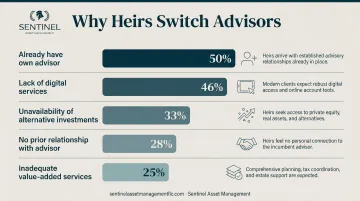
The pattern is clear: heirs leave because they were never included. They felt like strangers to the planning process. The advisor's communication style, service delivery, and investment approach were built for the wealth creator — not the wealth inheritor.
The Widowed Women Blind Spot
Nearly $40 trillion will transfer to widowed women in the Baby Boomer and older generations before reaching the next generation. Yet industry statistics suggest 70% of widowed women change their financial advisors within a year of their partner's death.
This represents one of the largest retention risks in the entire wealth transfer. Many advisory relationships were built exclusively with one spouse — typically the husband — leaving the surviving spouse feeling disconnected, unheard, or uncertain about the relationship's value.
What Loyalty Actually Looks Like
Loyalty across generations isn't automatic — it's built through deliberate, early inclusion:
- Introduce heirs to the advisor years before any transition — making them active participants in family financial conversations, not last-minute recipients
- Adapt communication across generational preferences, mixing traditional meetings with digital channels heirs already use
- Learn each family member's goals, values, and financial literacy level — not just the estate's balance sheet
- Align the advisory relationship with the family's shared purpose, not just portfolio performance
Preparing Heirs, Not Just Assets
There's a fundamental difference between an advisor who "prepares assets for heirs" and one who "prepares heirs for assets." The first focuses on documents, trusts, and tax efficiency. The second focuses on education, communication, and stewardship.
Families navigating the Great Wealth Transfer need the latter. That shift — from technical execution to relational preparation — is what separates advisors who retain the next generation from those who lose them at the moment of transition.
What Great Advisors Do Differently During the Transfer
They Engage the Whole Family
Great advisors don't wait until the primary client passes to meet the next generation. They build relationships early by introducing heirs to the advisory process, facilitating family meetings, and ensuring everyone understands what is being planned and why.
In practice, that means inviting adult children to annual reviews, explaining portfolio construction in accessible terms, and learning each family member's unique financial goals and concerns.
They Use Family Meetings as a Planning Tool
Structured family meetings serve multiple purposes: they build communication, surface family dynamics before those dynamics become financial problems, and create shared understanding across generations.
89% of high-net-worth firms surveyed identified conducting family meetings and maintaining regular communication as a key best practice for multigenerational planning.
These meetings typically cover:
- Family wealth philosophy and values
- Current estate plan overview and intentions
- Roles and responsibilities for beneficiaries
- Discussion of assets, including business interests and real estate
- Philanthropic goals and charitable giving plans
- Questions and concerns from all family members
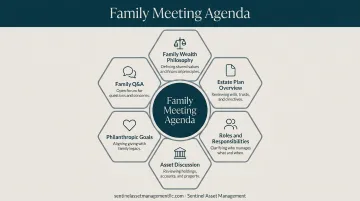
The goal is equal parts communication and conflict prevention — families who plan together tend to stay together when wealth actually transfers.
They Provide Heir Financial Education
Financial literacy can't be assumed. Great advisors offer age-appropriate financial education, involve heirs in investment discussions, and provide mentorship-style engagement that builds confidence alongside knowledge.
Practical approaches include:
- Explaining how portfolios are constructed and why specific strategies are used
- Involving younger family members in philanthropic decision-making
- Providing educational resources on tax-efficient investing and withdrawal strategies
- Creating "practice portfolios" where heirs manage a small allocation to build experience
The objective is ensuring heirs aren't just receiving wealth — they're receiving the tools and knowledge to manage it responsibly.
They Establish Family Governance Structures
Governance reduces the risk of conflict by establishing clear decision-making structures, defining roles for beneficiaries, and creating shared family financial values.
A governance framework typically covers:
- A documented family wealth story and shared values
- Clear criteria for major financial decisions
- Defined roles and responsibilities for each family member
- Accountability structures governing trust distributions
- Consensus on investment philosophy and risk tolerance
How Sentinel Asset Management Approaches Multigenerational Planning
The strategies above reflect what separates advisors who retain multigenerational clients from those who don't. At Sentinel Asset Management, these aren't abstract best practices — they're built into the firm's planning process.
Multigenerational planning at Sentinel means building relationships with the entire client family, not just the primary account holder. The firm's approach centers on guiding both asset and heir preparation, coordinating a comprehensive financial ecosystem that ensures wealth reaches the people and causes a family cares about — with minimal friction and on the family's timeline.
With 100+ years of combined advisory experience and 2,000+ families guided through retirement and legacy planning, Sentinel's process often begins with a pilot — a small, supervised pool of assets that allows beneficiaries to practice stewardship before full inheritance. This hands-on approach helps families articulate their values, educate their heirs, and establish guardrails that protect both wealth and relationships across generations.

Preparing Heirs, Not Just the Estate
Why Heir Preparation Matters More Than Technical Planning
The widely cited statistic that 70% of wealth transfers fail is methodologically flawed, tracing back to a 1987 study of Illinois manufacturing businesses — not modern wealth transitions. However, credible modern data confirms the underlying truth: communication breakdowns, not technical errors, drive failed transfers.
70% of family members face difficulties discussing wealth with each other, with the primary hurdles being perceived fairness, partial communication, near-total avoidance, and confusion about readiness. Millennials, Gen Z, and Gen X are nearly twice as likely as Boomers to see communication style differences as a main challenge.
Technical estate planning is necessary but not sufficient. Without preparing heirs, even the most sophisticated estate plan can unravel — and the preparation itself looks very different from the plan.
What Heir Preparation Looks Like in Practice
Effective heir preparation includes:
- Sharing the family's wealth story — where it came from, what sacrifices built it, and what values shaped it — gives heirs context that no legal document can provide
- Involving younger generations in charitable giving decisions teaches stewardship, impact assessment, and values alignment before they inherit anything
- Establishing shared expectations about how assets will be invested, spent, or preserved prevents the conflicts that legal agreements alone can't resolve
- Tailoring financial literacy to each heir's age and readiness — foundational knowledge for younger heirs, tax and preservation strategies for older ones
Special Planning Situations Require Tailored Preparation
Certain family situations demand specialized expertise:
- Special needs beneficiaries need trusts structured to preserve government benefits while providing supplemental support — Sentinel Asset Management has spent 25 years helping families navigate this, supporting 20+ special needs households through long-term planning
- Blended families face competing interests around fairness and prior obligations, where clear communication and legally sound structures prevent disputes before they start
- Families navigating divorce require revised estate plans, asset division strategies, and forward-looking support planning — Sentinel's advisors bring both professional expertise and personal experience to these situations
Tax-Smart Strategies That Protect What You've Built
Understanding the Current Estate and Gift Tax Landscape
The federal estate and gift tax exemption has fluctuated significantly in recent years. Key thresholds for 2025 and 2026:
- 2025 individual exemption: $13,990,000 (annual gift exclusion: $19,000 per recipient)
- 2026 individual exemption: $15,000,000 (annual gift exclusion: $19,000 per recipient)
- Federal estate tax rate: Up to 40% on amounts exceeding the exemption
Timing transfers around these thresholds is one of the highest-leverage decisions families can make.
Anti-Clawback Protection for Large Gifts
Families often worried whether large gifts made under today's higher exemptions would be "clawed back" if exemptions later decrease. Final IRS regulations (TD 9884) confirm that individuals taking advantage of increased gift and estate tax exclusions will not be adversely impacted if the exclusion drops in the future. The estate can compute its tax credit using the higher of the exclusion applicable to gifts made during life or the exclusion on the date of death.
That protection matters in practical terms: gifts made today under the current exemption won't create a retroactive tax liability — even if Congress reduces the exemption after 2025.
Key Planning Vehicles for Tax-Efficient Transfers
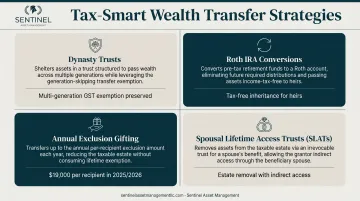
Several strategies enable families to transfer wealth while minimizing tax exposure:
Dynasty Trusts — Irrevocable trusts designed to hold assets for multiple generations without incurring estate or generation-skipping transfer taxes at each generational handoff. By allocating the grantor's GST tax exemption to the trust, future appreciation and distributions to skip persons are exempt from these taxes.
Roth IRA Conversions — Converting a traditional IRA to a Roth requires paying income tax on the converted amount now, but allows for tax-free growth and tax-free qualified distributions later. For heirs, this means inheriting tax-free assets rather than tax-deferred liabilities.
Annual Exclusion Gifting — Gifts up to the annual exclusion amount ($19,000 in 2025/2026 per recipient) are not included in taxable gifts. For a married couple, this means gifting up to $38,000 per child or grandchild annually without using any lifetime exemption.
Spousal Lifetime Access Trusts (SLATs) — One spouse creates an irrevocable trust for the benefit of the other spouse and descendants, utilizing transfer tax exemptions while removing assets from the taxable estate. The risk is that if spouses create substantially identical SLATs for each other, the IRS may "uncross" the trusts, resulting in estate inclusion.
Sentinel's Accessible Estate Planning Approach
Sentinel Asset Management handles the financial coordination and administrative groundwork of estate planning that makes legal documents effective once they're in place:
- Organizing assets across taxable, tax-deferred, and tax-free accounts
- Reviewing titling and beneficiary designations for consistency
- Coordinating insurance policies and ownership structures
For the remaining 2% — wills, trusts, and complex legal instruments — Sentinel works alongside estate attorneys to ensure every legal document is supported by the right financial infrastructure.
Weaving Values and Philanthropy Into the Legacy Plan
Values Matter More Than Dollars
90% of investors state, "I want to align my investments with my values," according to UBS research. For wealthy parents, passing down values matters more than the amount of money transferred.
This values-first mindset shapes how families approach legacy planning — not just what transfers, but why it transfers and what it says about who they are.
Philanthropic Vehicles That Align Intent with Tax Efficiency
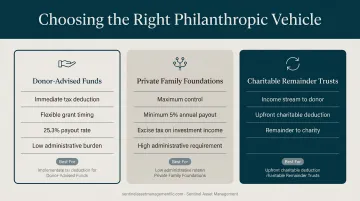
Three vehicles give families the most flexibility to match giving strategy with tax goals:
- Donor-Advised Funds (DAFs): Tax-advantaged accounts that let donors contribute, claim an immediate deduction, and recommend grants over time. 3.56 million DAF accounts held $326 billion in assets and granted $65 billion to nonprofits in 2024, with a 25.3% payout rate versus 8.1% for private foundations.
- Private Family Foundations: Tax-exempt organizations controlled by a donor or small group. They offer maximum giving control but require a minimum 5% annual payout and carry excise taxes on net investment income.
- Charitable Remainder Trusts (CRTs): Split-interest trusts that pay income to a noncharitable beneficiary for a set term or life, with the remainder going to charity. The donor receives an upfront deduction for the present value of that remainder interest.
Involving Younger Generations in Philanthropy
81% of parents who give report that their children under age 18 participated in a charitable activity in the past year, according to Fidelity Charitable. 62% actively engage their kids in planning, giving, and volunteering.
Early involvement builds financial responsibility, teaches impact assessment, and creates shared family purpose around wealth stewardship. It also opens a natural dialogue across generations: younger donors are nearly twice as likely to prioritize homelessness, social justice, and environmental causes compared to older donors, making philanthropy one of the most effective bridges between generational values.
Frequently Asked Questions
What is the Great Wealth Transfer?
The Great Wealth Transfer refers to the estimated $124 trillion in assets expected to transfer from Baby Boomers and the Silent Generation to younger heirs and charities through 2048. It represents the largest intergenerational wealth movement in history.
Why do most heirs change financial advisors after inheriting wealth?
Most advisors never built a relationship with the next generation, leaving heirs to seek someone who knows and understands them — not just the account. 81% of heirs plan to switch advisors within 1-2 years after inheritance because they feel like strangers to the planning process.
How can families start preparing heirs for an inheritance?
Start with open family conversations about values and financial goals, and involve heirs in planning discussions before any transition is imminent. An advisor who engages the whole family — not just the estate owner — can pair those conversations with financial education and hands-on practice with smaller asset pools to build real competence.
What estate planning strategies minimize taxes during a wealth transfer?
Several approaches reduce the tax burden on transferred wealth:
- Annual exclusion gifting — $19,000 per recipient in 2025/2026
- Dynasty trusts — avoid generational transfer taxes across multiple generations
- Roth IRA conversions — create tax-free inheritance for heirs
- Spousal lifetime access trusts (SLATs) — transfer assets while retaining indirect access
Acting before legislative changes affect exemption thresholds is critical to locking in current advantages.
When is the right time to start planning for the Great Wealth Transfer?
The best time to begin is well before any transition is imminent — ideally while the wealth-holding generation is healthy and actively able to participate in planning and family conversations. Starting 10 or more years out gives heirs time to develop financial literacy and gives advisors time to build the relationships that make a transition seamless.
How do advisors build loyalty with the next generation of heirs?
Loyalty comes from early inclusion — bringing heirs into conversations long before any wealth changes hands. Consistent communication across generations, education that builds real financial competence, and an advisor relationship that extends to every family member (not just the primary account holder) all signal that the advisor sees the family, not just the assets.
Take the next step in your financial journey by exploring our courses page for upcoming live seminars.