General information, not personalised tax, legal or investment advice.

The stakes are real. Decisions made in the years leading up to retirement—when to claim Social Security, which accounts to tap first, how aggressively to invest—have lasting consequences for both partners, including the one who outlives the other. A 65-year-old retiring today faces a 47% probability that at least one member of the couple will live to age 90, which means planning for 25 to 30 years of retirement, not just the first few.
This guide covers how to align on a shared retirement vision, coordinate investments and withdrawals across all accounts, optimize Social Security as a team, build a realistic income plan, and protect what you've built through healthcare and estate planning.
Key takeaways
- Align on retirement timing, location, and lifestyle first—53% of pre-retiree couples disagree on how much they need to save, and nearly half disagree on when to retire
- Treat both partners' accounts as a single portfolio—evaluate diversification, tax efficiency, and withdrawal sequencing across all accounts together, not separately
- Social Security timing directly affects lifetime income—spousal benefits, survivor benefits, and delayed credits require a coordinated claiming strategy, not individual decisions
- Plan explicitly for healthcare and long-term care costs—a 65-year-old retiring in 2025 can expect to spend $172,500 on healthcare throughout retirement, excluding long-term care
- Both partners need updated estate documents—beneficiary designations, powers of attorney, healthcare directives, and wills should reflect your current situation and wishes
Start with a Shared Retirement Vision
Why Retirement Timing Matters Financially
If one partner retires while the other keeps working, the household transitions from two incomes to one. That shift affects cash flow, healthcare coverage, and savings contribution rates in ways most couples don't anticipate. Many couples underestimate the "income cliff" period and find themselves making reactive spending cuts instead of planning proactively.
The transition also affects:
- Healthcare coverage (COBRA vs. marketplace vs. Medicare)
- Retirement account contributions (one partner can still save)
- Social Security timing (the working partner may delay claiming)
- Tax brackets (lower household income may create Roth conversion opportunities)
Simultaneous vs. Staggered Retirement
Staggered retirement offers financial advantages. The working partner continues contributing to retirement accounts, maintains employer-sponsored health insurance, and may allow the higher earner to delay Social Security until 70 to maximize delayed retirement credits. This approach provides a bridge between full dual income and full retirement.
Simultaneous retirement is straightforward in appeal: both partners stop working at once and step into retirement as a unit. The tradeoff is that both must be financially ready at the same time. If one partner isn't, the couple faces a real decision — delay together, or retire separately.
The "Where" Decision is a Financial Planning Variable
Cost of living, state income tax treatment of retirement distributions, proximity to healthcare providers, and housing market conditions all affect how far retirement savings will stretch.
High-tax states:
- California has nine income tax brackets with rates from 1% to 13.3%; 401(k) and IRA distributions are fully taxable
- Minnesota taxes most retirement income, with a lowest bracket that's high compared to other states
- New York taxes private pensions above a $20,000 exclusion and 401(k)/IRA distributions fully, with a top rate of 10.9%
Low/no-tax states:
- Illinois has a 4.95% income tax on wages, but retirees drawing from Social Security, pensions, and IRA distributions pay 0% state income tax
- Pennsylvania doesn't tax pensions, retirement plan distributions, or Social Security; taxable income is subject to a 3.07% flat rate
- Florida, Texas, and Wyoming have no state income tax
A couple retiring with $80,000 in annual retirement income could save $5,000–$8,000 per year by relocating from a high-tax state to a no-tax state.
Build a Shared Lifestyle Vision
Where you live shapes your budget — but what you do every day shapes your retirement. Once the financial picture is clearer, each partner should build an individual wish list covering:
- Travel goals and frequency
- Hobbies and activities
- Family support (adult children, grandchildren, aging parents)
- Housing preferences (downsize, age in place, relocate)
Compare lists to identify common ground and areas requiring compromise. This shared vision becomes the foundation for your retirement income target. A couple who wants to travel internationally twice a year needs a different budget than a couple planning to spend most of their time at home.
The Longevity Factor
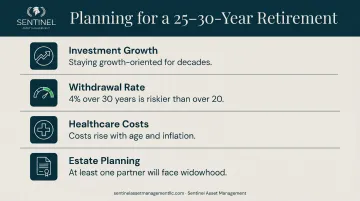
Research shows a 47% probability that at least one member of a 65-year-old couple will live to age 90. Couples need to plan for 25 to 30 years of retirement income — not just the transition into it.
This extended timeline has direct implications:
- How aggressively you invest (you need growth for decades, not just safety)
- How conservatively you withdraw (a 4% withdrawal rate over 30 years is riskier than over 20)
- Healthcare cost projections (costs rise with age and inflation)
- Estate planning (at least one partner will likely face widowhood)
Build a Coordinated Investment and Withdrawal Strategy
View All Accounts as a Single Unified Portfolio
Looking at each partner's 401(k), IRA, and taxable accounts in isolation creates risk. You might hold duplicate positions, unintended sector concentration, or a combined allocation that doesn't match your shared goals.
Instead, treat all retirement accounts—both partners' 401(k)s, IRAs, Roth IRAs, and taxable investment accounts—as one unified portfolio. Check whether:
- Both 401(k)s are overweighted in the same sectors (tech, healthcare, financials)
- One partner's aggressive account complements the other's conservative one
- Your combined allocation matches your joint risk tolerance and time horizon
Evaluate Diversification Across Both Partners' Accounts
Build a complete inventory of all holdings across both partners. If one partner's 401(k) is 40% large-cap U.S. stocks and the other's is 50% large-cap U.S. stocks, your household portfolio is heavily concentrated—even though each account looks balanced in isolation.
Consider:
- Asset class allocation (stocks, bonds, real estate, international)
- Sector exposure (are both plans heavy in the same industries?)
- Fund overlap (are you paying fees for duplicate holdings?)
- Tax location (are tax-inefficient assets in taxable accounts?)
Withdrawal Sequencing: Order Matters for Tax Efficiency
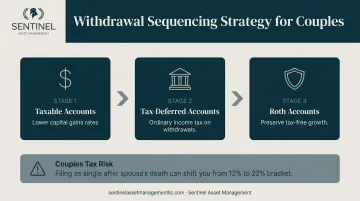
The order in which you draw from different account types affects lifetime taxes. The traditional approach is to withdraw first from taxable accounts, then tax-deferred accounts, and finally Roth accounts.
Standard sequencing:
- Taxable accounts first - Lower capital gains rates than ordinary income
- Tax-deferred traditional accounts next - Ordinary income tax on withdrawals
- Roth accounts last - Preserve tax-free growth and inheritance value
The couples-specific consideration: When one spouse dies, the surviving spouse files as single, where tax brackets are roughly half the size of married filing jointly thresholds. A couple comfortably in the 12% bracket as joint filers can suddenly land in the 22% bracket as a single filer with no change in income. Proactive Roth conversions during joint-filing years can reduce this future tax exposure.
Sequencing decisions don't end at conversion planning. Required Minimum Distributions (RMDs) add another layer: when both partners reach RMD age (currently 73), you must withdraw minimum amounts from tax-deferred accounts annually, which can push you into higher tax brackets and affect Medicare premiums.
The Bucket Withdrawal Approach
Managing sequencing complexity is easier with a clear structural framework. The bucket strategy allocates assets by time horizon:
- Near-term bucket (1-3 years): Money market funds and short-term bonds cover immediate income needs without forcing you to sell growth investments during a downturn
- Mid-term bucket (4-10 years): A moderate bond/stock mix bridges the gap between near-term safety and long-term growth
- Long-term bucket (10+ years): Growth-oriented investments (stocks, real estate) combat inflation across decades
This framework works especially well for couples, who face a longer combined retirement horizon than either partner alone. Sentinel Asset Management stress-tests bucket-based withdrawal plans against historical bear markets and recessions to identify gaps before they become problems.
The Spousal IRA: Preserve Savings Momentum
If one partner leaves work temporarily or permanently—for caregiving, health, or other reasons—the working partner can contribute to an IRA in the non-working spouse's name.
2026 rules:
- Each spouse can contribute up to $7,500 ($8,600 if age 50 or older)
- Total combined contributions can't exceed the taxable compensation on your joint return
- Traditional IRA deduction phases out if the working spouse is covered by a retirement plan and your modified AGI is between $242,000–$252,000
- Roth IRA contributions phase out completely at $252,000 modified AGI for married filing jointly
This keeps both partners building retirement savings even when one isn't earning income.
Optimize Social Security as a Team
The Spousal Benefit
A lower-earning spouse may be eligible to receive up to 50% of the higher-earning spouse's full retirement benefit. Basic eligibility conditions:
- The spouse must be at least age 62
- The higher-earning spouse must have filed for their own benefit
- The spousal benefit is reduced if claimed before full retirement age
This option is particularly valuable when there's a significant earnings gap between partners—for example, if one partner stayed home to raise children or worked part-time.
Timing Trade-Offs: 62 vs. 67 vs. 70
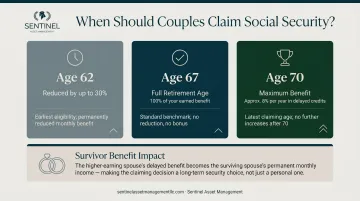
Claiming Social Security early permanently reduces monthly benefits:
- Age 62: Benefits reduced by up to 30%
- Full retirement age (67 for those born in 1960 or later): 100% of benefit
- Age 70: Approximately 8% per year in delayed retirement credits
For couples with different ages or health histories, choosing different claiming ages can maximize combined lifetime income. If one partner has health issues, claiming early may make sense. If both are healthy and expect long lives, delaying the higher earner's benefit to 70 can substantially increase monthly income for decades.
The Survivor Benefit: Life Insurance Function
The surviving spouse inherits the larger of the two Social Security benefits. This means delaying the higher earner's claim has outsized long-term value for the partner who outlives them.
Example: If the higher earner delays to 70 and receives $3,500/month, and the lower earner claims at 67 and receives $1,800/month, the household collects $5,300/month while both are alive. When the first spouse dies, the survivor receives only the higher benefit ($3,500/month), not both.
Maximizing that survivor benefit protects the remaining spouse for potentially decades.
WEP and GPO: Now Repealed
Beyond claiming strategy, recent legislation changed the Social Security landscape for many public-sector households. The Windfall Elimination Provision (WEP) and Government Pension Offset (GPO) previously reduced Social Security spousal or survivor benefits for couples where one partner received a pension from a government job not covered by Social Security. The Social Security Fairness Act, enacted in January 2025, fully repealed both provisions retroactive to January 2024. Teachers, firefighters, and public sector workers who were previously subject to reductions now receive full spousal and survivor benefits.
Plan Your Retirement Budget and Income Needs
The 70–80% Income Replacement Rule
Most financial planners suggest couples will need approximately 70–80% of their pre-retirement combined income to maintain their lifestyle in retirement, according to research from Vanguard.
Factors that push this higher:
- Significant travel plans
- Healthcare cost growth
- Financial support to adult children or aging parents
- Hobbies requiring equipment or instruction
Factors that push this lower:
- Paid-off mortgage
- No commuting or work expenses
- Downsizing to a smaller home
- Reduced spending on clothing or dining out
The 70–80% rule is based on replacing pre-retirement spending, not pre-retirement income. If you earned $100,000 but saved 20% and paid 15% in taxes, your actual spending was $65,000. Replacing 70–80% of $100,000 gives you $70,000–$80,000, which exceeds what you actually spent and builds in a meaningful buffer.
Three Expense Categories Couples Should Plan Around
Essential expenses:
- Housing (mortgage/rent, property taxes, insurance, maintenance)
- Food and utilities
- Healthcare premiums and out-of-pocket costs
- Transportation
Lifestyle expenses:
- Travel and vacations
- Hobbies and recreation
- Dining out and entertainment
- Family gifts and support
Contingency costs:
- Home repairs and replacements
- Unexpected medical events
- Potential caregiving costs for aging parents
- Emergency fund replenishment
Only 55% of retired couples spent the amount they expected, with 26% spending more than planned. Many couples underestimate lifestyle and contingency expenses, especially healthcare costs and ongoing family financial support.
The Income Cliff Risk
When one partner retires before the other, the household moves from dual income to single income, often for years. Many couples overlook this transition period entirely. Plan for it proactively rather than making spending cuts on the fly:
- Projecting cash flow during the single-income period
- Identifying which accounts will supplement the working spouse's income
- Determining whether the retired spouse will claim Social Security early or wait
- Evaluating healthcare coverage options (COBRA, marketplace, spouse's employer plan)
Protect Your Retirement: Healthcare, Long-Term Care, and Estate Planning
Healthcare Costs: The Medicare Gap
A 65-year-old retiring in 2025 can expect to spend $172,500 on healthcare throughout retirement, excluding long-term care. Medicare covers a meaningful portion but leaves significant gaps:
- Dental, vision, and hearing care
- Most long-term care services
- Prescription drug costs above Part D limits
- International travel medical emergencies
Couples need a plan for supplemental coverage — starting with the Medicare Advantage vs. original Medicare decision. Medicare Advantage plans often carry lower premiums but restrict provider networks; original Medicare with Medigap offers broader access at higher upfront costs.
Long-Term Care: A Couples-Specific Issue
Someone turning 65 today has almost a 70% chance of needing some type of long-term care in their remaining years. For couples, one partner often becomes the primary caregiver for the other — adding financial strain on top of an already difficult role.
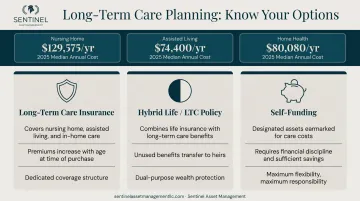
2025 median costs:
- Nursing home (private room): $129,575 annually
- Assisted living community: $74,400 annually
- Home health aide: $80,080 annually (44 hours/week)
Planning options:
- Long-term care insurance: Covers nursing home, assisted living, or in-home care; premiums rise with age, so earlier purchase is typically cheaper
- Hybrid life/LTC policies: Combine life insurance with long-term care benefits; if you don't use LTC benefits, heirs receive death benefit
- Dedicated self-funding: Set aside designated assets for potential care costs; requires discipline and sufficient assets
Waiting too long to plan increases cost and limits options. Couples in their 50s and early 60s have the most flexibility.
Estate Planning Essentials Every Couple Must Have
Every couple needs four documents in place:
- Beneficiary designations: Update on every retirement account and life insurance policy. These override your will — outdated designations (ex-spouses, deceased parents) can redirect assets regardless of your intentions.
- Durable power of attorney: Authorizes a partner (and a named backup) to make financial decisions if you become incapacitated.
- Living will + healthcare proxy: A living will specifies end-of-life care preferences; a healthcare proxy designates who makes medical decisions when you can't.
- Will: Directs how assets pass at death, names guardians for minor children, and appoints an executor.

Joint ownership does not automatically resolve everything, especially for blended families or when assets pass outside the estate. Sentinel Asset Management's advisors handle beneficiary coordination, asset titling, and ownership structure alignment directly as part of the comprehensive planning process, coordinating with attorneys when legal documents need drafting.
Frequently Asked Questions
What is a good retirement income for a married couple?
A "good" retirement income varies widely by lifestyle, location, and health needs. Many financial planners use the 70–80% pre-retirement income benchmark as a starting point, but couples should calculate their own number based on actual expenses, travel plans, and healthcare projections rather than relying on generic formulas.
How much do I need to retire on $80,000 a year at 60?
Retiring at 60 with an $80,000 annual income need may require a nest egg of $1.6–$2 million or more using common withdrawal rate guidelines. Early retirement extends the drawdown period, adds healthcare costs before Medicare kicks in at 65, and often means years without Social Security — all of which push that savings target higher.
What is the $1,000-a-month rule for retirement planning?
The $1,000-a-month rule suggests you need roughly $240,000 saved for every $1,000 of monthly retirement income, based on a 5% withdrawal rate. It's a useful gut-check, but actual withdrawal rates should reflect market conditions, longevity, and how flexible your spending can be.
What is the 50/30/20 rule for couples?
The 50/30/20 rule allocates 50% of take-home income to needs, 30% to wants, and 20% to savings and debt repayment. Couples approaching retirement often shift that savings slice to 25–30% to accelerate their nest egg through the final working years.
What is the 30/30/30/10 rule for retirement?
The 30/30/30/10 rule is a retirement income allocation framework where 30% goes to housing, 30% to living expenses, 30% to healthcare and savings, and 10% to discretionary spending. It's one framework among many, and actual allocations should reflect a couple's real budget, location, and healthcare needs rather than rigid percentages.
What are the 5 P's of retirement?
The 5 P's of retirement cover Purpose, People, Place, Priorities, and Prosperity: a framework that pushes planning beyond finances into the lifestyle side of retirement. For couples, it's a useful starting point for aligning two visions — what matters, where you'll live, and how you'll fund it.
Take the next step in your financial journey by exploring our courses page for upcoming live seminars.