
General information, not personalised tax, legal or investment advice.

Introduction
Imagine spending three decades building a career, paying off a mortgage, contributing to retirement accounts, and accumulating investments—only to have the state decide who receives it all because you never formalized a plan. According to a 2026 survey by Trust & Will, 56% of U.S. adults have no estate planning documents—no will, no trust, no healthcare directives.
Without an estate plan, state intestacy laws determine who inherits your assets, who makes medical decisions if you're incapacitated, and who assumes guardianship of your children. That gap creates financial strain, legal delays, and emotional stress for the people you love most.
Probate alone can consume 3% to 8% of your estate's value and stretch asset distribution across 9 to 20 months of court supervision.
This guide covers the essential documents every estate plan requires, strategies to reduce taxes and avoid probate, common mistakes that derail even well-intentioned plans, and how to keep your estate aligned with your life as it changes.
Key takeaways:
- 56% of Americans have no estate planning documents, leaving courts and state law to decide asset distribution
- A complete estate plan includes a will, trusts, powers of attorney, advance directives, and updated beneficiary designations
- Beneficiary designations legally override your will—outdated forms on retirement accounts can derail your entire plan
- Proper trust funding and account titling allow assets to bypass probate entirely, saving time and money
- Review your plan every 3–5 years and after major life events to keep it aligned with your current wishes
What Is Estate Planning and Why Does It Matter?
Estate planning is the process of deciding how your assets, medical care, and personal wishes will be managed and distributed if you become incapacitated or after you pass away. It covers who inherits your home, who makes healthcare decisions on your behalf, who cares for minor children, and how your wealth is transferred to the people and causes you value.
Who Needs an Estate Plan?
The common misconception is that estate planning is only for the wealthy. In reality, 40% of Americans without a will cite "not having enough assets" as their reason for avoiding estate planning—a dangerous misunderstanding. Anyone who owns property, has savings, has dependents (minor children, aging parents, or family members with special needs), or cares about who receives their belongings needs some form of estate plan.
Even if your estate falls below federal tax thresholds, estate planning addresses critical non-financial decisions: who raises your children if you can't, who manages your finances if you're unable to act for yourself, and whether you receive life-sustaining treatment in a medical crisis.
Core Benefits
A comprehensive estate plan delivers:
- Gives your family legal certainty about your wishes, reducing conflict at an already difficult time
- Prevents costly disputes when family members might otherwise disagree about your intentions
- Ensures your healthcare preferences are honored through advance directives, even when you cannot speak for yourself
- Keeps wealth transfer on your terms — not through a court-supervised process that can take months and cost thousands
Those benefits extend further when estate planning connects to the broader financial picture. At Sentinel Asset Management, advisors integrate estate planning with tax management, investment planning, and retirement income strategies — coordinating assets across taxable, tax-deferred, and tax-free accounts so wealth reaches intended beneficiaries efficiently, with minimal tax erosion along the way.
The Essential Documents Every Estate Plan Should Include
A complete estate plan is not just a will—it is a coordinated set of legal documents, each serving a distinct purpose. The four core documents are a Last Will and Testament, trusts, powers of attorney, and advance healthcare directives.
Last Will and Testament
A will names who inherits your assets, designates guardians for minor children or dependents, and appoints an executor to carry out your wishes. Without a valid will, state intestacy laws determine who gets what—typically prioritizing a surviving spouse and children, then parents and siblings—which may not reflect your intentions.
The will's key limitation is that assets it covers typically pass through probate, a court-supervised process that can be time-consuming and costly. A well-drafted will expedites this process but does not avoid it entirely.
Trusts: Revocable and Irrevocable
A trust is a legal structure that holds assets on behalf of your beneficiaries, allowing you to control how and when those assets are distributed while helping your estate avoid probate.
Two main types:
- Revocable Living Trust: Can be changed or revoked during your lifetime, ideal for maintaining control and flexibility. Assets held in a revocable trust bypass probate but remain in your taxable estate and are subject to creditors.
- Irrevocable Trust: Once established, generally cannot be altered, but offers stronger asset protection from creditors and potential estate tax benefits by removing assets from your taxable estate.
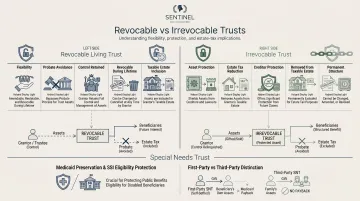
Special Needs Trusts allow individuals with disabilities to benefit from assets without disqualifying them from means-tested government programs like SSI and Medicaid. First-party trusts (funded with the beneficiary's own assets) require a Medicaid payback provision upon the beneficiary's death. Third-party trusts, funded by family members, carry no such requirement — allowing residual assets to pass to other heirs.
For families navigating special needs planning, trust structure decisions carry long-term consequences for both benefits eligibility and care funding. Sentinel Asset Management has worked with special needs families for 25 years, coordinating trust design with care planners and estate attorneys to align financial structures with each beneficiary's lifelong support needs.
Power of Attorney
Two essential POAs protect you during incapacitation:
- Durable Financial Power of Attorney: Grants a trusted person authority to manage your finances—paying bills, managing investments, filing taxes—if you become incapacitated. Without this, families face costly court-supervised conservatorship proceedings.
- Healthcare Power of Attorney (Healthcare Proxy): Gives someone authority to make medical decisions on your behalf when you cannot.
Advance Healthcare Directive (Living Will)
A living will records your preferences for specific medical treatments—life support, resuscitation, artificial feeding—and ensures those wishes are followed even if you cannot speak for yourself. Where a healthcare proxy designates someone to speak for you, a living will documents your instructions directly — removing ambiguity for both your proxy and your medical team.
Despite this, only 31% of U.S. adults have a living will or advance directive.
Among adults aged 50–80 without advance directives, 62% say they simply hadn't gotten around to it — a gap that one conversation with an advisor or attorney can close.
Beneficiary Designations: The Detail Most People Overlook
Beneficiary designations are critical and often misunderstood. On accounts such as retirement plans (401(k)s, IRAs), life insurance policies, and payable-on-death bank accounts, the named beneficiary receives the assets directly—bypassing the will entirely. An outdated or conflicting beneficiary designation can override even a carefully crafted estate plan.
What Needs Review
Review beneficiary designations on:
- Retirement accounts (401(k)s, IRAs, 403(b)s)
- Life insurance policies
- Annuities
- Health savings accounts (HSAs)
- Transfer-on-death (TOD) and payable-on-death (POD) bank accounts
Always name contingent (backup) beneficiaries in case the primary beneficiary predeceases you. In tax-qualified ERISA plans like 401(k)s, a married participant generally cannot designate a non-spouse beneficiary without the spouse's written consent.
Lifetime Gifting Strategies
Keeping beneficiary designations current is only part of the picture. Proactive lifetime transfers can reduce what passes through your estate at death — and the annual gift tax exclusion is one of the most straightforward tools available. For 2026, individuals can transfer up to $19,000 per recipient tax-free — or $38,000 for married couples splitting gifts.
529 college savings plans offer a complementary gifting option. Donors can elect to "superfund" a 529 by contributing up to $95,000 per beneficiary in 2026 — the equivalent of five years of exclusions in a single contribution.
One caveat: if the donor dies before the five-year period expires, the portion allocated to the remaining years is pulled back into their gross taxable estate.
Sentinel Asset Management's tax management service models these gifting strategies alongside investment and estate planning — so every withdrawal, sale, and gift works together to reduce lifetime tax exposure rather than creating new problems to solve later.
Navigating Estate Taxes and Avoiding Probate
Federal and State Estate Taxes
The federal estate tax basic exclusion amount for 2026 is $15,000,000 per individual ($30,000,000 for married couples). While most estates fall below this threshold, 17 jurisdictions impose their own estate or inheritance taxes at much lower levels.
State estate tax thresholds vary significantly:
- Oregon: $1,000,000
- Massachusetts: $2,000,000
- Minnesota and Washington: $3,000,000
- Illinois: $4,000,000
- New York: $7,160,000
- Connecticut: $13,610,000

Key distinction: Estate tax is levied on assets transferred from the estate; inheritance tax is paid by the recipient. Maryland is the only state that imposes both.
Strategies to Reduce Estate Tax Exposure
For larger estates, advanced strategies include:
- Irrevocable trusts that remove assets from your taxable estate
- Annual gifts to heirs within the $19,000 exclusion
- Charitable trusts or donor-advised funds
- Spousal Lifetime Access Trusts (SLATs): removes assets from the donor's taxable estate while preserving indirect access through the beneficiary spouse
- Grantor Retained Annuity Trusts (GRATs): transfers asset appreciation above the IRS hurdle rate to heirs free of gift and estate taxes
These strategies work best when planned proactively and coordinated with a financial advisor and tax professional.
Understanding and Avoiding Probate
Probate is the court-supervised process that validates a will and oversees asset distribution. It is slow, costly, and a matter of public record. The average estate takes 6 to 9 months to complete probate, though complex estates average 20 months. Probate costs typically consume 3% to 7% of the estate's total value.
The good news: assets held in trusts, accounts with named beneficiaries, and jointly titled property generally pass outside of probate entirely — no court involvement required.
Practical Probate Avoidance Strategies
- Establish a revocable living trust and properly fund it by transferring asset titles into the trust
- Keep beneficiary designations current on retirement accounts, life insurance, and bank accounts
- Use joint tenancy with right of survivorship where appropriate
- Consider payable-on-death (POD) or transfer-on-death (TOD) designations on financial accounts
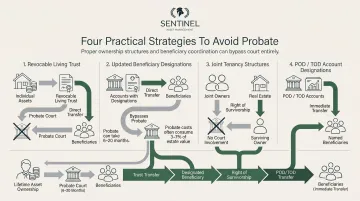
Much of this work happens at the account and ownership level — which is exactly where Sentinel Asset Management operates. The firm handles the financial coordination side of estate planning: reviewing titling, beneficiary designations, wills, and trusts for consistency, and ensuring everything aligns with your broader estate goals. When complex instruments like SLATs or GRATs are appropriate, Sentinel coordinates directly with estate attorneys to keep the full plan cohesive.
Common Estate Planning Mistakes to Avoid
Not Having a Plan at All
Waiting for the "right time" is itself a risk. Incapacitation or death can occur at any age, and the absence of any plan forces family members and courts to fill the gap. 43% of Americans without a will state they "just haven't gotten around to it". Even a basic will and power of attorney provide meaningful protection.
Failing to Update After Major Life Events
A will written before a divorce, second marriage, new child, or significant change in assets may distribute wealth in ways you no longer intend. Beneficiary designations set years ago and never revisited are a particularly common source of unintended outcomes.
Beneficiary forms legally override your will — so failing to update them after a divorce can result in retirement assets passing to an ex-spouse, regardless of your current intentions.
Treating Estate Planning as Separate from Financial Planning
Estate planning does not exist in a vacuum. Decisions about asset titling, investment account structure, life insurance, and retirement income all interact with your estate plan. Failing to coordinate these elements can produce:
- Unnecessary tax liability from uncoordinated account structures
- Probate exposure that delays or reduces what heirs receive
- Distributions that conflict with your current intentions

Sentinel Asset Management addresses this by integrating estate planning directly with investment management, tax strategy, and retirement income planning — so that asset location, withdrawal sequencing, and portfolio decisions support both your lifetime needs and your legacy goals.
When and How to Update Your Estate Plan
Review Frequency
Estate plans should be reviewed every three to five years as a baseline, and immediately following major life events:
- Marriage or divorce
- Birth of a child or grandchild
- Death of a named executor, trustee, or beneficiary
- Significant change in net worth
- Move to a new state (which may have different estate laws)
What to Review
During each update:
- Confirm that named executors, trustees, healthcare proxies, and guardians are still willing and able to serve
- Verify that beneficiary designations across all accounts align with your current wishes
- Check that trust documents, if applicable, are properly funded
- Assess whether recent changes in tax law affect your strategy
That last point carries particular weight right now. The Tax Cuts and Jobs Act (TCJA) temporarily doubled the federal estate tax exemption, which had been set to expire at the end of 2025. The One Big Beautiful Bill Act (OBBBA) changed the outcome: the exemption is now permanently set at $15 million starting in 2026, eliminating the scheduled sunset.
For most families, this shifts the planning focus away from federal estate tax avoidance. State-level estate taxes and capital gains basis planning deserve closer attention instead.
Frequently Asked Questions
What is the difference between a will and estate planning?
A will is one document within a broader estate plan. An estate plan encompasses a will, trusts, powers of attorney, advance directives, beneficiary designations, and tax strategies—while a will alone only addresses who inherits assets after death and goes through probate.
What is the difference between a trust and an estate plan?
A trust is one tool within an estate plan, used to hold and distribute assets while potentially avoiding probate. An estate plan is the full strategy, incorporating wills, trusts, powers of attorney, healthcare directives, and tax planning.
What is the biggest mistake with wills?
The most common mistake is not having one at all, or failing to update it after major life changes. Marriage, divorce, a new child, or the death of a named beneficiary can all leave an outdated will misaligned with your actual wishes.
What is the downside of a family trust?
Trusts carry upfront legal costs (typically $1,000–$2,000 for a revocable living trust) and must be properly funded to work. Irrevocable trusts sacrifice flexibility once assets are transferred, and ongoing trustee fees can run 1%–2% of trust assets annually.
What is the best way to leave your property to your children?
Common approaches include naming children as beneficiaries in a will, transferring property through a revocable living trust (which avoids probate), or using a transfer-on-death deed where state law permits. The right choice depends on the property type, the children's ages, tax implications, and any special needs considerations.
Who is first in line for inheritance?
When someone dies with a valid will, assets go to the named beneficiaries. Without a will, state intestacy laws govern the order—typically a surviving spouse first, then children, then other relatives. Accounts with named beneficiaries (retirement accounts, life insurance) pass directly to those designees, bypassing this order entirely.
Estate planning is more than filing documents. A well-structured plan ensures your wealth reaches the people and causes you care about on your terms—with clarity, minimal friction, and the protections your family actually needs. Whether you're building wealth or preparing to transfer it, starting with a comprehensive plan is how you stay in control of what happens next.
Take the next step in your financial journey by exploring our courses page for upcoming live seminars.