General information, not personalised tax, legal or investment advice.

Introduction
Imagine two people retire in the same year with identical nest eggs of $1 million. Both maintain the same $50,000 annual withdrawal (adjusted for inflation). Over 20 years, both portfolios average the same 6% annual return. Logic suggests they should end up in the same place—yet one retiree runs out of money 10 years before the other.
The culprit isn't how much they saved, or even what they earned on average. The difference comes down to when their losses hit. This is sequence of returns risk—one of the most dangerous and least discussed threats to retirement security.
Sequence of returns risk sits at the intersection of two uncomfortable realities: markets are unpredictable, and retirees must keep making withdrawals regardless of market conditions. A bear market in year two of retirement can inflict permanent damage that a bull market in year 12 simply cannot repair.
Understanding that damage—and how to limit it—is what this guide is built around. It covers a clear definition of sequence of returns risk, how to identify your vulnerability, and specific strategies—including withdrawal structuring, portfolio design, and guaranteed income integration—so your retirement plan holds up when markets don't.
Key takeaways
- Sequence of returns risk is the danger that poor investment returns early in retirement—combined with ongoing withdrawals—can permanently deplete a portfolio faster than later-career losses
- Identical average returns produce vastly different outcomes depending on the order of those returns
- The most vulnerable window is the 5–10 years immediately before and after retirement, often called the retirement risk zone
- Key strategies include a cash reserve, diversified assets, guaranteed income sources, and a bucket-based withdrawal approach
- Start planning 3–5 years before retirement to dramatically improve outcomes
What Is Sequence of Returns Risk?
Sequence of returns risk (SORR) is the danger that the order in which investment returns occur—not just their average—can dramatically determine how long a retirement portfolio lasts, especially when withdrawals are happening simultaneously.
The Critical Difference: Accumulation vs. Distribution
During your working years (the accumulation phase), a down market creates a "paper loss" that can be recovered when the market rebounds. You're adding money consistently, buying more shares when prices are low.
During retirement (the distribution phase), withdrawals made while the portfolio is declining permanently reduce the number of shares available to benefit from any future recovery. When you sell assets at depressed prices to fund living expenses, you lock in those losses—and eliminate those shares from future compounding.
That's what makes the sequence matter so much. The following illustration shows just how large that difference can be.
The Same Average, Different Outcome
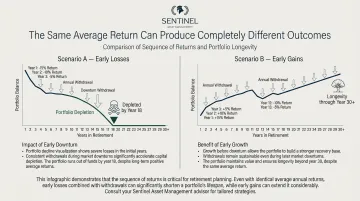
Two portfolios can have identical average annual returns over 20 years but produce wildly different balances depending on the sequence. Here's a simplified illustration:
Scenario A: Early Losses
- Starting balance: $1 million
- Annual withdrawal: $45,000
- Year 1 return: -15%
- Years 2-20: Average 8% annual returns
- Result: Portfolio depleted by year 18
Scenario B: Early Gains
- Starting balance: $1 million
- Annual withdrawal: $45,000
- Years 1-10: Average 8% annual returns
- Year 11 return: -15%
- Years 12-20: Continued growth
- Result: Portfolio sustains withdrawals through year 30+
Both scenarios average roughly the same return—but the order makes Scenario A catastrophic and Scenario B sustainable. Early losses paired with withdrawals cause compounding damage; early gains build a buffer before any downturn hits.
Related but Distinct Retirement Risks
SORR interacts with other retirement threats to amplify damage:
- Longevity risk means more years of exposure to potential bad sequences
- Inflation risk forces withdrawals to increase over time, worsening drawdowns during bad stretches
- Market risk provides the volatility that triggers SORR in the first place
Together, these risks compound each other—a bad sequence early in retirement, layered with inflation and a long lifespan, can exhaust a portfolio that looked perfectly healthy on paper at the start.
Why Sequence of Returns Risk Is Especially Dangerous Near Retirement
The Retirement Risk Zone
The "retirement risk zone" spans roughly the 5–10 years immediately surrounding your retirement date. This window is when portfolio balances are typically at their highest—peak accumulation—meaning any percentage loss translates to the largest absolute dollar loss of your investing lifetime.
A 20% decline on a $1.2 million portfolio costs $240,000. That same 20% decline 15 years earlier on a $400,000 portfolio costs only $80,000. The difference compounds when you add mandatory withdrawals.
The Compounding Damage Mechanism
When markets decline and you must still withdraw for living expenses, you're forced to sell more shares to raise the same dollar amount. Selling 1,000 shares at $50 yields $50,000. Selling the same dollar amount when shares drop to $35 requires selling approximately 1,429 shares—429 more shares gone forever.
This accelerated share depletion leaves fewer assets to participate in the eventual recovery — and the research on what happens next is stark.
The First Decade Determines Your Fate
Research by retirement planning expert Wade Pfau found that approximately 77% of the final retirement result is explained by the average return of the first decade of retirement. The pattern holds across multiple documented market cycles.
Consider this real-world comparison based on Vanguard research:
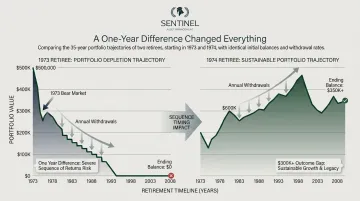
- 1973 Retiree: Started with $500,000, withdrew $25,000 annually (adjusted for inflation), experienced severe bear market in year one. Portfolio depleted after 23 years.
- 1974 Retiree: Same starting balance, same withdrawals, avoided the 1973 crash by one year. Portfolio maintained $300,000 for most of the 35-year period.
A single year's difference in retirement timing produced outcomes separated by more than $300,000 over a 35-year period — which is why the length of your retirement matters as much as the start date.
The Growing Threat: Longer Retirements
According to the CDC's 2024 data, life expectancy at age 65 is now 19.7 years for the total U.S. population—18.4 years for males and 20.8 years for females. Many retirees will live 25-30+ years in retirement.
A longer draw period creates a wider window of exposure to SORR. For a significant share of Americans retiring today, planning for 30 years of withdrawals is not pessimistic — it reflects the actual math.
Strategies to Mitigate Sequence of Returns Risk
Strategy 1: Maintain a Cash Reserve
Keep 1–2 years of essential living expenses in cash or cash equivalents (money market accounts, CDs, short-term Treasuries). This allows you to fund withdrawals during a down market without selling depressed assets.
This reserve is separate from your emergency fund and is purpose-built for market downturns. When equities fall 20%, your cash bucket remains stable, protecting you from locking in losses.
Strategy 2: Portfolio Diversification and Strategic Asset Allocation
A mix of uncorrelated asset classes—equities, fixed income, real assets—can reduce the severity of drawdowns during any single type of market event.
The Limits of Traditional Approaches:
The classic 60/40 stock/bond portfolio doesn't always provide protection. In 2022, Morningstar's global 60/40 portfolio declined 25.1%—the only year in a 150-year period where bonds offered no diversification benefit during a downturn. Vanguard's global 60/40 proxy fell approximately 16% that same year.
A Broader Approach:
Globally diversified, tax-efficient portfolios built using modern portfolio theory are specifically designed to reduce concentrated exposure. Sentinel Asset Management's approach builds on Nobel Prize-winning work by Harry Markowitz, using deliberate diversification to reduce unsystematic risk across asset classes.
Strategy 3: Incorporate Guaranteed Income Sources
Income that isn't tied to market performance eliminates the need to sell assets during downturns for essential expenses. The two primary tools are Social Security and annuities.
Social Security Optimization:
Delaying Social Security past full retirement age yields a guaranteed 8% annual increase up to age 70. This benefit increase is permanent and inflation-adjusted—a guaranteed, inflation-adjusted return that few other strategies can replicate.
When guaranteed income covers most or all essential expenses, your market portfolio can be managed more flexibly. You're no longer forced to sell during downturns to keep the lights on.
Strategy 4: Flexible Withdrawal Strategies
Rigid withdrawal rules (always taking a fixed dollar amount regardless of market conditions) amplify SORR. Flexible strategies provide crucial relief:
- Temporarily reduce withdrawals during down markets
- Forgo inflation adjustments in poor years
- Use dynamic spending rules tied to portfolio performance
Vanguard research found that a 5% reduction in withdrawal amounts during the first five years of retirement can eliminate the possibility of premature portfolio depletion for cohorts facing the worst historical return sequences. Even modest flexibility extends portfolio life meaningfully.
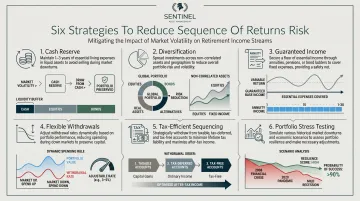
Strategy 5: Tax-Efficient Withdrawal Sequencing
Which accounts you draw from—and in what order—affects how much of each withdrawal is lost to taxes. The common baseline is:
- Taxable accounts first
- Tax-deferred (traditional IRA/401k) second
- Tax-free (Roth) last
The optimal sequence depends on your tax situation. Coordinating withdrawals with RMD timing and Roth conversion opportunities can preserve more of the portfolio. Getting this sequencing right matters: a poorly timed Roth conversion or early IRA draw can create unnecessary tax liability that erodes the portfolio for years.
Strategy 6: Regular Portfolio Stress-Testing
SORR planning isn't a one-time exercise. Periodically stress-testing your portfolio against historical worst-case sequences helps identify vulnerabilities before they materialize:
- 1929: The Great Depression
- 1966: Stagflation era where stocks lost approximately 70% of inflation-adjusted value by 1982
- 2000: Dot-com crash followed by the 2008 financial crisis
At Sentinel Asset Management, every client portfolio is guided by an Investment Policy Statement and stress-tested under different market conditions—so vulnerabilities are identified and addressed before markets force the issue.
The Bucket Strategy: A Structured Defense Against SORR
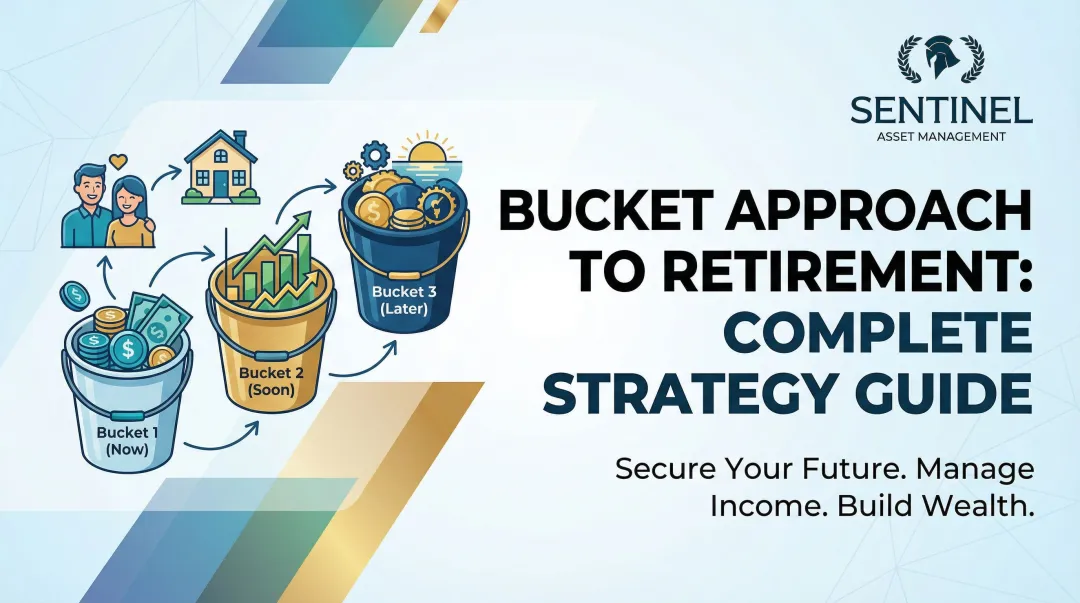
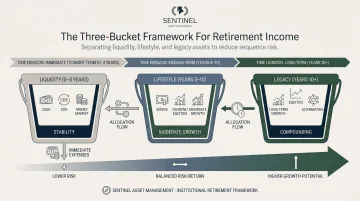
The three-bucket framework is one of the most practical and well-tested approaches to managing sequence risk. Originally developed by wealth manager Harold Evensky in 1985, it segments retirement assets by time horizon to ensure near-term spending never depends on selling volatile assets at the wrong time.
The Three Buckets
Bucket 1: Liquidity (0–3 years)
- Cash, money market funds, short-term CDs
- Protected from market fluctuations
- Funds day-to-day expenses
- Insulates you from selling in a down market
Bucket 2: Lifestyle (Years 3–10)
- Moderate allocation to bonds and dividend-producing equities
- Designed to replenish Bucket 1 over time
- Balances growth with stability
Bucket 3: Legacy (Years 10+)
- Longest time horizon
- Invested for maximum growth (equities, real assets, alternatives)
- Not touched until later in retirement
- Decades to compound without forced withdrawals
Practical Implementation
Sentinel Asset Management uses structured withdrawal buckets to insulate clients from near-term cash flow disruptions caused by market volatility — an approach shaped by experience across 2,000+ client retirements.
That real-world track record aligns with the academic evidence. Research shows bucket strategies produce virtually equivalent financial results to systematic withdrawal plans, while delivering a critical behavioral edge: retirees who can see a dedicated cash reserve are far less likely to make reactive decisions when markets drop.
The specific allocation within each bucket should reflect your individual income needs, risk tolerance, and tax situation.
When Should You Start Planning for Sequence of Returns Risk?
The 3–5 Year Window
Conventional wisdom of "adjusting your portfolio near retirement" understates the urgency. Most financial professionals recommend beginning to reposition assets 3–5 years before your target retirement date. Some suggest starting the conversation 7–10 years out.
Why? The structural changes needed take time to implement effectively:
- Shifting to a bucket strategy
- Identifying guaranteed income sources
- Stress-testing withdrawal rates
- Coordinating tax-efficient account distributions
Fidelity guidance recommends understanding income needs and setting up reliable income sources no later than five years before the cash flow is needed.
Key Pre-Retirement Actions
Three to five years before retirement:
- Evaluate all income sources (Social Security, pensions, annuities)
- Identify gaps between guaranteed income and essential expenses
- Gradually de-risk the near-term bucket
- Lock in a withdrawal strategy and spending plan before market conditions become the deciding factor
Ongoing Monitoring After Retirement
Pre-retirement preparation is only half the equation. Once withdrawals begin, SORR requires active, ongoing management — not a one-time setup.
A retiree who enters retirement during a bull market may become complacent. A sudden bear market in year 3 or 4 can still cause significant damage if no protective structure is in place. Key areas to monitor include:
- Withdrawal rate drift: Spending more than planned during strong markets depletes the buffer needed for downturns
- Bucket rebalancing: Near-term cash buckets need periodic replenishment from longer-term growth assets
- Income gap changes: Shifts in Social Security timing, pension adjustments, or unexpected expenses can reopen gaps
This is where a retirement income specialist adds distinct value. Unlike accumulation-phase advisors focused on growing a portfolio, distribution planning requires managing withdrawal sequencing, tax efficiency, and longevity risk simultaneously — often with little margin for error.
Frequently Asked Questions
What does sequence of returns risk mean?
Sequence of returns risk refers to the danger that poor investment returns early in retirement—combined with withdrawals—can permanently reduce a portfolio's longevity. Selling assets at a loss leaves fewer shares to recover when markets rebound, creating a deficit the portfolio may never overcome.
What is the best way to mitigate sequence of returns risk?
No single strategy eliminates this risk — effective mitigation requires combining several approaches:
- Keep a 1–2 year cash reserve to cover near-term expenses without selling assets
- Diversify across asset classes to reduce portfolio volatility
- Incorporate guaranteed income sources (Social Security, annuities) to reduce withdrawal pressure
- Use a bucket withdrawal strategy to avoid liquidating depressed positions during downturns
What is the biggest mistake most people make regarding retirement?
Treating retirement savings as a lump sum — rather than as an income-generating system — is one of the most damaging errors retirees make. Most fail to account for how withdrawals interact with market downturns in those critical early years, when sequence of returns risk is highest.
What is a red flag for a financial advisor?
An advisor focused solely on accumulation — with no documented plan for the distribution phase — is likely unprepared for retirement income planning. Look for advisors who address withdrawal strategy, SORR mitigation, and portfolio stress-testing before you retire, not after.
What is Dave Ramsey's 8% rule?
Dave Ramsey advocates withdrawing up to 8% of a retirement portfolio annually, based on expectations of consistently high market returns. Historical simulations show this rate carries a 56–61% failure rate over 30 years, making portfolios especially vulnerable to sequence of returns risk. Morningstar research suggests 3.3% is a more realistic safe withdrawal rate for today's environment.
Take the next step in your financial journey by exploring our courses page for upcoming live seminars.