General information, not personalised tax, legal or investment advice.

Introduction
The "shirtsleeves to shirtsleeves" proverb isn't just folklore—it's a statistical reality. Studies on intergenerational wealth transfer consistently find that 70% of wealthy families lose their wealth by the second generation, and 90% by the third. Most families struggle to pass meaningful assets beyond their grandchildren, not because they lack resources, but because they lack a coordinated plan.
Multi-generational wealth planning addresses this directly. It goes beyond drafting a will or opening a trust: the goal is an integrated system that aligns investment strategy, tax planning, legal structures, and family communication.
This article covers the key considerations every family should address before wealth transfer begins, the most effective strategies to implement, and why preparation — not just documentation — separates legacies that endure from those that erode.
Key takeaways
- Multi-generational wealth planning transfers values and financial habits alongside assets
- Start with shared family goals, address each generation's needs, and establish estate documents early
- Tax-efficient tools—Roth conversions, annual gifting up to $19,000 per person (2025), and 529 superfunding—reduce wealth transfer costs
- Protect wealth with trusts, Family Limited Partnerships, and life insurance for liquidity
- Bring the next generation into planning conversations early, not just at the point of decision, to strengthen long-term outcomes
Why Most Family Wealth Doesn't Survive Three Generations
The "three-generation rule" describes a predictable pattern: the first generation builds wealth through hard work and sacrifice, the second maintains it through careful management, and the third dissipates it through lack of preparation. This isn't a character flaw—it's a planning failure.
Three primary culprits drive generational wealth erosion:
- Heirs who inherit without financial context or skills typically lose wealth within a generation
- Families without documented plans, values statements, or decision-making structures face disputes and drift
- Without tax-efficient transfer strategies, significant wealth is lost to estate taxes, probate, and forced asset sales
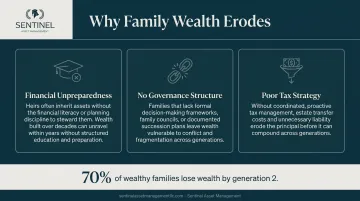
The solution isn't a single document or account. It's an ongoing, coordinated system that integrates investment strategy, tax planning, legal structures, and family communication. Real multi-generational wealth planning addresses why wealth erodes and builds the infrastructure to prevent it.
Key Considerations for Multi-Generational Wealth Planning
Define Your Family's Goals, Values, and Legacy Intent
Before any legal or financial structure is put in place, families need clarity on what they're trying to accomplish. Is the goal to provide financial security? Fund education? Sustain a family business? Support charitable causes? All of the above?
A written family mission statement or legacy letter creates alignment and reduces disputes later. These documents articulate not just what you're transferring, but why it matters and how you want it used. Future generations can refer back to them when making distribution decisions, resolving disagreements, or honoring the original intent of the plan.
Include all relevant family members—especially the next generation—in early conversations. Open dialogue around inheritance intentions prevents resentment and litigation, particularly in blended families or those with members of varying financial circumstances. When heirs understand the reasoning behind your decisions, they're more likely to honor them.
Account for Each Generation's Distinct Financial Needs
A multi-generational plan must balance competing financial realities:
- Aging parents need liquidity and healthcare cost coverage
- Working-age adults face retirement saving pressure and income demands
- Young heirs need education funding and early wealth-building tools
A one-size-fits-all plan fails all of them. Effective planning segments strategies by generation, creating tailored solutions that serve each group's timeline and needs.
Some family members may not be capable of managing wealth independently—minors, individuals with special needs, or those with spendthrift tendencies. Legal instruments like special needs trusts or custodial arrangements must be identified early to protect both the beneficiary and the inheritance.
This is where specialized planning experience matters. Sentinel Asset Management has spent 25 years working with families that include members with special needs, coordinating with attorneys and care planners to design financial structures that preserve eligibility for government benefits while providing supplemental support.
Build a Complete Estate Planning Foundation
Every multi-generational plan must include core legal documents:
- Will — Directs asset distribution and names guardians for minor children
- Revocable living trust — Avoids probate and provides flexible control during your lifetime
- Durable power of attorney — Designates someone to manage financial affairs if you're incapacitated
- Healthcare directive — Specifies medical treatment preferences and appoints a healthcare proxy
- Beneficiary designations — On all accounts and insurance policies (supersedes what's in your will)
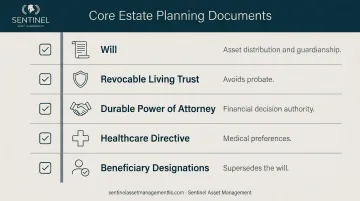
Outdated beneficiary designations are one of the most common and costly oversights in estate planning. Review them annually to ensure they align with your current intentions and family structure.
Estate planning doesn't have to be entirely dependent on attorney fees. Much of the groundwork—asset organization, beneficiary coordination, account titling, and insurance review—can be handled by a coordinated financial advisor.
Sentinel Asset Management manages the vast majority of this work directly, bringing in estate attorneys only when complex instruments like irrevocable trusts require legal drafting.
Proven Strategies for Multi-Generational Wealth Planning
Tax-Efficient Wealth Transfer
Roth conversions serve as a powerful "bracket-filling" strategy in lower-income years. By converting traditional IRA balances to Roth IRAs, you pay taxes now at your current rate, reduce future required minimum distributions (RMDs), and pass a tax-free asset to heirs. For 2025, Roth IRA contributions are limited to $7,000 ($8,000 if age 50+), but conversions have no annual limit—allowing strategic repositioning of retirement assets.
Annual gifting strategies remove assets from your taxable estate during your lifetime while benefiting heirs directly:
- Annual gift tax exclusion: The IRS allows $19,000 per person in 2025 ($38,000 for married couples) without tapping lifetime exemptions
- 529 superfunding: Contributors can front-load up to $95,000 per beneficiary in 2025 ($190,000 for couples) by electing to treat it as five years of annual exclusion gifts, effectively removing substantial assets from the estate
Recent FAFSA simplification means grandparent-owned 529 plans no longer impact financial aid eligibility, making them ideal vehicles for grandparents to fund education without jeopardizing student aid.
Legal Structures That Protect and Transfer Wealth
Two structures dominate multi-generational planning for asset-holding families: Family Limited Partnerships (FLPs) and LLCs. Both allow assets to be held collectively, enable valuation discounts for gift and estate tax purposes, and create liability protection. The key difference: FLPs are typically used for investment assets under a partnership structure, while LLCs offer more operational flexibility governed by state-specific operating agreements. The right choice depends on your family's asset mix and whether centralized management or flexibility matters more.
Irrevocable trusts layer additional protection by removing assets from your taxable estate while maintaining structured benefits for heirs:
- Irrevocable Life Insurance Trusts (ILITs) hold life insurance policies outside your estate, creating tax-free liquidity
- Spousal Lifetime Access Trusts (SLATs) remove assets from your estate while allowing your spouse access
- Dynasty trusts can span multiple generations, protecting wealth from creditors, divorce, and estate taxes
Different trust types serve different objectives—liquidity, control, tax reduction—and coordinating with an advisor to match trust type to your family's goals is the most direct way to avoid costly structural mismatches.
Life Insurance and Education Savings as Legacy Accelerators
Second-to-die (survivorship) permanent life insurance held inside an ILIT creates tax-free liquidity at the death of both spouses. This enables heirs to:
- Pay estate taxes without forced asset sales
- Buy out co-owners of illiquid assets (real estate, business interests)
- Equalize inheritances when some heirs receive business interests and others receive cash
Where life insurance addresses estate liquidity at death, 529 plans address wealth transfer during your lifetime — serving dual purposes as both an education funding tool and an estate reduction strategy. According to the Investment Company Institute, 529 accounts reached 17.0 million by year-end 2024, with average balances of $30,961—indicating most families are underfunded for private college costs.
SECURE 2.0 Act update: Beneficiaries can now roll over up to $35,000 in unused 529 funds to a Roth IRA, provided the 529 has been open for at least 15 years. This eliminates the overfunding penalty risk that once made families hesitant to contribute aggressively — and turns 529s into multi-purpose wealth transfer vehicles.
Custodial accounts (UTMA/UGMA) provide more flexibility than education-restricted accounts, allowing youth to invest and learn with real assets before full inheritance.
Preparing the Next Generation to Be Good Stewards
Heirs who inherit wealth without context or financial skills often dissipate it within a generation. Real preparation means building financial literacy through direct involvement, not just disclosing what heirs will eventually receive:
- Review investment accounts together and explain diversification and compound growth
- Let younger members make small, guided investment decisions to learn from experience
- Discuss the reasoning behind your wealth transfer strategy, not just the mechanics
Family governance structures create continuity across generations. Families that formalize this process tend to maintain both their assets and their values far longer than those who don't:
- Family councils document shared values, make decisions collectively, and pass investment philosophy from one generation to the next
- Scheduled financial meetings keep all members informed and aligned on goals
- Donor-advised funds introduce philanthropy early and build a sense of shared purpose
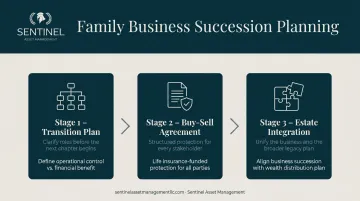
For families with a business, succession planning deserves its own attention within the broader wealth plan. Getting it wrong can unravel years of careful estate planning:
- Formalized transition plan identifying who takes operational control vs. who receives financial benefit
- Buy-sell agreements funded by life insurance to handle unexpected departures
- Integration with the broader estate plan to avoid conflicts between business succession and wealth distribution
Working with a Financial Advisor to Protect Your Legacy
Coordination across advisors—financial, legal, and tax—is essential. Each specialist tends to optimize within their domain, but without an integrating advisor, gaps emerge: a will that contradicts beneficiary designations, or a trust that creates unintended tax consequences.
A seasoned financial advisor serves as the quarterback, ensuring all components work together. Sentinel Asset Management structures legacy planning around exactly this kind of cross-functional coordination:
- Over 100 years of combined advisory experience across the team, spanning retirement, estate, and tax strategy
- 2,000+ clients guided through retirement and legacy planning, with average plan horizons exceeding 20 years
- Every portfolio governed by a client-specific Investment Policy Statement, stress-tested under varying market conditions
- Withdrawal "buckets" structured to balance near-term liquidity for aging parents against long-term growth for younger heirs
Starting this conversation early — before a health event or estate crisis forces the issue — gives families the time to close gaps and build a plan that holds across generations. The sooner coordination begins, the fewer surprises remain.
Frequently Asked Questions
What is the 3 generation rule wealth?
The "three-generation rule" (or shirtsleeves to shirtsleeves) refers to the pattern where the first generation builds wealth, the second preserves it, and the third loses it. Proactive planning, financial education, and governance structures break this cycle before it starts.
What is a multi-generation plan?
A multi-generational wealth plan is a coordinated strategy combining estate planning, tax-efficient transfer mechanisms, investment management, and family governance, designed to preserve and transfer wealth intentionally across two or more generations.
What are the best strategies for managing multi-generational wealth?
Core strategies include Roth conversions to reduce heir tax burden, trusts and legal structures for asset protection, life insurance for liquidity, 529 and education accounts for the next generation, and ongoing family financial education.
How much money is needed to create generational wealth?
Generational wealth is less about a specific dollar amount and more about having a plan. Families at various asset levels can build multi-generational legacies through consistent investing, tax-efficient transfers, and early heir preparation.
How to plan for succession in a family business?
Effective business succession planning requires several coordinated steps:
- Identify successors early and prepare them for ownership responsibilities
- Separate operational ownership from financial benefit where appropriate
- Use buy-sell agreements, often funded by life insurance, to protect all parties
- Integrate the business succession plan with the broader estate plan
What is the difference between an LLC and a FLP?
Both are family ownership structures that allow collective asset holding and potential valuation discounts for gift and estate tax purposes. FLPs are typically used for investment assets under a partnership structure. LLCs offer more operational flexibility and are governed by state-specific operating agreements.
Take the next step in your financial journey by exploring our courses page for upcoming live seminars.