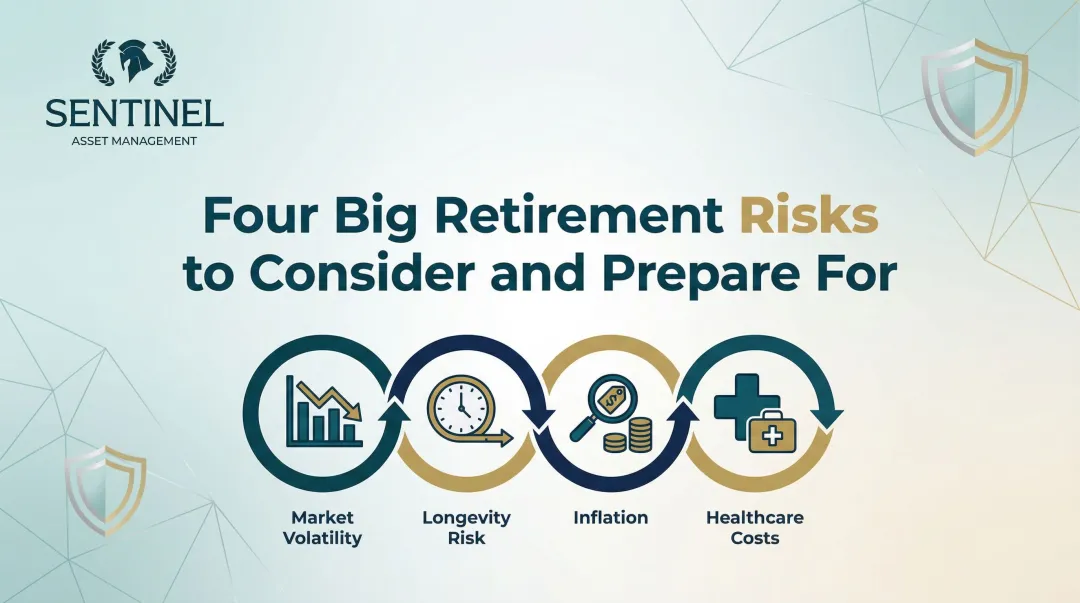
General information, not personalised tax, legal or investment advice.

The transition from accumulation to distribution demands a different skill set entirely. You're navigating Social Security timing decisions worth tens of thousands in lifetime benefits, coordinating withdrawals across taxable and tax-deferred accounts to minimize taxes, rebalancing portfolios to protect against sequence-of-returns risk, and planning for healthcare costs that can devour savings faster than any market crash. This guide covers the essential areas: budgeting on a fixed income, managing multiple income sources strategically, adjusting investment risk for the distribution phase, planning for healthcare expenses, and protecting your estate from unnecessary costs and scams.
Key takeaways
- Retirement income demands active management across budgeting, withdrawals, investments, and healthcare — not a set-it-and-forget-it approach.
- Social Security timing, RMDs, and tax-efficient withdrawal sequencing can meaningfully extend — or shorten — how long your money lasts.
- Shifting from growth to preservation means managing different risks, not eliminating risk entirely.
- Common mistakes — ignoring inflation, claiming Social Security too early — are avoidable with clear, structured planning.
- Most estate planning essentials can be handled through coordination and documentation, without significant legal costs.
Creating a Retirement Budget That Goes the Distance
A retirement budget differs fundamentally from a working-years budget. Your income is now finite and largely fixed, while certain expenses — especially healthcare — tend to rise over time. Building and maintaining a structured budget isn't optional; it's the foundation that determines whether your savings last 15 years or 35 years.
Mapping Your Actual Monthly Spending
Start by auditing your real monthly expenses, not what you think you spend. Distinguish between two categories:
- Fixed expenses: housing, insurance, utilities, property taxes
- Variable expenses: travel, dining, medical co-pays, entertainment
Track actual spending for at least three months rather than estimating, since most people underestimate actual spending by 20–30%.
Free budgeting tools like Mint, YNAB (You Need A Budget), or simple spreadsheet templates can organize spending into clear categories. Review your budget quarterly rather than annually — health shifts, housing decisions, and unexpected family needs can change your picture faster than an annual review catches.
Adjusting for the "Retirement Spending Smile"
Retiree spending doesn't remain static or simply track inflation. Research from RAND using Health and Retirement Study data shows that real spending declines after age 65 by approximately 1.7% annually for singles and 2.4% for couples.
This creates a "smile" trajectory: higher discretionary spending in early, active retirement (ages 65–75), a lower-spending middle phase (75–85), then rising again as healthcare costs climb in later years.
Budgets built around static spending assumptions often fail retirees in their 70s and 80s when healthcare inflation outpaces general inflation. Planning for spending flexibility means building healthcare reserves during the lower-spending mid-retirement years and maintaining growth investments to combat inflation over a potentially 30-year horizon.
Cutting Non-Essential Spending Without Sacrificing Quality of Life
Identify "lifestyle creep" spending that carried over from working years but no longer fits a fixed-income reality. Small recurring costs compound dramatically over 20-30 years:
- Subscriptions you rarely use ($15/month = $5,400 over 30 years)
- Duplicate insurance coverage or services
- Premium cable/streaming packages when basic would suffice
- Unused gym memberships or club dues
- Routine dining out that's become automatic rather than a deliberate choice
Redirecting even modest savings from low-value recurring costs toward experiences that matter adds up fast — and keeps your spending aligned with what retirement is actually for.
Making the Most of Your Retirement Income Sources
Most retirees draw from multiple income streams: Social Security, pensions, 401(k)/IRA withdrawals, and potentially part-time work or rental income. Coordinating these streams strategically is what separates a sustainable retirement from one that runs dry prematurely.
Social Security: When to Claim and Why It Matters
The financial impact of your Social Security claiming decision is massive and permanent. Claiming at age 62 results in a 30% reduction compared to Full Retirement Age (67 for those born in 1960 or later), while delaying to age 70 yields a 124% benefit, a 76% increase over early claiming.
Concrete example using SSA data:
| Claiming Age | Benefit % | Monthly Benefit (if FRA = $1,000) |
|---|---|---|
| Age 62 | 70% | $700 |
| Age 67 (FRA) | 100% | $1,000 |
| Age 70 | 124% | $1,240 |
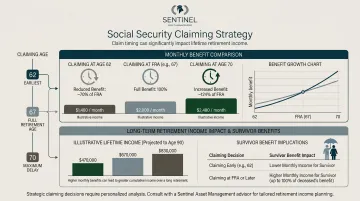
For married couples, the higher earner's claiming decision carries outsized weight on the surviving spouse's long-term income. Survivor benefits provide 100% of the deceased worker's benefit amount, including any delayed retirement credits earned by waiting past FRA.
That difference compounds fast. If the higher earner delays to age 70, the surviving spouse inherits the enhanced $1,240/month benefit for life rather than $700/month — that's $6,480 more per year, every year.
Coordinating 401(k), IRA, and Pension Withdrawals
Once Social Security timing is set, the next lever is managing withdrawals from tax-advantaged accounts. Required Minimum Distributions (RMDs) kick in at age 73 for those born between 1951–1959, and age 75 for those born in 1960 or later under SECURE 2.0. RMDs are calculated by dividing your prior year's December 31 account balance by a life expectancy factor from the IRS Uniform Lifetime Table. Missing an RMD triggers a 25% excise tax on the amount you should have withdrawn.
The order in which you withdraw from taxable accounts, traditional IRAs/401(k)s, and Roth accounts shapes your lifetime tax liability more than most retirees realize. Research shows that a dynamic tax-bracket management strategy can reduce total lifetime taxes by over 40%. That same approach can extend portfolio longevity by nearly a full year compared to the traditional "taxable-first" rule.
Tax-efficient sequencing strategies include:
- Using low-income pre-RMD years (ages 60-72) for Roth conversions
- Filling current tax brackets strategically each year
- Coordinating withdrawals with other income sources
- Using Qualified Charitable Distributions (QCDs) to satisfy RMDs tax-free after age 70½
Sentinel Asset Management's structured withdrawal framework analyzes taxable, tax-deferred, and tax-free accounts as one cohesive plan, drawing income from the most tax-efficient source each year to protect more of what you've built.
Building a Withdrawal Structure That Insulates Against Market Volatility
A "bucket strategy" segments retirement savings into three layers: short-term liquidity (cash/money market funds for 1-2 years of expenses), medium-term stability (bonds/fixed income for years 3-7), and long-term growth (equities for 8+ years). This structure keeps you from selling stocks during downturns just to cover living expenses, which is the core protection against sequence-of-returns risk.
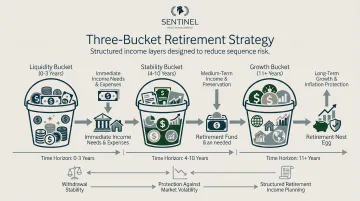
Sentinel Asset Management's structured withdrawal buckets pursue insulation against near-term cash flow fluctuations from market volatility, pairing stable income sources with growth-oriented allocations for longer horizons. Each plan is stress-tested against historical bear markets, recessions, and inflationary periods to ensure sustainability through market cycles.
Managing Investment Risk When You Can No Longer Wait Out a Downturn
At retirement, investment philosophy shifts fundamentally: from building wealth to protecting and distributing it. Sequence-of-returns risk is the danger that major market losses early in retirement permanently impair your portfolio's long-term sustainability. It's a threat pre-retirees can largely ignore — but retirees cannot. You no longer have 10 years to wait for a recovery.
Understanding the Five Retirement Risks
The PRIME framework provides a comprehensive lens for understanding what can erode retirement wealth. These five systematic risks cannot be eliminated through diversification:
- Purchasing Power Risk (Inflation): The risk that inflation outpaces investment returns, eroding the real value of fixed incomes and cash holdings
- Reinvestment Risk: The danger that maturing bonds or cash flows must be reinvested at lower rates, reducing future income
- Interest Rate Risk: Bond price sensitivity to rate changes, measured by duration (a bond fund with 5-year duration loses roughly 5% value when rates rise 1%)
- Market Risk: Broad market declines that reduce portfolio values, especially dangerous early in retirement
- Exchange Rate Risk: Foreign currency fluctuations in globally diversified portfolios
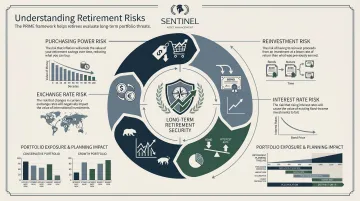
Understanding all five risks — not just market volatility — is essential for building retirement portfolios that withstand real-world conditions.
Rebalancing Your Portfolio for the Distribution Phase
A portfolio appropriate for a 45-year-old accumulating wealth is too aggressive for a 68-year-old drawing it down. The shift toward income-generating, lower-volatility assets must be balanced against enough growth exposure to outpace inflation over a 20–30 year retirement horizon.
A structured approach — one anchored by a formal Investment Policy Statement and stress-tested under different market conditions — removes the guesswork from allocation decisions. Sentinel Asset Management builds portfolios rooted in modern portfolio theory (specifically Harry Markowitz's Nobel Prize-winning work on reducing unsystematic risk through deliberate diversification) while managing the unavoidable systematic PRIME risks. Every client portfolio is monitored continuously for style drift, ensuring allocations stay appropriate as circumstances evolve.
Avoiding Emotional Investment Decisions
Behavioral finance pitfalls such as panic selling, over-concentrating in familiar stocks, or chasing yield are amplified in retirement because there's no paycheck to rebuild losses. The average equity investor earned just 16.54% in 2024 compared to the S&P 500's 25.02% return, an 848 basis point gap driven by emotional market timing and panic selling.
Two practices help retirees stay disciplined when markets drop:
- Written withdrawal policies and rebalancing rules — defined in advance, so decisions aren't made under pressure
- Spending guardrails — predetermined portfolio value thresholds that trigger systematic spending adjustments rather than reactive cuts
Planning for Healthcare Costs Before They Plan for You
Healthcare represents one of the largest and most underestimated expenses in retirement. Fidelity estimates that a 65-year-old retiring in 2025 needs approximately $172,500 in after-tax savings just to cover lifetime healthcare costs — and that excludes long-term care. Medicare beneficiaries spent an average of $6,330 out of pocket annually on healthcare costs in 2022, including premiums and non-covered services.
Understanding Medicare: Parts, Gaps, and Supplements
Medicare consists of four parts, each covering different services:
- Part A: Hospital insurance (most people pay no premium)
- Part B: Medical insurance covering doctor visits, outpatient care (standard premium $185/month in 2025)
- Part C (Medicare Advantage): Alternative to Original Medicare, offered by private insurers
- Part D: Prescription drug coverage
Medicare leaves significant gaps: deductibles, co-pays, and services not covered at all. Medigap (Medicare Supplement) plans cover many of the out-of-pocket costs Original Medicare doesn't pay.
Missing initial enrollment periods triggers permanent late enrollment penalties: Part B adds 10% to your premium for each 12-month period you were eligible but didn't enroll. Part D adds 1% per month — roughly 12% annually — for each month you went without creditable drug coverage. Both penalties last for as long as you have Medicare.
Planning for Long-Term Care and HSA Strategy
Medicare does not cover custodial long-term care — assistance with daily living activities like bathing, dressing, and eating. According to the 2025 CareScout Cost of Care Survey, national median costs are $74,400 annually for assisted living and $114,975 for a semi-private nursing home room.
Long-term care options include:

- Long-term care insurance (purchased before age 65 for reasonable premiums)
- Hybrid life/LTC products combining death benefits with care coverage
- Self-funding through dedicated portfolio allocations or home equity
Whichever path you choose for long-term care, pairing it with a strong pre-retirement savings strategy strengthens your position considerably. Health Savings Accounts (HSAs) are one of the most tax-efficient tools available before Medicare begins. The triple tax advantage includes:
- Tax-deductible contributions that reduce your current-year income
- Tax-free growth on invested balances
- Tax-free withdrawals for qualified medical expenses
IRS rules prohibit HSA contributions starting with the first month you enroll in Medicare, and violating this triggers tax penalties. Front-loading HSA contributions in the years before 65 lets you build a dedicated reserve that reduces your dependence on taxable accounts once healthcare costs rise.
Protecting What You've Built: Estate Planning and Avoiding Scams
Two distinct threats endanger retirement wealth: failure to formalize how assets transfer after death, and the growing surge of financial fraud targeting older Americans.
Estate Planning Essentials That Don't Require a Lawyer
The majority of estate planning work involves organization and coordination, not complex legal instruments. Four foundational documents every retiree should have:
- Will: Directs asset distribution and names guardians for dependents
- Durable Power of Attorney: Designates someone to manage financial decisions if you're incapacitated
- Healthcare Directive/Living Will: Specifies medical care preferences and designates healthcare decision-makers
- Updated Beneficiary Designations: On retirement accounts, life insurance, and transfer-on-death accounts
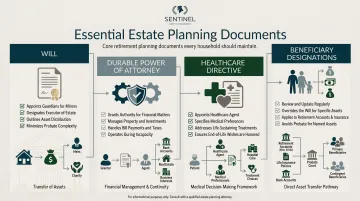
Most estate planning can be accomplished without extensive legal fees. The key is ensuring consistency across all documents and accounts — wills mean nothing if beneficiary designations contradict them.
Tax treatment matters here too. Under IRS Topic No. 703, inherited assets generally receive a step-up in basis to fair market value at the date of death, eliminating capital gains taxes on appreciation built during the decedent's lifetime. Keeping beneficiary designations current preserves this advantage and ensures assets transfer efficiently.
Yet 93% of adults 50+ acknowledge estate planning's importance, while only 66% of those 65+ actually have a legal will. That gap exposes families to unnecessary probate costs, disputes, and avoidable tax losses.
Staying Alert to Financial Scams Targeting Retirees
Fraudsters actively target retirees because they typically hold accumulated savings and may be less familiar with fast-moving digital scams. U.S. adults over 60 lost a record $3.4 billion to internet crimes in 2023, with investment scams accounting for $1.24 billion of those losses.
Most common scam types:
- Investment fraud (often involving cryptocurrency or "guaranteed returns")
- Government impersonation (fake IRS, Social Security, Medicare agents)
- Romance scams targeting widows and widowers
- Grandparent scams claiming family emergencies
- Tech support scams
Red flags to recognize:
- Unsolicited investment offers promising returns above 8-10% annually
- Pressure to act immediately or "opportunity expires today"
- Requests for wire transfers, gift cards, or cryptocurrency payments
- Anyone asking for Medicare ID or Social Security numbers over the phone
- Inability to verify credentials through official channels
Implement trusted contact alerts on all financial accounts and verify any unusual requests through independent channels, not phone numbers provided by the caller.
Frequently Asked Questions
What are the biggest financial mistakes that retirees make?
The most costly mistakes tend to cluster around a few core missteps:
- Claiming Social Security at 62 instead of waiting for higher lifetime benefits
- Underestimating healthcare inflation and long-term care costs
- Withdrawing from retirement accounts in a tax-inefficient order
- Holding portfolios too aggressive (sequence risk) or too conservative (inflation erosion over 20-30 years)
What are common retirement rules and guidelines, such as the 30-30-30-10 rule and the $1,000-a-month rule?
The 4% withdrawal rule suggests withdrawing 4% of your portfolio annually (adjusted for inflation). The $1,000-a-month rule estimates you need roughly $240,000 saved per $1,000/month of retirement income desired. The 30-30-30-10 rule allocates 30% to housing, 30% to living expenses, 30% to savings/investments, and 10% to discretionary spending. These are useful starting points, not rigid prescriptions — your actual numbers will depend on your spending habits, tax situation, and timeline.
When is the best time to start claiming Social Security benefits?
Delaying from 62 to 70 can increase monthly benefits by up to 76% — one of the highest-return financial decisions available. The right timing depends on your health, life expectancy, and other income sources. For married couples, the higher earner should strongly consider delaying to maximize survivor benefits.
What is the 4% withdrawal rule, and is it still reliable today?
The 4% rule comes from William Bengen's 1994 research showing that withdrawing 4% annually (adjusted for inflation) survived worst-case 30-year market sequences. Given longer life expectancies and lower expected bond returns, some planners now suggest 3–3.5%. Dynamic spending strategies can push initial rates above 5% — making personalized planning more reliable than any single number.
How can retirees protect their savings from inflation over a long retirement?
Several strategies work together to preserve purchasing power:
- Keep 30–50% in equities for long-term growth (adjusted for risk tolerance)
- Use Treasury Inflation-Protected Securities (TIPS) for bond allocations
- Delay Social Security to lock in cost-of-living adjustments on a higher base
- Review spending plans against actual inflation, not a fixed 2–3% assumption
What documents do retirees need for basic estate planning?
Four documents cover the essentials: a will, a durable power of attorney, a healthcare directive/living will, and updated beneficiary designations on all retirement accounts and insurance policies. Most can be established without extensive legal involvement and should be revisited after any major life event.
Take the next step in your financial journey by exploring our courses page for upcoming live seminars.