General information, not personalised tax, legal or investment advice.

Introduction
Millions of Americans hold pre-tax retirement savings in traditional IRAs or 401(k)s, knowing that future withdrawals will be taxed as ordinary income—but at what rate, nobody knows. A Roth IRA conversion lets you pay taxes now in exchange for tax-free growth and withdrawals later, but whether it's the right move depends on your personal tax situation, timeline, and retirement goals.
Many retirees underestimate their tax burden in retirement. According to research from the Center for Retirement Research at Boston College, effective tax rates for top-earning retirees reach as high as 22.7% — well above what most people expect.
Traditional IRA balances, pension income, rental income, and Social Security benefits often combine to push taxable income higher than anticipated.
This guide covers how a conversion works, its tax impact, who it benefits most, when to do it, and the pitfalls to avoid. The goal: help you make a decision grounded in your numbers, not guesswork.
Key takeaways
- A Roth IRA conversion moves pre-tax retirement funds into a Roth IRA, triggering ordinary income tax now in exchange for tax-free growth and withdrawals later
- The real question: does converting at today's tax rate beat paying taxes at your expected future rate?
- Conversions work best during low-income years, down markets, or the gap between retirement and RMDs starting at age 73
- Paying conversion taxes with outside funds (not IRA assets) preserves the full benefit of the strategy
- There is no income limit to convert, but conversions are irreversible—careful planning with an advisor is essential
What Is a Roth IRA Conversion?
A Roth IRA conversion moves funds from a pre-tax retirement account into a Roth IRA, where the money grows tax-free and qualified withdrawals in retirement are tax-free. Eligible source accounts include traditional IRAs, 401(k)s, 403(b)s, SEP IRAs, and SIMPLE IRAs. Unlike regular Roth contributions, there is no income limit on who can convert — making it a viable option for high earners who are locked out of direct Roth IRA contributions.
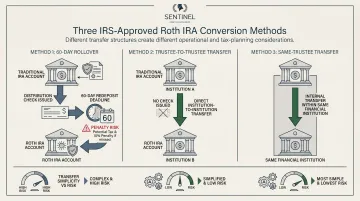
The IRS recognizes three methods of converting:
- 60-day rollover: You receive a distribution check made out to you and must deposit it into the Roth IRA within 60 days to avoid taxes and penalties
- Trustee-to-trustee transfer: Funds move directly between two separate financial institutions, with no check issued to you
- Same-trustee transfer: Both accounts sit at the same institution, so the conversion is handled as an internal reclassification
Since the Tax Cuts and Jobs Act (2018), conversions are permanent and cannot be recharacterized (reversed). This means you cannot undo a conversion if the market drops or your tax situation changes.
Conversion vs. Contribution
A Roth conversion differs fundamentally from a regular Roth IRA contribution. For 2025, Roth IRA contributions are limited to $7,000 ($8,000 if age 50 or older) and phase out for single filers earning $150,000–$165,000 and married couples filing jointly earning $236,000–$246,000. Conversions have no such limits on amount or income, making them a separate and more flexible tool for retirement tax planning.
The Tax Impact of a Roth Conversion
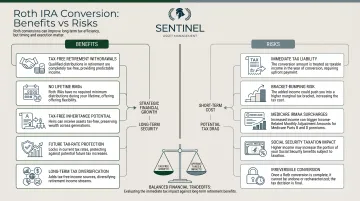
Understanding the tax mechanics upfront prevents costly surprises. The entire converted amount is added to your ordinary taxable income in the calendar year the conversion occurs. There is no 10% early withdrawal penalty on the conversion itself, but you owe income taxes at your marginal rate on the converted sum.
2025 Federal Income Tax Brackets
| Tax Rate | Single Filers | Married Filing Jointly |
|---|---|---|
| 10% | $0 to $11,925 | $0 to $23,850 |
| 12% | $11,926 to $48,475 | $23,851 to $96,950 |
| 22% | $48,476 to $103,350 | $96,951 to $206,700 |
| 24% | $103,351 to $197,300 | $206,701 to $394,600 |
| 32% | $197,301 to $250,525 | $394,601 to $501,050 |
| 35% | $250,526 to $626,350 | $501,051 to $751,600 |
| 37% | $626,351+ | $751,601+ |
Source: IRS Rev. Proc. 2024-40
The Bracket-Bumping Risk
Because the converted amount stacks on top of other income, a large single-year conversion can push you into a significantly higher bracket. A strategic approach is partial conversions—converting only enough to "fill up" your current tax bracket without spilling into the next. Spreading conversions over multiple years can reduce total lifetime tax exposure compared to converting everything at once.
Pay Taxes with Outside Funds
Key rule: Always pay taxes on the converted amount using outside, non-retirement funds. If you withdraw IRA assets to cover the tax bill, the IRS treats those withdrawn funds as an additional taxable distribution. If you're under age 59½, the 10% early withdrawal penalty also applies — turning a tax bill into a tax bill plus a penalty.
The Pro-Rata Rule
The pro-rata rule affects backdoor Roth conversions. When you have multiple existing traditional IRAs with pre-tax funds and attempt a backdoor Roth conversion, the IRS calculates tax owed based on the ratio of pre-tax to after-tax money across all traditional, SEP, and SIMPLE IRAs combined—not just the account being converted.
Example: If you have $93,000 in a pre-tax traditional IRA and make a $7,500 nondeductible contribution (giving you $100,500 total), 92.5% of your conversion will be considered taxable income, even if you're only converting the $7,500 contribution.
Secondary Tax Consequences
Beyond your income tax bill, a large conversion can trigger three additional financial consequences:
- Medicare IRMAA surcharges — High conversion amounts push income above thresholds that trigger higher Medicare Part B and D premiums. For 2025, IRMAA surcharges begin at $106,000 for single filers and $212,000 for married couples filing jointly, with a two-year lookback.
- Social Security taxation — Up to 85% of Social Security benefits become taxable if provisional income exceeds $34,000 (single) or $44,000 (married filing jointly).
- Loss of deductions — Higher income can reduce eligibility for other income-driven deductions or benefits.
Is a Roth IRA Conversion Right for You?
Whether a Roth conversion makes sense is a tax arbitrage question—you are betting that paying taxes at your current rate is cheaper than paying taxes at your future rate. The answer depends on several interconnected factors: current income, expected retirement income, time horizon, estate planning goals, and whether outside funds are available to cover the tax bill.
When a Roth Conversion May Make Sense
A conversion tends to work in your favor when one or more of these apply:
- Higher future tax bracket: Retirees with substantial traditional IRA balances, pension income, rental income, or Social Security benefits often find taxable income in retirement is higher than expected. The Center for Retirement Research found that many retirees—particularly those in the top income quintiles—underestimate their retirement tax burden.
- RMD elimination: Traditional IRAs require mandatory withdrawals beginning at age 73 (per SECURE 2.0), taxed as ordinary income whether you need the money or not. Roth IRAs carry no RMD obligation during your lifetime, letting assets continue compounding tax-free.
- Tax-free inheritance: Non-spouse beneficiaries inheriting a Roth IRA must empty the account within 10 years under the SECURE Act—but those withdrawals are income-tax-free, provided the account has been open at least five years. Heirs inheriting a traditional IRA owe ordinary income tax on every distribution, often at their peak earning-year rates.
When a Roth Conversion May Not Make Sense
Conversely, a conversion can cost you more than it saves in these situations:
- Your tax rate drops in retirement: If you expect minimal Social Security, no pension, and modest withdrawals, converting now at a higher marginal rate means overpaying. The comparison that matters is your marginal rate today versus your projected marginal rate later—not just averages.
- You need the funds within five years: Each conversion starts its own five-year clock. Withdrawing converted funds before that period ends and before age 59½ triggers a 10% penalty.
- You'd use IRA funds to cover the tax bill: Pulling from the IRA itself to pay conversion taxes erodes principal and forfeits years of compounding—effectively making the conversion work against you.
Smart Timing Strategies for Your Roth Conversion
Target Low-Income Gap Years
The period between early retirement and when Social Security benefits begin—or between retirement and the start of RMDs at age 73—is often the most tax-efficient window for Roth conversions. In these years, income may be temporarily low, allowing larger conversions at lower marginal rates. A year with a job transition, sabbatical, significant business loss, or large deductible expense can create the same favorable window.
Convert During Market Downturns
When a traditional IRA's value has fallen due to market conditions, converting at a lower valuation means owing income tax on a smaller amount—while future recovery and growth in the Roth IRA will be tax-free. The risk: no one can time the exact market bottom, and the account's value may keep declining after conversion.
Use Multi-Year Partial Conversions
Rather than triggering a large one-time tax bill, convert a specific dollar amount each year—enough to "fill up" a tax bracket without crossing into the next. Coordinating with wages, Social Security, and investment distributions helps you target the right amount annually and can dramatically reduce total lifetime taxes paid.
Where you live—and where you plan to retire—adds another layer to this calculation.
Account for State Income Tax and Residency
Some states exempt retirement income from state income tax; others tax it fully. If you plan to move from a high-tax state to one with no income tax, delaying conversions until after the move can reduce your total tax bill. Conversely, those moving to a higher-tax state may want to convert before relocating.
States with no income tax or full retirement income exemptions:
- No income tax: Alaska, Florida, Nevada, New Hampshire, South Dakota, Tennessee, Texas, Washington, Wyoming
- Full retirement income exemption: Illinois, Iowa, Mississippi, Pennsylvania
How Sentinel Asset Management Can Help
Roth conversion decisions are rarely straightforward in isolation—they intersect with Social Security timing, RMD planning, Medicare costs, estate goals, and portfolio allocation. Sentinel Asset Management's approach to retirement income planning is built around minimizing lifetime tax liability through coordinated planning across tax, income, and investment decisions, drawing on 100+ years of combined advisory experience and more than 2,000 clients guided through retirement.
Sentinel advisors build personalized retirement plans guided by an Investment Policy Statement, stress-tested across different market and tax scenarios. For clients evaluating a Roth conversion, this means modeling the projected tax cost of conversion today against the projected tax drag of RMDs and ordinary withdrawals over a 20-to-30-year retirement horizon. The goal is finding the strategy that preserves the most after-tax wealth over your full retirement.
Across 5 U.S. offices, Sentinel's advisors coordinate your full financial picture — ensuring every withdrawal, sale, and investment decision works toward the same goal:
- Reducing your lifetime tax burden across all income sources
- Timing conversions to avoid Medicare surcharges and RMD spikes
- Aligning Roth strategy with estate and legacy goals
- Stress-testing your plan against market and tax-rate scenarios
To schedule a consultation, call +1 203-793-0707 or visit a Sentinel office in Fairfield, Rockville, Middletown, or West Haven.
Frequently Asked Questions
How much tax do you pay when converting a traditional IRA to a Roth IRA?
The full amount converted is treated as ordinary income in the year of conversion and taxed at your applicable federal (and potentially state) marginal income tax rate—not a flat rate. The tax owed depends on the conversion amount, total income for the year, and filing status.
What are the IRS rules for converting a traditional IRA to a Roth IRA?
Anyone can convert regardless of income. The converted amount is taxable as ordinary income in the year of conversion. Conversions since 2018 are permanent and cannot be recharacterized. The conversion must be reported using Form 8606. RMDs for the year must be taken before any conversion can occur for account holders subject to RMDs.
Is it a good idea to convert a traditional IRA to a Roth IRA?
It can be a smart move if you expect higher taxes in retirement, want to eliminate RMDs, or have estate planning goals. The right answer depends on your current versus future tax bracket, time horizon, and whether you can pay the conversion tax bill from outside funds.
What is the "backdoor Roth" strategy for converting traditional IRA funds to a Roth IRA?
The backdoor Roth is a two-step strategy for high earners above Roth contribution income limits: contribute after-tax money to a non-deductible traditional IRA, then convert it to a Roth. If you hold other pre-tax IRA funds, the pro-rata rule may make a portion of the conversion taxable—consult a tax advisor before proceeding.
Can I do Roth conversions after age 72 when I start taking RMDs?
Yes, Roth conversions are allowed at any age. You must take your required minimum distribution for the year first—RMDs cannot be converted, only funds beyond that amount are eligible. Because conversions add to taxable income, bracket management is especially important at 73 and older under current SECURE 2.0 rules.
What is the 5-year rule for converting a traditional IRA to a Roth IRA, especially after age 70?
Each conversion starts its own five-year clock from January 1 of the conversion year. Withdrawing converted principal before that window closes and before age 59½ triggers a 10% early withdrawal penalty; once you're past 59½, that penalty no longer applies to converted principal. The separate five-year rule for tax-free earnings still applies if the Roth IRA itself is less than five years old.
Take the next step in your financial journey by exploring our courses page for upcoming live seminars.